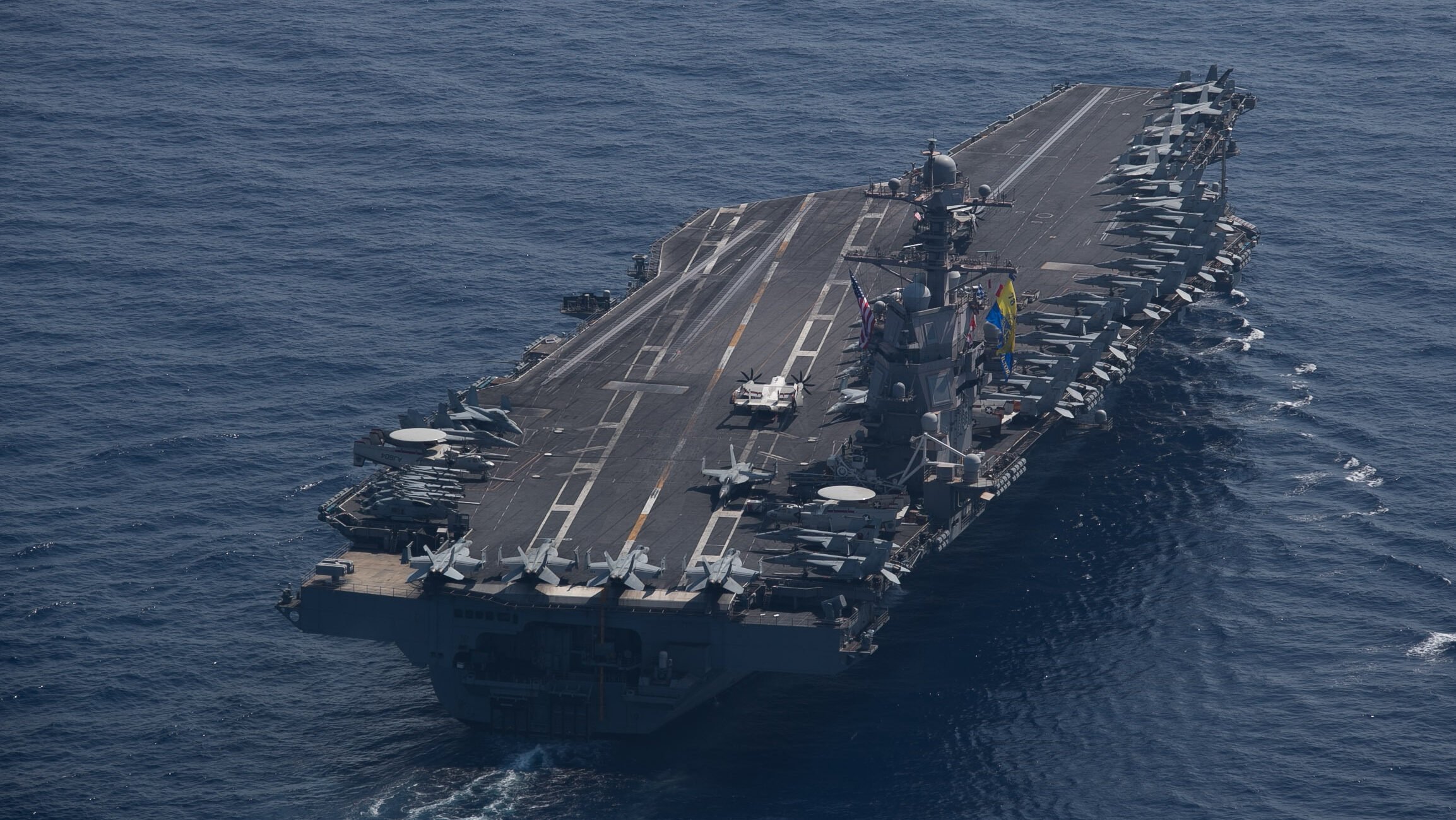








It’s hard enough for a human pilot to take off from the cramped and pitching deck of a US Navy aircraft carrier. Today, for the first time in history, a Remotely Piloted Aircraft did it. You can bet that military leaders in Beijing and Tehran sat up and took note as the batwinged X-47B drone… Keep reading →
iran
NATIONAL HARBOR: The Navy will send a prototype laser weapon to the troubled Persian Gulf for a roughly year-long test deployment starting “less than a year from now,” the Chief of Naval Operations, Adm. Jonathan Greenert, announced today at the Navy League’s annual Sea-Air-Space conference.
The bad news is this isn’t some superweapon out of science fiction. The Navy’s Laser Weapon System (LaWS) is a fairly modest death ray that, for now, can only kill small boats and drones. Unlike the lasers of Ronald Reagan’s Star Wars dreams, nuclear missiles aren’t on the menu. Keep reading →
Mattis: Keep 13.6K Troops In Afghanistan, Keep Talking With Iran & Keep Out Of Syria
By Sydney J. Freedberg Jr.
[updated Tuesday, March 6 with Gen. Mattis's remarks to the House Armed Services Committee] CAPITOL HILL: The US should keep 13,600 troops in Afghanistan to advise and assist the Afghan forces after American combat brigades withdraw in 2014, about a quarter of the current troop level, said Central Command chief Gen. James Mattis, giving his personal recommendation — not the Administration’s final decision — after prodding from the Senate Armed Services Committee Tuesday. Rumored figures have been significantly lower. “We have to send a message of commitment,” declared Mattis, who will soon retire. But with the Navy halving its aircraft carrier presence in the Gulf and all the services cutting corners in expectation of a continued budget crunch, it’s getting harder to project resolve.
“A perceived lack of an enduring US commitment” is the biggest danger to American interests in the Central Command region, which sprawls from Egypt to Pakistan, Mattis told the House Armed Services Committee on Wednesday. While the drawdown in Afghanistan unnerves some allies, he said, “our budget ambiguity right now is probably the single greatest factor. I’m asked about it everywhere I go in the region.”
“Already, sequestration is having an operational impact in the CENTCOM area” with the indefinite postponement of the aircraft carrier USS Truman’s deployment to keep an eye on Iran, lamented SASC’s chairman, Carl Levin. Facing a funding shortfall from both the automatic cuts known as sequestration and the Continuing Resolution now funding the federal government I the absence of proper 2013 appropriations, Navy will keep Truman stateside, albeit ready for rapid deployment in a crisis. Keep Reading →
Nuclear Weapons Critics Suffer Cold War Brain Freeze; Deterrence Works, Argues Top Air Force Official
By James Blackwell

Before his latest State of the Union speech, President Obama was widely reported to be ready to propose a significant reduction in nuclear weapons. Then North Korea conducted a nuclear test the day before the address. (The photo above shows Kim Jong-Un smiling after his country’s recent successful ballistic missile test.) In his speech, President Obama only committed the US government to work with Russia to “seek further reductions,” though the New York Times said before the speech that the administration aimed to cut as many as 700 of our 1,700 deployed nuclear weapons. One of America’s most highly regarded nuclear strategists argues below that nuclear deterrence works. James A. Blackwell, an Air Force official, posits that those who argue they are Cold War weapons of such tremendous power as to be unusable are demonstrably wrong. The Editor.
There is an unsettling paradox in much of the recent debate over nuclear weapons in this country. Some pundits, fixated on purging “Cold War thinking” from those of us with real-world responsibilities for nuclear deterrence, are themselves suffering from thoughts frozen in time. In the midst of this important debate, let me offer some examples of the new strategic concepts emerging from a new generation of deterrence thinkers.
The conventional wisdom is that a world with fewer nuclear weapons is inherently a better world. What we are discovering is that less is not less, less is different.
US policy has led in reducing nuclear weapons. At its peak in 1967, the US stockpile stood at a staggering 31,255 warheads. Just since 1991, we have disassembled more than 13,000 weapons, and in the past decade taken our stockpile – the total number of weapons — down from 10,526 in 2001 to 5,113 in 2010. Our nuclear weapons and delivery platforms now number an order of magnitude less than during the Cold War, and this policy continues — creating new conditions in the global nuclear balance.
In this new nuclear environment, potential adversaries are reaching conclusions we did not expect, and our allies and partners are more nervous about it than we want them to be. This new world of several contending nuclear powers behaves differently than the bi-polar world that preceded it.
Deterrence is no longer (if it ever really was) a rational actor systems model; it works as a mental model. It’s more like the “hot hand” rule in basketball – players do not keep mental statistics on who has the highest percentage shot for a particular game situation; instead they carry a moving mental image of who at that moment is on a streak and feed the ball to that player instinctively. The same kind of thing happens in crisis and conflict. Behavioral scientists call this “fast, frugal heuristics,” and are beginning to explore the empirical dimensions of this 21st century deterrence dynamic.
There are some surprising findings and insights.
First, just because no one has detonated a nuclear weapon in war since 1945, does not mean they are sitting idly by, with little purpose. Nuclear weapons are in fact “used” every day — not to win a war, but to deter any adversary from thinking they could get away with starting one. As budget pressures rise, many call for not spending more on weapons we cannot use in the kinds of conflicts most likely to occur – presumably counter-terrorism or conventional warfare. But a nuclear war is the conflict we need to make sure remains the least likely to happen.
Second, there is much new research on 21st century deterrence of rogue actors and terrorists. We now know that, during the 1991 Persian Gulf War, Saddam Hussein was persuaded that if he were to order use of chemical weapons against US troops, the US would have responded with tactical nuclear weapons.
Hussein had extensive discussions with his generals – lectures really – and injected that assumption into all their war planning. Such thinking likely resides within the decision-making processes of other states that face a similar calculus. There is merit in reinforcing such fears among others who would harm their neighbors. It turns out that terrorists, even suicide bombers, harbor visceral fears of nuclear weapons, fears that can be exploited to deter them from acting should they ever get one.
Islamic terrorists adhere to the Koran’s proscriptions against poisoning the earth with radiological effects and creating mass casualties among the innocent. Cyber and psychological campaigns can broadcast messages across terrorists’ own social networks to convey this narrative challenge to terrorists’ intent. Terrorist cells also fear failure, so technical sabotage, misinformation and deception can magnify doubt about the prospects for a successful detonation.
Third, US nuclear weapons serve as a powerful instrument of nonproliferation. Post-Cold War experience reveals that others, from Saddam’s Iraq, to North Korea, Libya, Iran and others, pursue nuclear weapons as the centerpiece of an asymmetric counter to the United States’ conventional military superiority. As every other nuclear power except the U.S. modernizes their nuclear weapons, and as the number of nuclear armed states continues to grow, our allies and partners who rely on our extended deterrent are increasingly motivated to consider obtaining their own nuclear arsenal. We must actively pursue a flexible strategy that allays such concerns among allies.
Some assert that a reliable nuclear deterrent does not require the ability to retaliate immediately, only the assurance that U.S. nuclear forces would survive any attack.
Aside from the fact that none of America’s nuclear triad is on “hair-trigger” alert, the reality of fewer nuclear weapons is that we cannot rely solely on a super-survivable second strike nuclear force that deters only by threatening retaliation. Such a posture could readily be perceived as threatening our intent to strike first. We must have a resilient nuclear arsenal that deters a nuclear strike in the first place.
No president would want to ask the American people to ride out a first strike and then trust him to order a retaliatory strike on behalf of the remaining fraction of our population. What the president needs is a nuclear force that would lead no nuclear armed state, faction or terrorist to conclude that it has less to lose by striking us first, even with just one or a few nuclear weapons. We must not give anyone cause to contemplate such a move.
This is a very different form of deterrence than the Cold War. No longer can we rely on the mathematics and purely rational models of nuclear exchange developed in the 20th century. We must understand human perception and decision-making. For 21st century deterrence, the value of first-strike stability is now at least equally important as maintaining an assured retaliation capability. Those of us in the new generation of strategic thinkers have liberated our minds from Cold War thinking to make sure that today, nuclear weapons are never used.
James Blackwell is special advisor to the Air Force’s assistant Chief of Staff for strategic deterrence and nuclear integration.
The Army’s Navy: Fast Boats, Long-Range Rockets Play In Classified Wargame
By Sydney J. Freedberg Jr.
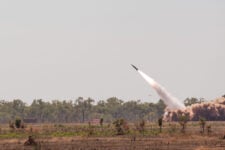
ARMY WAR COLLEGE: For the last decade, the Army has emphasized “boots on the ground.” Large numbers of foot troops slogged through valley and village, field and town, to safeguard civilians and hunt insurgents. Now, as the largest service looks beyond Afghanistan, a classified wargame about a hypothetical Korean conflict shined a spotlight on high-speed, long-range assets such as air defense missiles, guided artillery, and the Army’s own fleet of boats.
“When you think about landing craft, like Saving Private Ryan, most of those reside in the Army, actually,” Maj. Gen. Bill Hix, director of concept development at the Army Capabilities Integration Center, said in a conversation with reporters here. Keep reading →

WASHINGTON: Long-awaited talks between the world’s six most powerful nations and Iran are set for February 26 in the mountain city of Almaty in Kazakhstan.
The question is, are the two sides ready to bridge the considerable rift dividing them and actually negotiate? This has not happened in a decade of diplomacy that started in 2003 amid fears Iran was secretly building nuclear weapons. Keep reading →

CAPITOL HILL: In one of the least salubrious displays of partisan rancor in a long time on the Senate Armed Services Committee, the defense policy panel sent Chuck Hagel’s nomination to the Senate floor on a straight party-line vote, 14-11.
In a hearing that, at times, had faint echoes of the infamous anti-Communist witch hunt hearings dominated by Sen. Joseph McCarthy, Democrats praised Hagel for his service in Vietnam while Republicans berated him as left of center, a possible friend of Iran, a possible enemy of Israel, and someone who just wouldn’t tell them what they wanted to hear. Keep reading →
Sen. Levin praises #Hagel with vote soon for his support for Israel, stand on Iran. Sez #NorthKorean test etc bad time for no SecDef now @colinclarkaol

WASHINGTON: What does America need an army for, anyway? The question has bedeviled policymakers since the Founding Fathers, who wrote their distrust of large ground forces into the Constitution. The question returns as budgets come back down after every land war.
Colin Clark
Sydney J. Freedberg, Jr.
Chuck Hagel’s First Test: North Korea and the Second Nuclear Age
By Robbin LairdWhat is the U.S. and allied nuclear and conventional responses to the threat of war on the Korean peninsula? In a world of dynamic learning, the North Koreans watched the NATO-Obama led operation in Libya. They concluded that nucs are very useful to keep the United States and its allies at bay. Keep reading →