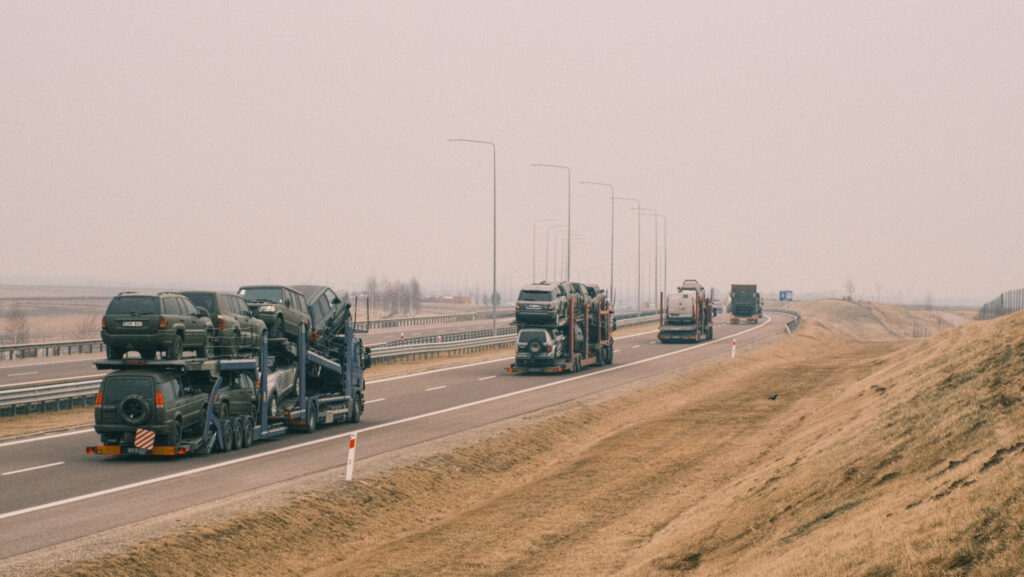
When Russia invaded Ukraine in February 2022, its initial ground forces advanced rapidly, leveraging major highways to move armored columns from Belarus and Russia. Yet, that speed was short-lived. The advance faltered not just from fierce Ukrainian resistance and logistical failures, but also from the friction of urban combat and built-up environments that slowed their mobility.
For the Baltic nations, this lesson holds critical weight. The key to successful deterrence, and to a successful defense should deterrence fail, is to disrupt an invading force’s timeline. And a key vulnerability lies in the very infrastructure that supports day-to-day life: the road networks.
By strategically redesigning critical road junctures and water crossings, the Baltic nations can create an enhanced, non-lethal layer of deterrence-by-denial that buys precious time for allied forces to respond.
NATO has already committed to deploying a new Allied Reaction Force and additional combat-ready forces on its Eastern Flank. This directly enhances the deterrence-by-denial strategy, but these forces are just one piece of a comprehensive plan. We must consider how the built environment can support them.
Instead of fixed, high-speed roads that favor an invader’s rapid movement, NATO and its Baltic allies can counter with creative, construction-based solutions. Using existing, non-lethal technology, they could re-engineer key sections of roads to create serpentine patterns, install roundabouts with central reinforced obstacles, or build moveable bridges.
The E28 highway, a vital artery linking Belarus to Kaliningrad through Lithuania, is a prime example of this strategic vulnerability. While the current road system may not be able to handle the traffic volume of a full-scale invasion, ongoing regional infrastructure improvements — beneficial for commerce and travel — could also inadvertently smooth the way for an invading force.
Now, imagine the four-way intersection west of Gudžiai, Lithuania, on the A3/E28 highway. Currently, the road runs straight through it, offering unimpeded traffic flow. By building a large roundabout with a central reinforced concrete wall, advancing convoys would be forced to slow down to navigate it. The central obstacle would further consume valuable time if the invaders tried to remove it. These changes, easily integrated into existing European design standards, would deny an adversary easy movement and give defenders a tactical advantage.


Challenges with technology overload will determine the future of autonomy
To stop overwhelming warfighters and enhance the effectiveness of drones and robots, give warfighters tech tools they want to use.
Another crucial pressure point is the Suwalki Gap, the 65-kilometer land corridor connecting Poland and Lithuania. This area is a critical land bridge for the rest of NATO and historically has been a key target for any adversary seeking to isolate the Baltic States. Redesigning the road network in this area to include latent, non-lethal obstacles could delay an invading force, buying vital hours or even days for reinforcements to arrive.
Of course, any invasion will not just come on major highways, so these non-lethal approaches must be extended beyond major highways into urban areas and over water obstacles.
Take the area north of the Lithuanian town of Daržininkai, for example, which is already naturally constrained by a built-up area to the south and a river to the north. Here, a series of successive concrete planter boxes could be installed with reinforced foundations. These innocuous “planter boxes” would actually serve as a series of latent log cribs, acting as disguised point obstacles. If a conflict were to occur, personnel could quickly place logs across the road, creating an immediate choke point to halt an advance.
Similarly, traffic bollards could enhance the effects of these natural choke points. The roadway could typically remain clear, with bollards either pre-drilled for manual installation or automated and retracted below the road surface. As an invading force approaches, operators could simply raise the bollards to halt traffic, creating a barrier without any permanent damage or civilian disruption.
When it comes to water obstacles, NATO can achieve the same tactical effect as destroying a bridge, but without the permanent loss of the structure. The Nemunas River bridge in Prienai, Lithuania, currently a fixed crossing, could be reconstructed as a swing, bascule, or vertical lift bridge. Any of these options could be easily activated to impede traffic flow when needed, offering a flexible and reversible counter-mobility solution.
This approach offers a tangible, non-lethal way to bolster the Baltic states’ security. It requires no new weapons systems, only the strategic application of civil engineering.
Therefore, NATO and its Baltic allies should immediately undertake a joint strategic review of the region’s road networks to identify and prioritize key traffic points. They should then implement these non-lethal infrastructure redesigns, turning vulnerabilities into defensive assets and making it demonstrably clear to any potential adversary that the cost of invasion has just gone up.
As an added benefit to NATO nations, this kind of investment would seem to fall under the guidelines for the new alliance spending target, which includes a goal of 1.5 percent GDP on “defense related” projects such as infrastructure.
Now, some defense planners might argue for establishing extensive defensive lines with bunkers and static obstacles. While these are valid approaches that could support a deterrence-by-denial strategy, they require immense effort and rapid mobilization across vast distances. Our proposed strategy of redesigning traffic to slow invading forces on major highways and within urban areas offers a more efficient solution, requiring far fewer personnel and leveraging existing infrastructure.
These non-lethal options avoid the restrictions and permanence of mines and kinetic weapons, allowing the Baltic nations to deploy obstacles rapidly. When not in use, these measures integrate seamlessly with existing infrastructure and rely on readily available, current technology. By adopting these and similar strategies, the Baltic nations can strengthen their deterrence-by-denial strategy and significantly complicate any adversary’s timeline.
NATO, in partnership with the Baltic nations, must immediately commit to integrating these innovative, non-lethal infrastructure solutions into their regional defense plans, turning civilian infrastructure into a powerful, dual-use deterrent.
Lt. Col. Michael Carvelli is an assistant operations officer at Division East, First Army, Forces Command, Department of the Army. The views expressed are his own and do not reflect the official policy of the Department of Defense.