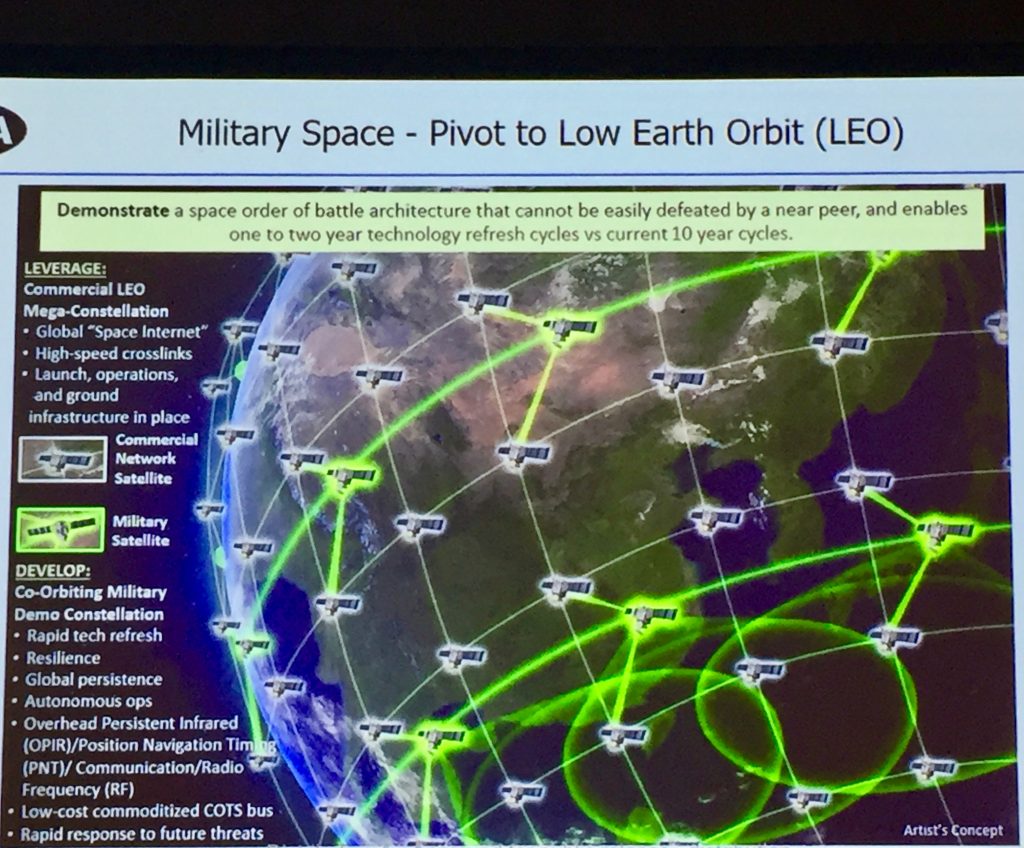
WASHINGTON: DARPA’s Blackjack program is slated to get $75 million in 2021 to demonstrate the viability of small satellite constellations in Low Earth Orbit (LEO) for a variety of military missions, up $25 million from the $50 million allocated by Congress last year.
This reflects DARPA’s 2021 plans to procure a missile tracking payload sensor and conduct on-orbit testing of the first two satellites in the constellation, according to the agency’s budget justification documents released over the long President’s Day weekend.
But DoD budget documents fail to clear up the long-standing question of where in DoD the popular Blackjack program will wind up for development into a program of record. DARPA’s role is to prove the feasibility of new technologies, which then can be transitioned into development programs by the military services or other DoD agencies.
According to DARPA’s budget request, the agency is eyeing both the Air Force and the Army as potential transition partners for Blackjack.
No mention of Blackjack could be found in the Army’s online budget documents, and Army Public Affairs didn’t respond to a request for clarification by press time.
The Air Force’s 2021 request includes Blackjack under Space Force research, development, test and evaluation (RTD&E) within a programmatic basket called Space Systems Prototype Transitions (SSPT, PE 1206427SF). The Space Force’s budget justification documents show $59 million in Military Interdepartmental Purchase (MIPR) funds for Blackjack development between the first and third quarters of 2021 and support for the launch of two satellites beginning in the fourth quarter stretching through the end of 2022.


Meeting Zero Trust goals while maintaining information dominance
Balancing security and access to data are critical to providing users with trustworthy, reliable data for real-time decisions.
“Blackjack is a joint technology demonstration project by DARPA and the Space Force to evaluate military utility and concepts of operation for a Proliferated Low Earth Orbit (P-LEO) satellite constellation,” the Space Force budget documents say.
Breaking D readers may remember that Blackjack also was being eyed by the Space Development Agency (SDA) when the agency was launched in 2019. In recent years. However, DoD Undersecretary for Research and Engineering Mike Griffin has expressed skepticism about the feasibility of relying heavily on commercial technology for SDA’s planned next-generation space architecture, made of up of six different types of satellite constellations plus a ground control segment.
SDA’s 2021 budget documents mention Blackjack as a possible source of “Proliferated Low Earth Orbit (pLEO) Sensor Technology” (Project 032 under PE 1206310SDA) for its Transport Layer of small satellites to provide near real-time data transfer between satellites on orbit and terrestrially-based users. But while the documents show $20 million allocated by Congress for that effort in 2020, there is no funding requested in 2021 nor for any of the out-years through 2025.
Despite the lack of a budget line, SDA spokeswoman Jennifer Elzea clarified in an email that “SDA remains a transition partner for Blackjack.” She added, “DARPA’s work through the Blackjack program is burning down some of the technical risks for technologies SDA plans to incorporate into our Warfighter Immersion Tranche (Tranche Zero in FY22) and especially in Tranche One, planned for FY24, depending on when Blackjack burns those risks down.”
Tranche Zero will comprise “dozens” of satellites launched in 2022 to create a skeleton architecture in Low Earth Orbit (LEO) to provide communications between satellites and ships, aircraft and ground-based weapon systems; track advanced missile threats including low-flying hypersonic cruise missiles; and to support targeting of adversary mobile ground systems. Tranche One will see a second set of dozens of satellites, and eventually, the architecture will include hundreds of satellites in six different constellations.
According to DARPA’s budget request, Blackjack will focus specifically on using technology developed by commercial firms planning to orbit mega-constellations in LEO to provide global broadband Internet service, such as SpaceX, OneWeb, Telesat and Amazon. The overarching goal of the program is to prove whether military payloads — such as communications; intelligence, surveillance and reconnaissance; position, timing and navigation; etc. — can be integrated into a generic satellite bus that can be mass produced.
“The project leverages industry innovation in commercial P-LEO concepts by integrating military payloads onboard commercial commoditized satellite vehicles, demonstrating onboard data processing and autonomous tasking, and transmitting encrypted data through a mesh network of satellites in LEO with the goals of augmenting existing warfighter capability, increasing national security space resiliency, and decreasing per-unit satellite costs,” the Space Force budget documents say.
As colleague Sandra Erwin first reported, DARPA is in talks with Airbus, Blue Canyon Technologies and Telesat as potential providers of satellite busses with a downselect planned for later this year. Payload providers include Collins Aerospace, Raytheon, Northrop Grumman Mission Systems, Trident, SA Photonics, Airbus, Systems & Technology Research, Sky Quantum and L3Harris.
Specific technologies to be assessed under the demo program, DARPA explains, are “low size, weight, power, and cost (SWaP-C) multi-modality smallsat sensor payloads, algorithms for autonomous payload and architecture command and control, algorithms for satellite on-board processing and data fusion, and advanced manufacturing for military payload mass production.”
PHOTOS: AFA 2025

 Gallery