WASHINGTON: Air Force Research Laboratory (AFRL) today opened the doors on its new lab for testing innovative materials and designs for spacecraft — technologies to underpin assembly and manufacture of satellites and subsystems on-orbit.
Currently, the new Deployable Structures Laboratory (DeSel) at Kirtland AFB is focused on nearer-term high-strength materials and satellites structures that can expand the types of missions that small satellites can perform. But those same technologies are being eyed by the Air Force to eventually expand operations to the Moon and beyond.
““With the push toward hybrid architecture and smaller satellites, high packing efficiency structures and the ability to bring large satellite capability to small satellites,” Benjamin Urioste, AFRL’s lead for the Integrated Structural Systems team that will be performing the research, said in AFRL’s press release today.
“High packing efficiency refers to structures that can be folded or otherwise compressed in size for launch, then deployed to full size once on orbit. They are super-efficient in their utilization of size/weight at launch to achieve a specified level of on-orbit performance,” Col. Eric Felt, head of ARFL’s Space Vehicles Directorate, explained in an email today.
These materials can be used to build components such as antennas for communications or solar power arrays that unfurl once a satellite is on orbit, meaning that they can be carried by smaller satellites, he explained. “Examples of key enabling technologies include significant processing/computer power advancements (Moore’s Law), increases in solar cell efficiency, Roll Out Solar Arrays (ROSA), and mesh antennas of extremely low launch size and weight that unfurl into 1-5 meter parabolic dishes on orbit.”
Indeed, one of the first projects the new DeSel lab will work on is testing spacecraft structures for another futuristic capability that could be enabled by on-orbit assembly and manufacturing — space-based solar power under AFRL’s Space Solar Power Incremental Demonstration and Research (SSPIDR) project. SSPIDR will collect solar energy in space, convert it to radio frequency, and beam it to forward operating bases. But for that to work, large solar arrays are required that will have to be assembled on orbit.
“We see advances in both the viability/cost of performing on-orbit manufacturing and servicing and the mission utility/need for these capabilities. For example, 3-D printing and robotic advances make it now quite technically feasible to assemble a large structure on orbit, and emerging missions such as power beaming (SSPIDR) make some large structures very useful,” Felt told me. “Logistics is important in every operating domain, including space. Ubiquitous launch logistics is enabling the Proliferated Low Earth Orbit (PLEO) constellations and advances in on-orbit logistics will similarly unleash new missions in all orbits, including MEO, GEO, and cislunar.”
The SSPIDR project is “closing out a $25M contract with Northrop Grumman Space Systems (Gilbert, AZ) due to the delivery of the Helios bus later this month. This is an exciting milestone for us, as the Helios bus is the vehicle that will carry the first experiment of the SSPIDR program,” SSPIDR Chief Engineer Rachel Delaney told me in an email this afternoon.
Equipping smallsats to do a big sat’s job also means being able to miniaturize satellite components, explained Pete Cannito, CEO of Redwire, who is involved with some of AFRL’s efforts to push into on-orbit assembly and manufacture. “By miniaturizing some of those components — cameras, navigation components, things like that — we’ll be able to do more with smaller [satellites],” he said.
Redwire is a new(ish) company created in June, when private-equity firm AE Industrial Partner bought and merged two small space companies — Deep Space Systems and Adcole Space — and then acquired Made In Space, which specializes in 3D printing on orbit. Just last Friday, Redwire bought smallsat component maker Roccor.
Roccor is providing a deployable broad-band antenna array to Viasat for AFRL’s XVI project to test out putting a Link 16 tactical data link on Low Earth Orbit (LEO) satellites to expand connectivity across domains. AFRL awarded Viasat a $10 million contract to put a Link 16 transponder on one of its small satellites in May 2019 as a pilot; in August 2019 Viasat tapped startup Blue Canyon Technologies to build the tiny cubesat and Roccor to build the antenna array. A prototype of the satellite is expected in March 2021.
Cannito told me in an interview today that Redwire is positioning itself as a unique firm in the current ‘new space’ market — a mid-tier provider of innovative space infrastructure capabilities from small satellites capable of on-orbit manufacturing to innovative, high-tech subsystems.
“As we started looking at the landscape, what we discovered was that the space market was shaped like a barbell,” Cannito said. “You had the really large aerospace primes on one side. And then you had either niche or very small companies on the other side, or venture-backed, emerging disruptors but also, you know, much smaller players. But you didn’t have a lot in between, So we decided that there was an opportunity in that middle market for a consolidator to come in.”
“What SpaceX has done for launch, we’re going to do for space infrastructure,” he added — that is, change the market so that in-space architecture — from satellites doing traditional missions to the on-orbit factories of the future — becomes more economical and efficient.
“In-space manufacturing and assembly … is one of the game changers that we think will absolutely change and transform the way that we do business operations, and really, truly build this next generation of space infrastructure,” Redwire COO Andrew Rush chimed in.
As Breaking D readers know, the Air Force is eyeing 3D printing in space as one step on the way to possible future military operations in cislunar space as DoD keeps a wary eye on Chinese activities around the Moon. Further, the Defense Innovation Unit (DIU) last July asked industry for options to build an on-orbit logistics hub that could manufacture parts, assemble other spacecraft or re-fuel satellites.
DARPA in 2018 granted a $1.5 million contract to Made In Space for development of the “External Augmentation of Generic Launch Elements (EAGLE) System, an innovative capability that that will rapidly deconstruct used launch hardware that normally would be scrapped, and reassemble the components into a phased array antenna. Under the award, the company is to complete critical design review (CDR) for the system in February, according to a DARPA fact sheet provided to Breaking D.
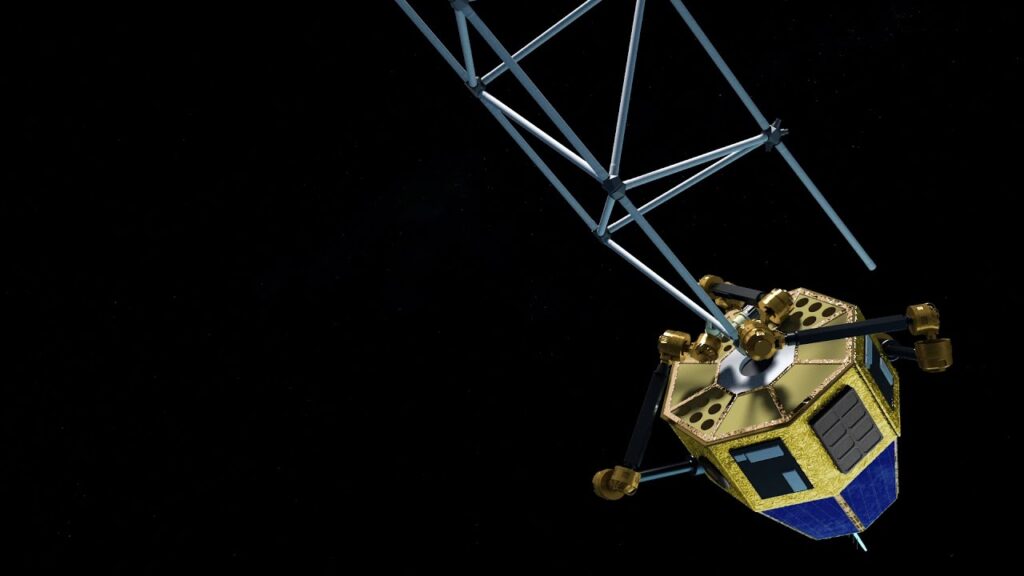
Made In Space also is building a refrigerator-sized satellite that will assemble and deploy two large solar-power arrays for NASA’s On-Orbit Servicing, Assembly and Manufacturing-2 (OSAM-2, formerly known as Archinaut) demonstration designed to enable exploration of the Moon and Mars — technology that Cannito says also has interest from the national security community.
PHOTOS: AFA 2025

 Gallery