SATELLITE 2022: European satellite firm SES has been growing its government portfolio for the past five years, and sees no end in sight for the upward trend in demand — a market analysis that lies behind its decision to acquire the satellite communications arm of Leonardo DRS, says SES CEO Steve Collar.
That $450 million acquisition, announced March 22, will double revenue for the company’s US subsidiary SES Government Solutions (SES-GS) — going from about $250 million to $500 million per year, he told Breaking Defense today. That is on top of the 30 percent growth in SES’s government business overall since 2017.
“It’s clear from our direction of travel — with the technology that we’re acquiring, the system that we’re launching, O3b mPower, the investments that we’ve made in infrastructure — that government was an increasingly important part of our business,” he said.
“And so as we thought about how to scale both organically and inorganically, we were kind of looking at the industry and figuring out who’s best in class. And we feel like the DRS GS team, their relationships, what they built, is super complementary with what we have at SES GS,” he added.
The acquisition, which is expected to be finalized by the second half of the year, comes as SES readies to launch in late May or early June the first of its new O3b mPower satellite constellation for space-based internet services into Medium Earth Orbit (MEO), he said.
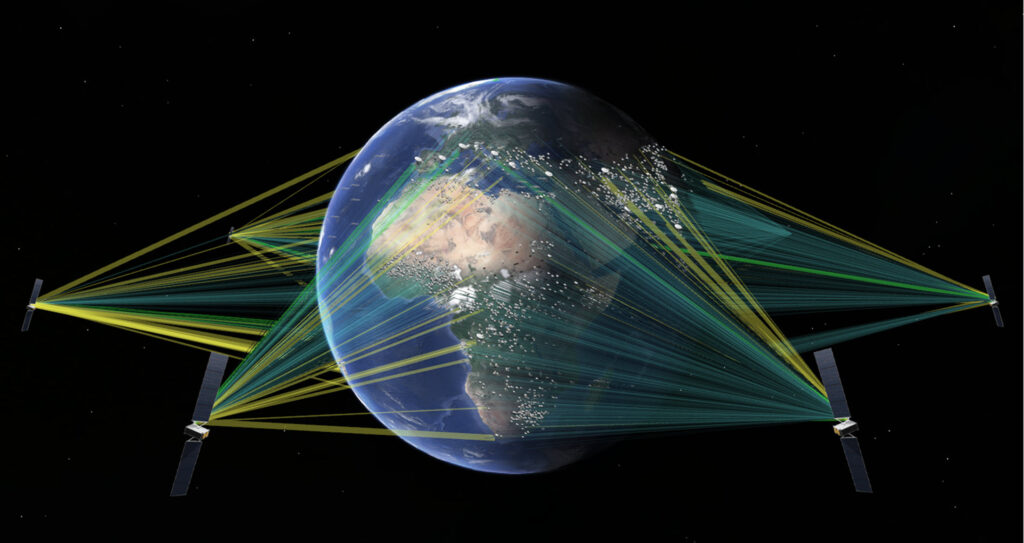
The firm plans on having six of the new, higher throughput satellites up by the end of the year allowing initial operations, he explained, and all 11 of them on orbit by the end of 2023. Built by Boeing, the new satellites will have improved capability over the current 20 O3b satellites in MEO, perhaps most importantly by boosting the number of reconfigurable “beams” (i.e. signals) each bird can send from 10 to 5,000.
“With mPower, we can stand up beams instantaneously, then take them down, we can go for anywhere from 10 megabits per second to 10 gigabits per second,” Collar said. “The capability that we’re going to have with mPower really takes us sort of two levels up.”
Peter Hoene, the head of SES-GS, told a panel at SATELLITE 2022 today that the O3b mPower satellites will provide “incredible anti-jam capabilities and cyber defense capabilities.”
Part of the attraction of the O3b and O3b mPower network is the fact that the satellites, with perigees around 8,000 kilometers above sea level, are in the “under-appreciated” MEO belt, between 2,000 and 35,786 km, Collar explained.
“The problems we can solve from MEO are high flexibility and high throughput, and the fantastically good news is if you map government services, government solutions, most of them fall there,” he said. This includes growing military demand for faster turn around times for space-based intelligence, surveillance and reconnaissance data, as well as communications.
“So ISR is a great example there,” he noted. “Most broadband systems are designed to deliver a lot of throughput into a location and take not very much out. ISR is 180 degrees the other way, right? So you’re trying to take a lot of information off a small moving platform, what you need is a very flexible spacecraft where you can change the amount of bandwidth you assign to forward and return. That’s exactly what we have with mPower.”