Land Warfare

Racing to ‘adapt,’ Army estimates climate plan will cost over $6.8B over 5 years

Step-by-step plan shows that nearly 76 percent of the that $6.8 billion goes toward increasing the climate resiliency of Army installations with microgrids and vehicle electrification.

army climate
A U.S. Army Green Beret with 1st Special Forces Group (Airborne) sets up solar panels for operational communications at the National Training Center, Fort Irwin, California. (U.S. Army photo by Pfc. Lisa-Marie Miller)

UPDATED Nov. 28 at 5:01 pm ET to correct a cost figure.

AUSA 2022 — The US Army estimates that implementation of its climate strategy will cost more than $6.8 billion over the next five years, according to its implementation plan released today, an investment the service believes will increase the resilience of its installations and equipment in the face of climate change.

The implementation plan, which details steps to achieve the goals laid out in the service’s previously released Climate Strategy, lists several objectives and tasks to make the Army more energy efficient between fiscal 2023 and 2027. It follows the Army climate strategy’s three lines of effort: installations, acquisition and logistics, and training. The assistant secretary of the army for installations, energy and environment is responsible for overseeing the implementation.

“As extreme weather becomes commonplace, the Army must adapt its installations, acquisition programs, and training so that the Army can operate in this changing environment and reduce our greenhouse gas emissions,” Secretary of the Army Christine Wormuth said in an Army release. “This climate implementation plan will improve our resiliency and readiness in the face of these changes.”

The 50-page document says the plan “will begin to create a climate- and sustainability-informed workforce and integrate climate change adaptation and mitigation appropriately into operations and programs.” The total dollar figures, found in an annex to the published plan, include direct programmed cost as well as “other costs” for programmed actions “affecting” each objective.

About $5.2 billion of the estimated $6.8 billion will go to the installation line of effort, where the service wants to reduce its greenhouse gas emissions and field fully electric non-tactical vehicles. Under the implementation plan, the Army plans to complete and operationalize 55 microgrids on Army installations.  The service wants 20 of them by FY24, with an additional 15 operational by FY26 and 20 more entering service in FY27. The total estimated cost for the microgrid objective is $1.6 billion, according to the plan.

The plan also states that the service will reduce greenhouse gas emissions from Army property by 10 percent over a 2008 baseline by the end of FY23. By FY27, it was wants to reduce emissions by 40 percent of the baseline.

That goal feeds into the Army’s electrification push. By FY27, the service aims to fully electrify its light duty, non-tactical vehicle fleet — vehicles mostly driven at or between installations. It plans to enable that by establishing orders in FY23 to direct the purchase, lease and use of the “most efficient and effective fleet with the lowest carbon footprint possible,” the plan states. The service also aims to electrify 40 percent of its non-tactical fleet by FY27, including its medium- and heavy-duty non-tactical fleet. In FY23, it plans to introduce an Army-wide policy “favoring zero-emission, plugin hybrid, and hybrid platforms for medium and heavy-duty [non-tactical vehicle] leases and purchases.”

The Army estimates that initiatives under its acquisition and logistics portfolio will cost around $1.6 billion, including an effort to make tactical vehicles more efficient. Under that plan, the service wants to field its tactical vehicle electrification kit, which turns off the engine during extended periods of idling, to small portions of its tactical vehicle fleet. By FY27, the Army wants the kit in 12 percent of its Joint Light Tactical Vehicle fleet, 7 percent of its medium tactical vehicle fleet, and 5 percent of its heavy fleet.

The Army also wants to develop hybrid-drive components for tactical vehicles, create high energy density vehicle energy storage capabilities, and test hybrid-drive in select tactical wheeled vehicles by FY27. By FY26, it wants to prototype the Battlefield Rapid Recharge Capability, a standalone vehicle charger. The service also plans to develop policies aimed at making its logistics more energy efficient by fiscal 2023.

The third line of effort, training, will cost $1 million the budget estimates — a relatively low figure because associated climate-related training activities “existed prior to the ACS (Army Climate Strategy) and are broader than the ACS,” the plan states. This effort wants to “train and educate the Army to operate in a climate-altered world.” To do so, the plan states that the service will publish climate change-related lessons learned and best practices in fiscal 2024 and 2026. By the end of FY27, the service wants to update civilian and leader training to incorporate “climate literacy.”

“For the foreseeable future, climate impacts will disrupt Army activities and increase the frequency of crisis deployments,” the implementation plan states. “Future competitive advantage requires enhanced operational capabilities reflecting changing environmental conditions. The Army must strengthen those capabilities through a combination of installation management, training, acquisition and logistics initiatives.”

AUSA 2022

AUSA 2022

Over at Rheinmetall's booth sat the hefty Lynx OMFV (Optionally Manned Fighting Vehicle). The company, as its competitors, is hoping to make a strong impression as the Army looks for OMFV proposals later this fall -- the early stage of an almost certainly lucrative long-term contract award. (Breaking Defense/Brendon Smith).
All the way from down under, the Australian firm Defendtex presented some of its modular UAVs. Here visitors can see the Drone155, which the company says can be outfitted with ISR payloads or explosives. (Breaking Defense/Brendon Smith).
The MVPP from Globe Tech stands for Modular Vehicle Protection Platform, a vehicle add-on that can take the brunt of improvised explosive device detonations. (Breaking Defense/Brendon Smith).
AUSA was well attended by international officers and officials as well, and by foreign defense firms. The Korean booth, shown here, featured some products hoping to make a splash in the US military. (Breaking Defense/Brendon Smith).
Not your traditional defense contractor, the computing giant IBM has a booth at AUSA showing off its flashy but functional quantum computer. The US government as a whole, and the Pentagon in particular, are heavily invested in the quantum computing race with the likes of China. (Breaking Defense/Brendon Smith).
Among the fleet of vehicles parked throughout the AUSA floor for display was the Flyer 72-U, made by General Dynamics. The company says the vehicle takes a "modular approach" so it can be configured for anything from "light strike assault" to rescue and evacuation. (Breaking Defense/Brendon Smith).
The stuff of counter-UAS nightmares, the Virginia-based BlueHalo firm makes drone swarms that use AI and machine learning to provide battlefield intelligence to soldiers. The Army's Rapid Capabilities and Critical Technologies Office awarded the company $14 million in February to develop the HIVE. (Breaking Defense/Brendon Smith).
It's a .50 caliber Gatling gun, one that Dillon Aero says can fire 1,500 shots per minute, or 25 rounds per second. (Breaking Defense/Brendon Smith).
For this year's show AM General rolled its own Humvee Saber, Blade Edition, onto the floor. The company claims "leap-ahead" technology for a light tactical vehicle. (Breaking Defense/Brendon Smith).
Patria, a defense firm owned jointly by Finland and Norway's Kongsberg Defence & Aerospace, made it's way across the Atlantic for AUSA 2022, bringing along its AMV multi-role vehicle. The AMV was recently purchased by the dozens by Slovakia and its home country of Finland. (Breaking Defense/Brendon Smith).
At the Pratt Miller Defense booth, visitors will see a full-sized Expeditionary Modular Autonomous Vehicle (EMAV) is the "newest and perhaps most mobile and lethal" of the company's autonomous offerings. (Breaking Defense/Brendon Smith).
Marathon's Autonomous Robot Targets are exactly what that sounds like: shooting targets guided by computer code and designed to "look, move, and even behave like people," the company says. The robots were on the move on the AUSA floor -- though no shooting was allowed. (Breaking Defense/Brendon Smith).
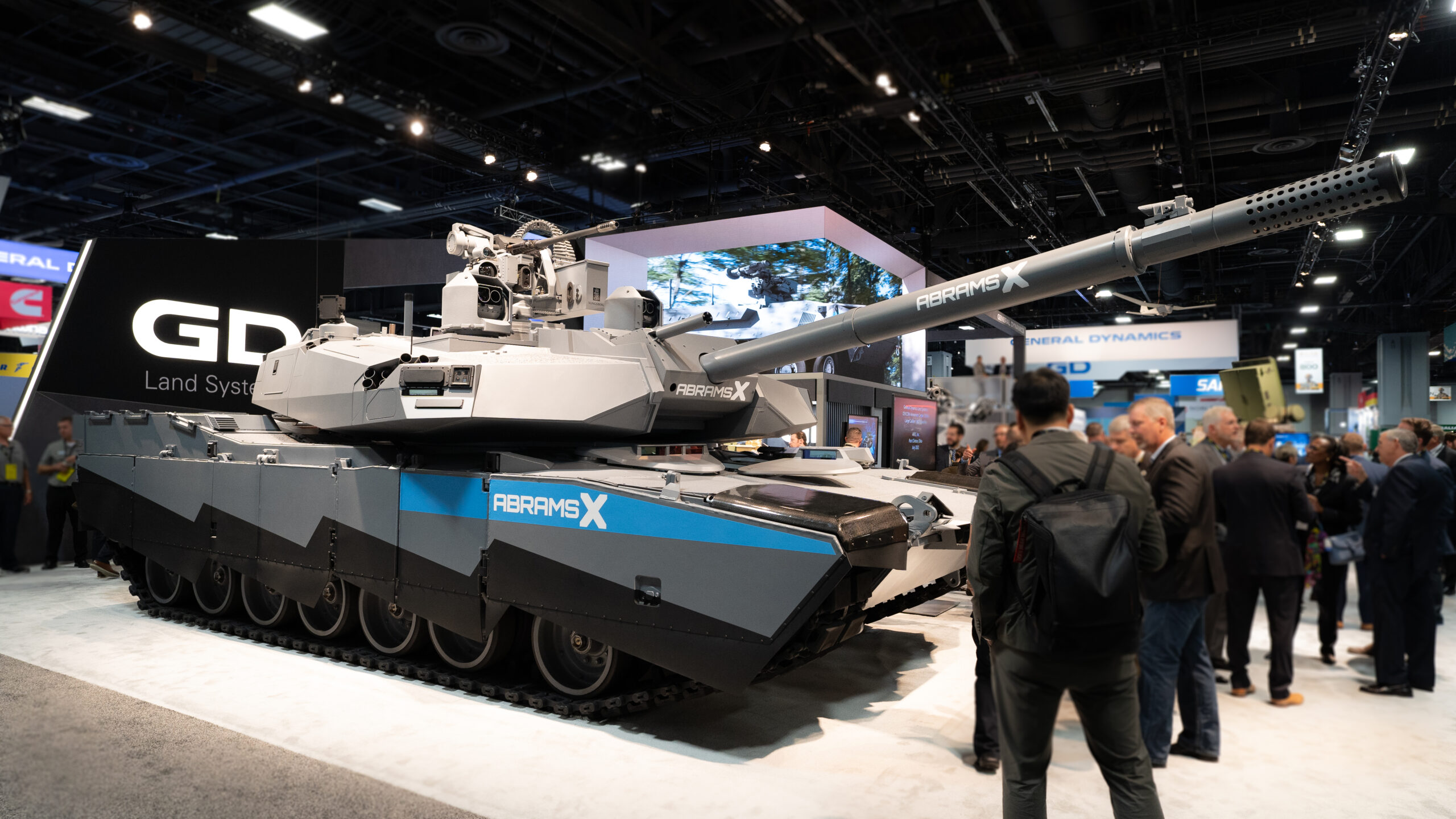
The AUSA show floor offered a fresh look at a futuristic version of an old Army standby: the Abrams tank. This one, the Abrams X, is made by General Dynamics Land Systems, manufacturers of the current Abrams M1A1 and M1A2 battle tanks used by the US Army. (Breaking Defense/Brendon Smith).
Attendees may walk by model versions of the famous Iron Dome system, in use for years in Israel, and its sister SkyCeptor system, both made by Rafael. The SkyCeptor, in particular, is meant to "defeat short- to medium-range ballistic and cruise missiles and other advanced air defense threats," the company says. (Breaking Defense/Brendon Smith).
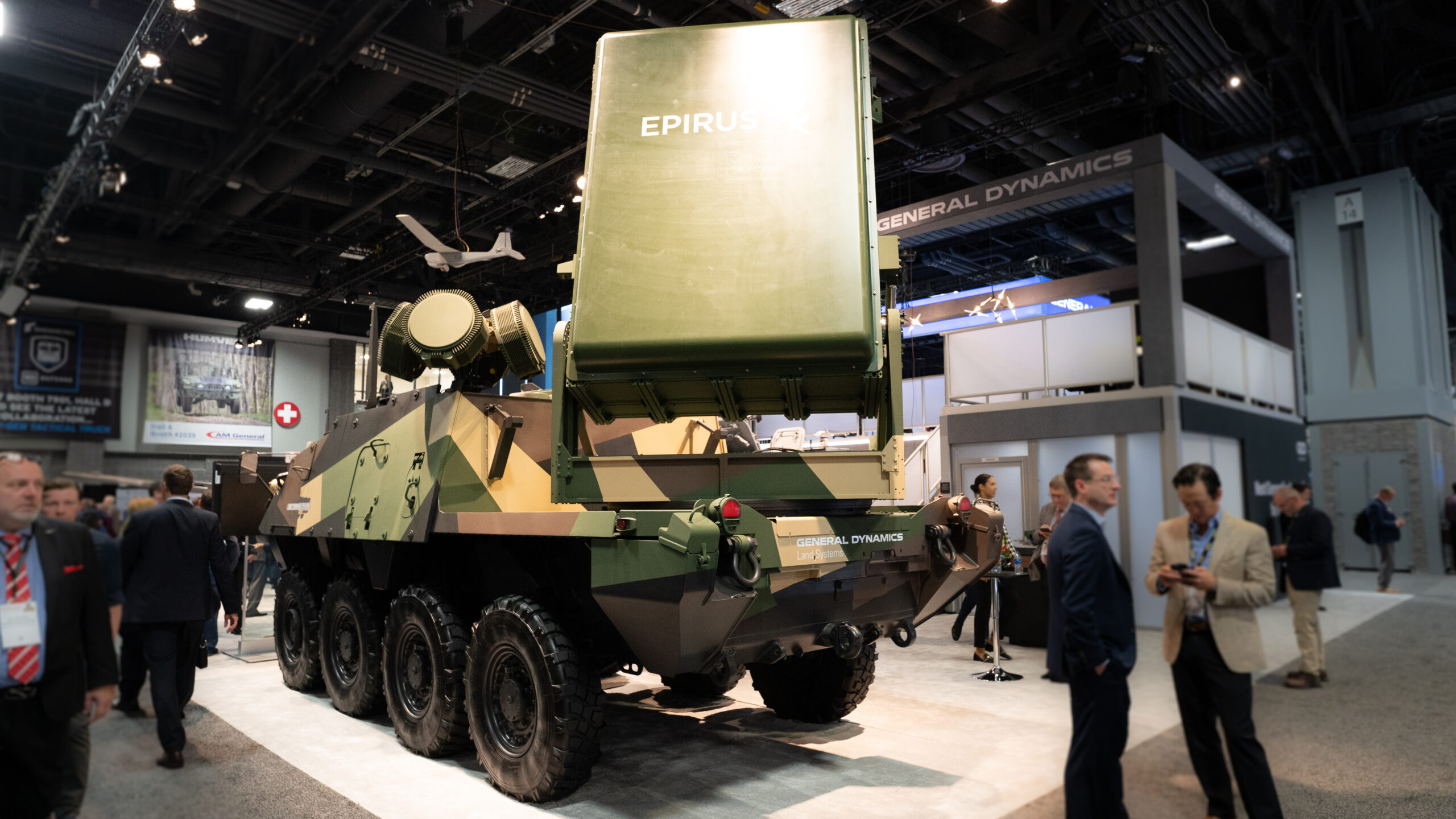
As the need for counter-UAS systems explodes, Epirus is at AUSA repping its counter-electronics system Stryker Leonidas, made with General Dynamics. The system's "counter-swarm" weapon "fills a pressing short range air defense (SHORAD) capability gap," the company says. (Breaking Defense/Brendon Smith).
A new unveiling for AUSA, Rheinmetall announced this week the Mission Master CXT platform, the newest addition to the company's "family" of autonomous ground vehicles. The company says the CXT "combines the power of a diesel engine with a silent electric motor." (Breaking Defense/Brendon Smith).
The GMC Hummer EV Platform, the first vehicle on GM's New Ultium EV Platform, goes on display at AUSA 2022. All-electric offerings are the center of much of the Army's attention these days as it aims to electrify its non-tactical, and eventually tactical, fleet. (Breaking Defense/Brendon Smith)
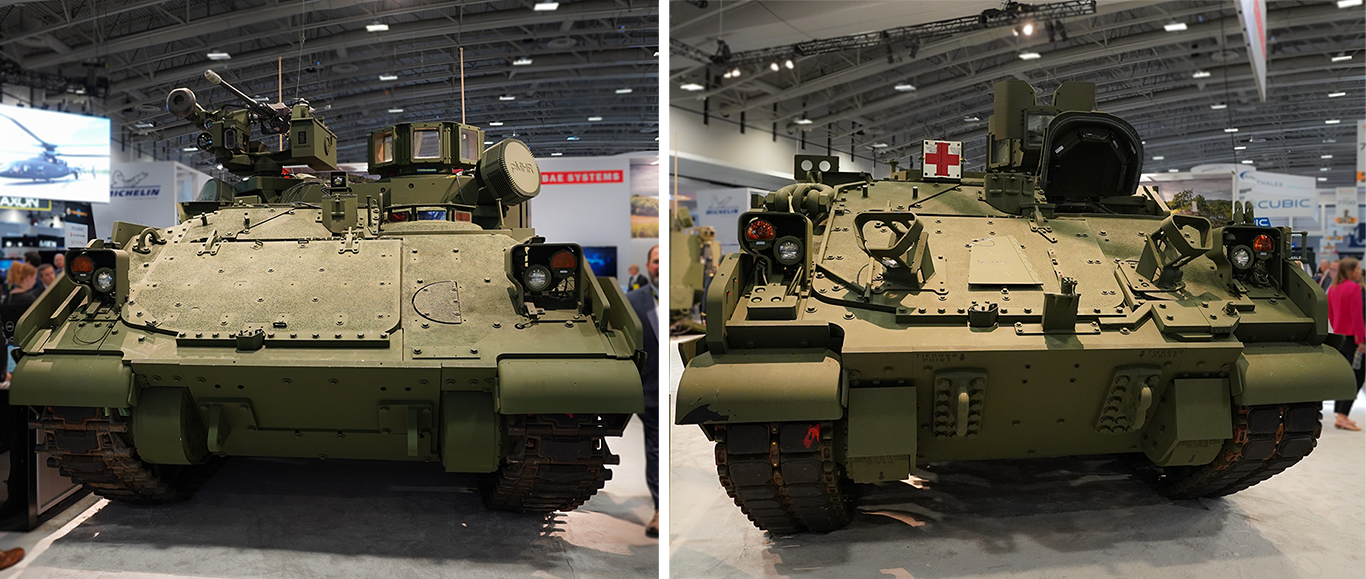
Two new Armored Multi-Purpose Vehicles (AMPV) sit at the booth by Bae Systems. The vehicles are meant to replace the Army's venerable, but old M113s. (Breaking Defense/Brendon Smith)
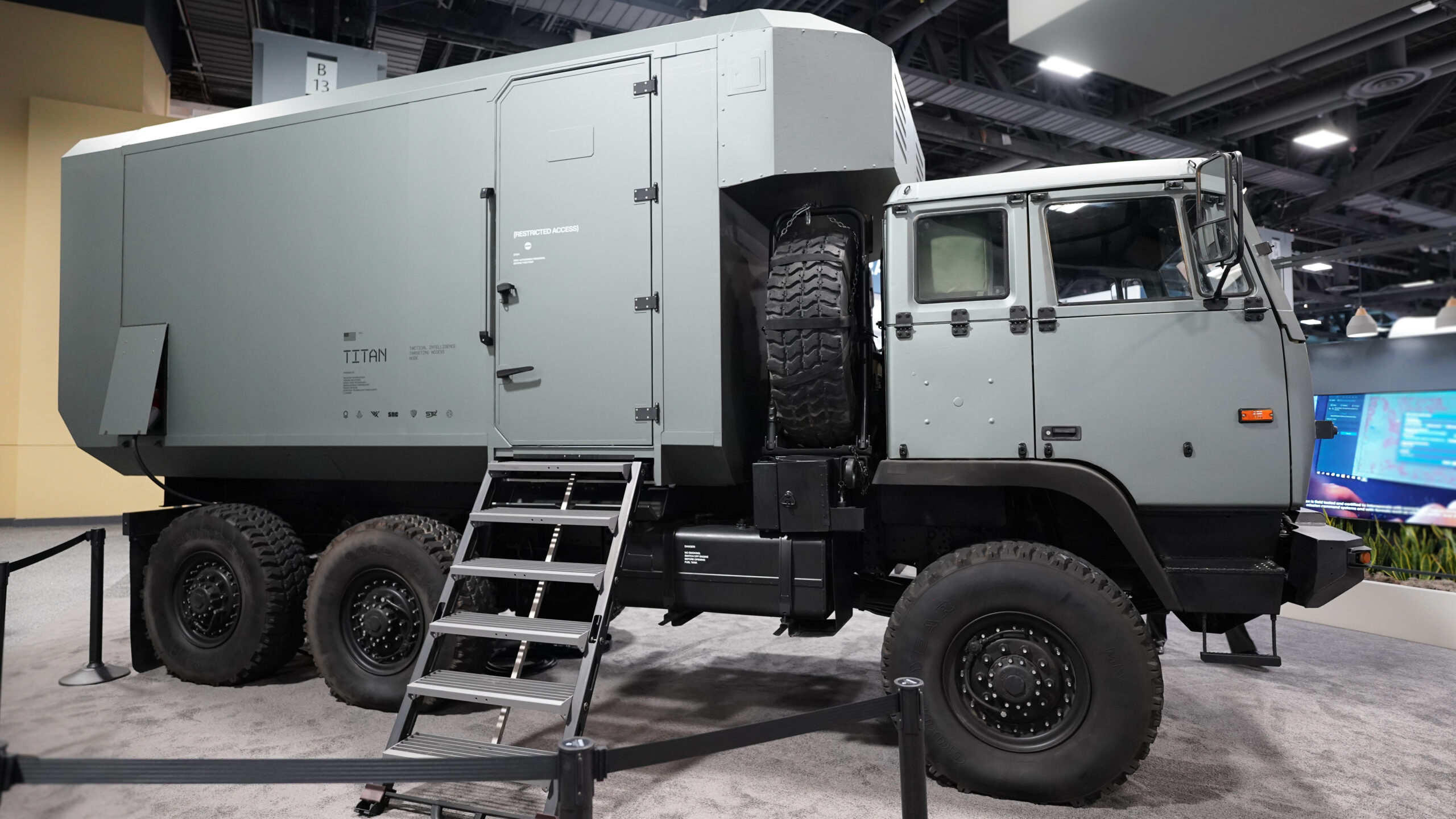
Palantir shows off its prototype for the Tactical Intelligence Targeting Access Node (TITAN) vehicle. The company says the TITAN "will be the critical backbone that provides correlation, fusion, and integration of sensor data alongside insights from AI/ML overlaid at the tactical edge." In other words, it's meant to find the signal in the noise. (Breaking Defense/Brendon Smith)
A model of a "modernized" Boeing Apache AH-64E shown Association of US Army Conference in 2022. While the Army is about to choose two new airframes, there's currently no Apache replacement on the horizon. (Breaking Defense/Brendon Smith)
Lockheed Martin teamed up with Sikorsky to produce the Raider X, the team's competitor in the Army's Future Attack Reconnaissance Aircraft (FARA) program, one of two high-profile Army Future Vertical Lift contests currently underway. (Breaking Defense/Brendon Smith)
The Bell 360 Invictus is the other FARA competitor, looking to beat out the Lockheed-Sikorsky team. The Army's expected to make its decision in fiscal 2024. (Breaking Defense/Brendon Smith)
The defense start-up Anduril has expanded its footprint in the defense market in recent years. This product, the Mobile Sentry, "brings autonomous fixed site counter UAS and counter intrusion capabilities into a mobile form factor," the company says. (Breaking Defense/Brendon Smith)
The military's no-so-furry friendly robot dogs are back at AUSA this year. This model, called the Vision 60 Q-UGV from Ghost Robotics, is an "all-weather ground robot for use in a broad range of unstructured urban and natural environments for defense, homeland and enterprise applications," the company says. (Breaking Defense/Brendon Smith).