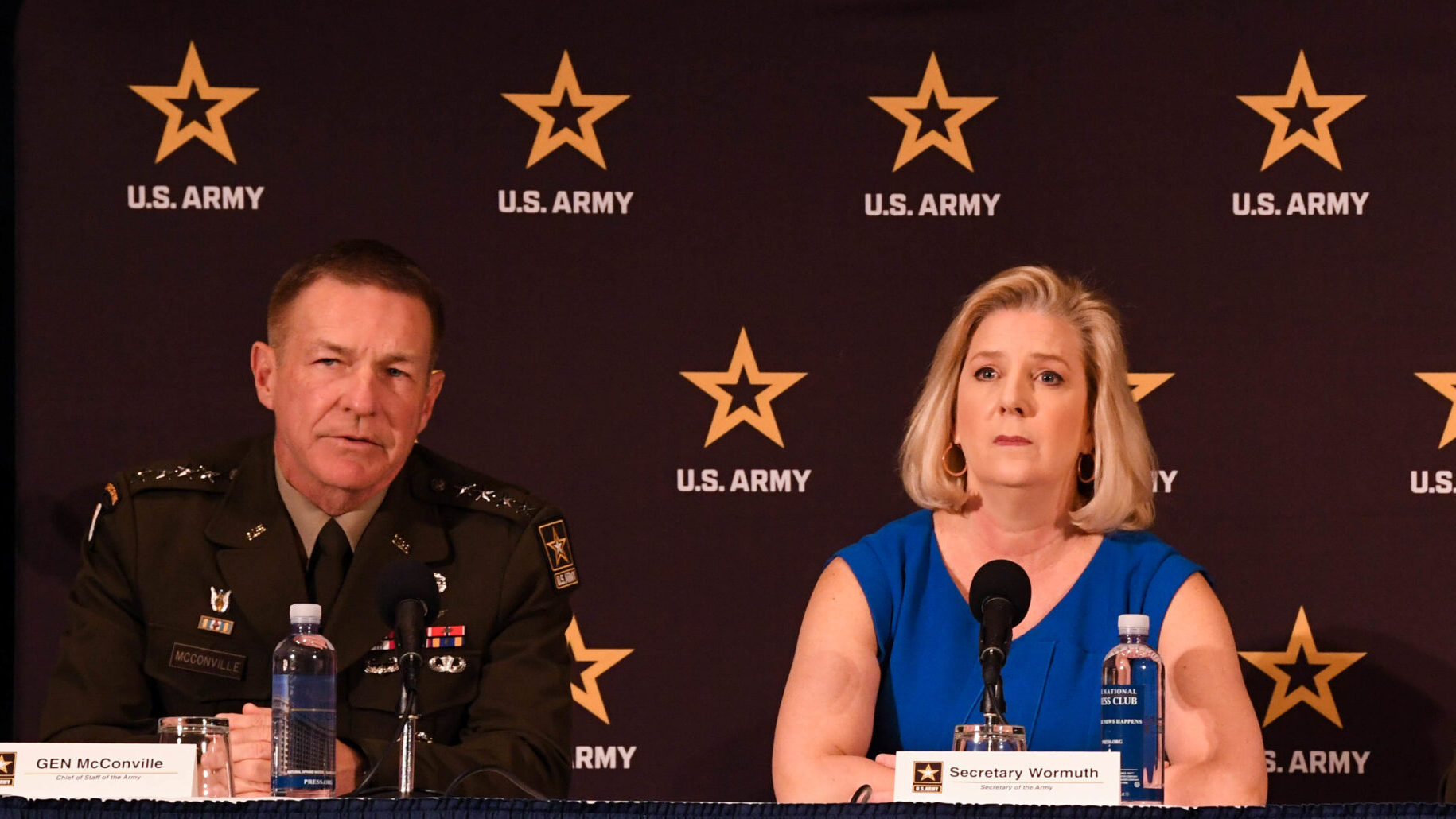
WASHINGTON — Last month’s last-minute budget deal avoided a catastrophic default, but one top Pentagon official is already pushing back against its spending caps, arguing they limit defense spending at a time of global crisis. The crucial legal question, Army Secretary Christine Wormuth said, is whether Congress can pass a supplemental spending bill that doesn’t count against the caps.
“Frankly, it would be a help if our friends in Congress can come to some sort of agreement on whether a supplemental is going to be doable under the debt ceiling agreement,” Wormuth told reporters at a Pentagon briefing Tuesday.
Pressed on this point by Breaking Defense, Wormuth, a DC veteran with decades of Pentagon and thinktank experience, took care not to step over a political red line by explicitly asking Congress to take action. But Wormuth made very clear how “helpful” a supplemental would be.
“Like all good defense offense officials, I do not speculate on hypotheticals,” she began. “I’m certainly pleased that Congress was able to reach an agreement on the debt ceiling that allows us to go forward. That said… it puts a cap on defense spending at a time where, traditionally, crises have always been handled through supplementals.
“We want to continue as a department to support Ukraine, for example, and to be able to do that, to date, the supplemental funding from Congress has been very important,” Wormuth continued. “Particularly… given that we want to make sure that we are not only able to support Ukraine but that we also replenish our own stocks and have sufficient stocks to deal with unforeseen contingencies… . That takes money, so a supplemental, I think, would be very helpful. It will be much harder to do that kind of balancing [under] the debt ceiling.”
There would certainly be precedent for supplemental funding: Legislators largely funded the Afghanistan and Iraq wars through Overseas Contingency Operations funds that bypassed the so-called “sequestration” caps of 2021-2021. Indeed, DC’s most quotable budget guru, Todd Harrison, noted in a LinkedIn post just days after last month’s deal that “[because] this is a resurrection of the same part of the U.S. Code as the Budget Control Act of 2011… the OCO/emergency supplemental ‘loophole’ still exists. That means anything Congress designates as OCO or emergency funding isn’t subject to the caps. Would it be cynical to think that Congress would use this to get around the caps they just set for themselves? Yes, and of course they will.”
That’s the supply side, and the demand pressure is present, too. While America isn’t directly waging war in Ukraine, the US Army is under a different kind of pressure, trying simultaneously arm Kyiv with a wide array of weapons, replace Reagan-era equipment with cutting edge tech, and replenish its ammunition stocks for the kind of ferocious firefight Ukraine has shown still occur in the Information Age.
“Throughout the process of arming the Ukrainians, we’ve been very careful , obviously to balance their needs, which we absolutely want to support, and our needs to remain ready,” Wormuth told reporters. “[Assistant Secretary for Acquisition] Doug Bush has been on the front lines of this, working closely with industry to increase the production capacity of our partners in industry on things like Javelins, GMLRS [missiles], 155 mm [shells].”
“There are things like Patriots, obviously, that the Ukrainians have used to very good effect, that they would undoubtedly like more of,” Wormuth said, “[but] our air defense community has a lot of strain on it, and Patriots are a finite resource, so those are things we are going to have to weigh carefully.”
“We look at every single request” from Ukraine, added the Army Chief of Staff, Gen. James McConville. “We can do it but we have to replenish and we have to replace” what we’re giving away.
McConville emphasized that the US Army is “not buying ‘new old stuff.'” Rather, the Army is giving Ukraine its existing equipment, much of it upgraded versions of weapons introduced in the 1980s, and replacing it with more modern designs. (The Pentagon recently ran afoul of congressional auditors when they discovered it was accounting for aid to Ukraine based on the cost to replace the donated arms with more modern tech).
So, if supplemental funding were made available, should it be focused on aid to Ukraine, or support defense spending more broadly? The latter, Wormuth said Tuesday, in part because the intense needs of Ukraine revealed to the US defense community just how logistically demanding modern war can be.
“One of the lessons learned from Ukraine is that our just-in-time approach to logistics and our estimates about munitions for protracted conflicts were too low,” Wormuth said. “I would like to see it be broader and really be looking more broadly about weapons systems and munitions that we in the Army and in the Department [of Defense] need to face current and future threats.”
“A lesson learned, I think for our country from the Ukraine conflict is that our industrial base is not as robust as we need it to be and it’s been a wakeup call,” she added a few minutes later. The Army and private industry have worked hard to ramp up capacity for munitions and more, she said, but it takes months or years to build up such highly specialized manufacturing capability.
That requires a long-term financial commitment, said McConville. “Defense contractors don’t operate on enthusiasm, they want to see contracts — and what they really want to see is long-range contracts,” he said. “If the resources are there, this country can produce all the weapons systems, all the ammunition, they need — but they need those contracts.”