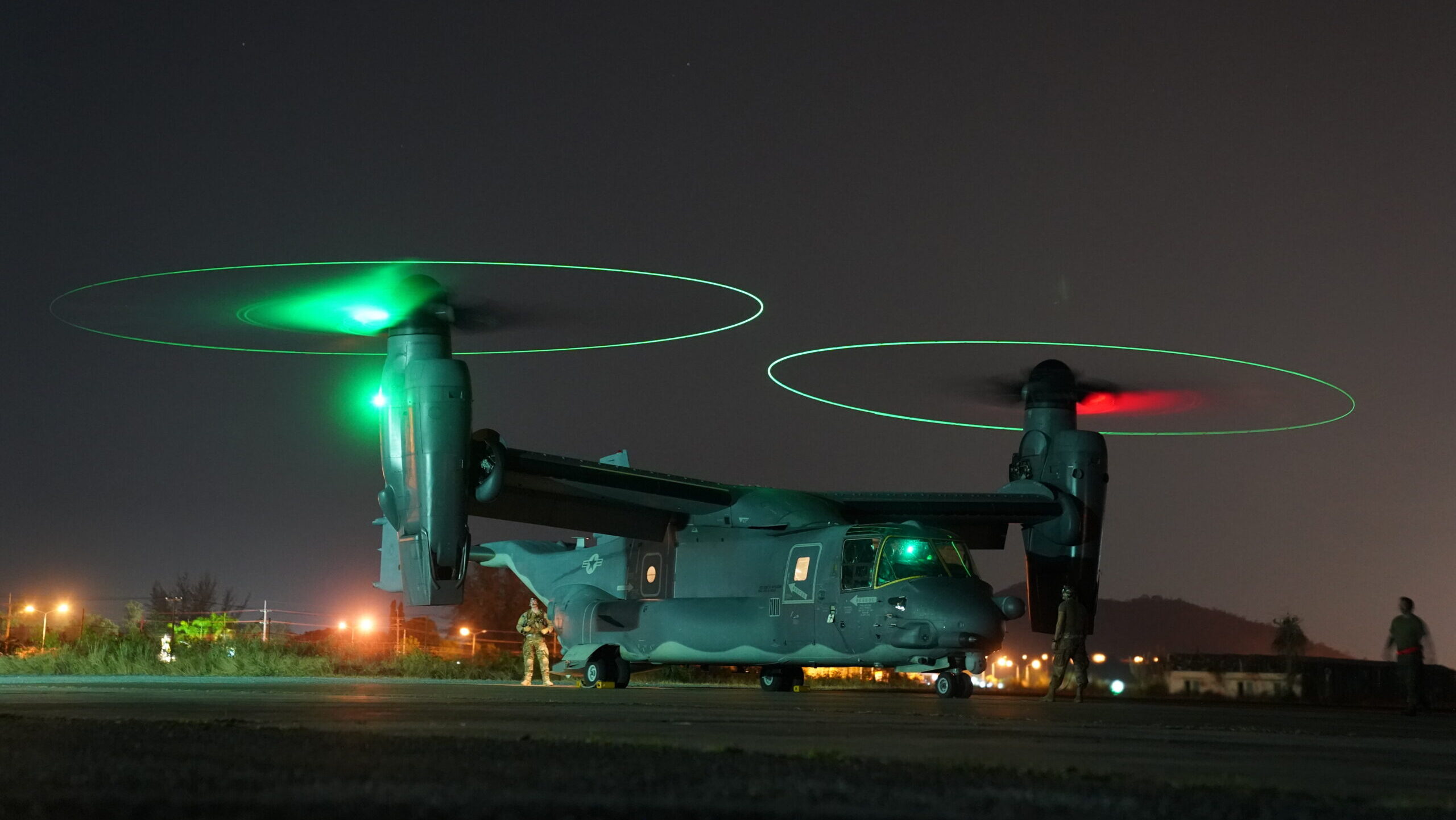
AFA 2024 — Within a few weeks, Air Force CV-22 Ospreys will be ready to deploy for the first time since a fatal Osprey crash in November, the head of Air Force Special Operations Command said today.
About 60 percent of AFSOC’s CV-22s are back to being fully operational, with the rest to follow by late 2024 or early 2025, said Lt. Gen. Michael Conley during a roundtable at the Air Force Association’s Air, Space and Cyber conference.
The CV-22 units in Japan and the United Kingdom “are almost back to full mission readiness. We will deploy out here in the coming weeks, back to support other geographic commanders,” he said. “My whole fleet is not operationally running yet, but I have enough capacity and the right crews training to provide the capabilities on the battlefield.”
Conley, who took the helm at AFSOC in July, declined to comment on where specifically the Ospreys will deploy, stating only that it will not take place in the Indo-Pacific or European theaters, which already have permanently stationed V-22 squadrons.
The Pentagon grounded all versions of the Osprey in December after a CV-22 flying a training mission crashed off the coast of Japan on Nov. 29, killing eight crewmembers onboard.
The Pentagon in March gave the services the green light to begin returning the Bell-Boeing-made tiltrotor to flight, putting into action a phased approach that involved retraining crews, reviewing maintenance records and instituting changes to emergency procedures meant to improve flight safety.
In August, the Air Force released its accident investigation report on the crash, which found that it was caused by a “catastrophic failure” of the Osprey’s proprotor gearbox, but also listed decisions made by the aircrew as a factor that contributed to the accident.
In particular, the report pointed to the aircrew’s actions in light of multiple “left-hand proprotor gearbox (PRGB) chip burn” advisories. Per Air Force guidance at the time, crews were directed to land as soon as possible if they receive that warning three times during a flight, but service regulations also provide commanders some discretion based on their circumstances and mission.
Conley said that guidance has changed so that crews are now advised to land “as soon as practical” after a single chip burn warning, and to land “as soon as possible” after two warnings.
“At the end of the day, there will always be aircraft commander and crew discretion. It’s the nature of what we do. The environments are unique, depending on where we’re flying, what we’re dealing with,” he said. “But we have tightened up the guidance to make it less ambiguous to the crews up there.”
The Air Force has sometimes taken a different, and perhaps more cautious approach to Osprey operations than the Marine Corps, having previously suspended V-22 flight operations due to safety concerns at times where the other service kept flying. Last week, Aviation Week reported that the Air Force is considering assuming airworthiness authority for the CV-22 from Naval Air Systems Command, which manages Osprey procurement and support for the US military through the PMA 275 program office.
Asked about the potential move, Conley said it was a question for Air Force Materiel Command head Gen. Duke Richardson, and that AFSOC’s relationship with NAVAIR, the Marine Corps and PMA 275 “is probably as strong as it’s ever been.”
“I’d say that over the last eight or nine months, we’ve had the time, and we’ve kind of looked at the program in a holistic view. We’ve considered lots of things, and there’s been lots of ideas, lots of recommendations, and we’re still kind of calling through those on what is feasible, what makes sense,” he said. “I don’t think anyone’s close to a decision on whether we need to break from the current construct.”
PHOTOS: AFA 2024

 Gallery













Breaking Defense Video