AFA 2024 — As industry eagerly awaits the Air Force’s decision on an interim tanker plan, service officials now say the potential acquisition hinges on the fate of a different plane: the service’s future next-gen tanker and, specifically, how quickly they can make it operational.
In a briefing with reporters Monday, Air Force acquisition chief Andrew Hunter said the service’s efforts are now focused on completing an analysis of alternatives for the Next Generation Air-refueling System (NGAS), a future tanker concept that’s currently in early stages but one that officials believe will be critical for refueling operations in contested environments like the Indo-Pacific. The results of that analysis, Hunter said, will ultimately determine the shape of the nearer-term tanker buy.
The service’s most recent tanker strategy unveiled in March 2023, which called for an interim buy of roughly 75 tankers to continue recapitalizing the aging KC-135 Stratotanker, is broadly “still the case,” Hunter emphasized during a roundtable at the Air, Space & Cyber here in Washington. However, that “construct” is “critically dependent on getting after NGAS” and how quickly the service can field the aircraft.
“So we need to understand the NGAS part of the story to truly make additional progress on tanker recap,” Hunter said.
Essentially, when the service unveiled its new tanker strategy — doing away with a three-pronged approach known as KC-X, KC-Y and KC-Z in the process — officials expected the interim purchase would buy time to field the NGAS by the mid-2030s. But as the NGAS analysis of alternatives proceeds, officials expect to get a better idea of what the NGAS program will look like, including what a realistic timeline could be. A longer timeline would, presumably, necessitate more interim capability, for instance.
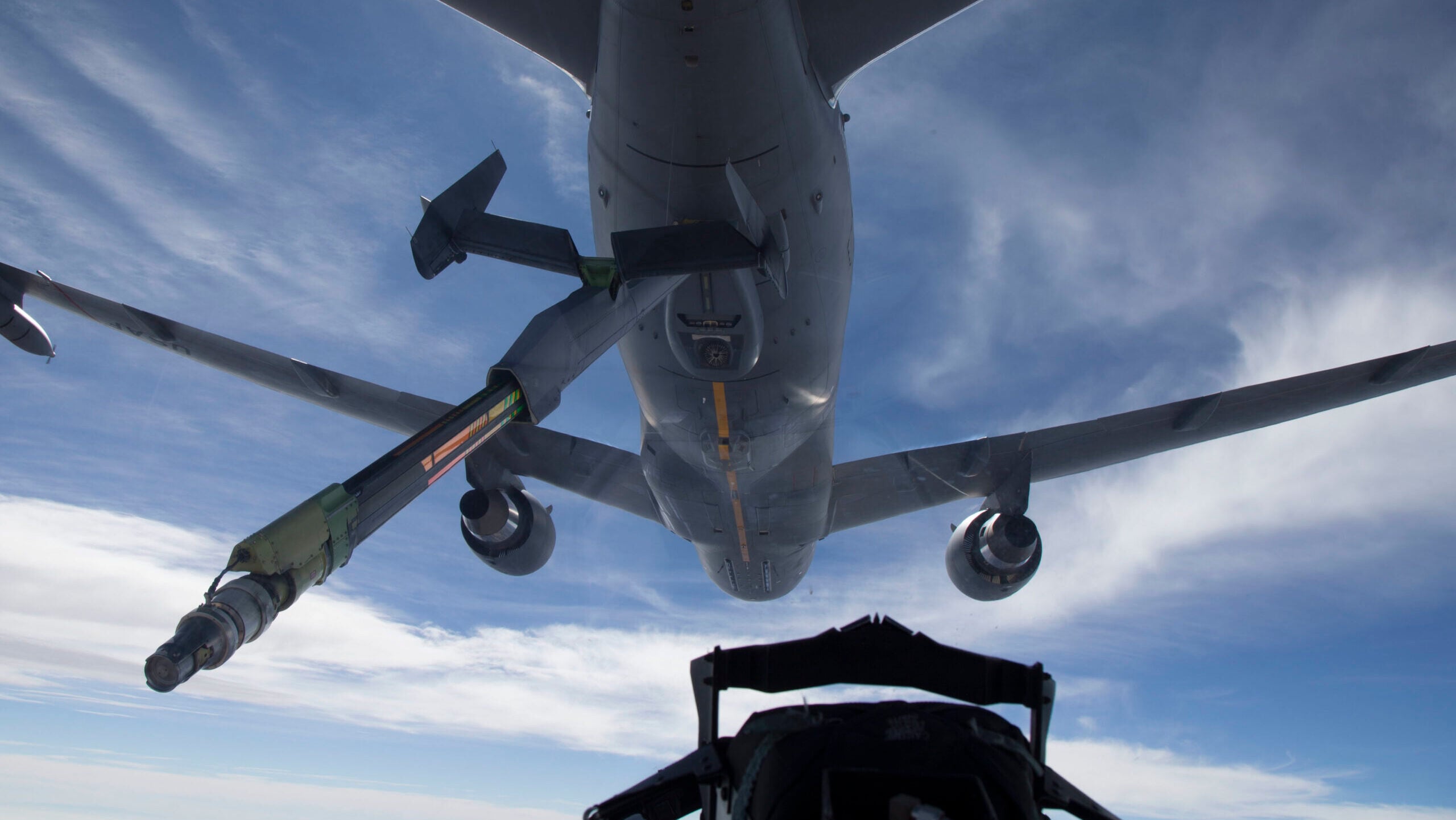
A congressional mandate requires the Air Force to maintain a minimum inventory of 466 tankers, the bulk of which are currently Eisenhower-era KC-135s, also known as Stratotankers. Some of that fleet is currently being replaced by Boeing’s KC-46 Pegasus, and the potential interim tanker buy, perhaps for more KC-46s or for another airframe, would continue that process and enable more KC-135 divestments.
Asked whether the Air Force would be challenged to maintain KC-135s in the event the service dramatically changes the interim tanker buy or skips it altogether, Hunter replied that KC-135R variant of the aircraft would be maintained “as necessary until we are able to replace them.” Additionally, Hunter said the service does not currently intend to propose altering the tanker inventory requirement.
In a roundtable with reporters today, US Transportation Command chief Gen. Jacqueline Van Ovost stressed that she needs the Air Force to ensure KC-135s remain “credible” in the event they need to be relied on. Van Ovost’s command formulates the number of tankers needed to fulfill war plans.
“The crews need to be trained for the high-end fight, to this contested logistics fight. And I need the capabilities to fight [with these] airplanes in the environment I intend to fly them in,” she said.
As for NGAS, the Air Force has released a small number of requests for information (RFI) to industry in a bid to gather feedback on the service’s plans, the most recent coming last week for the aircraft’s mission systems. Air Force Secretary Frank Kendall said the RFI will help establish a “competitive vendor pool” and that results could be incorporated into the rest of the tanker fleet.
Hunter said that RFI demonstrated a new approach with industry, allowing the Air Force to engage vendors earlier in the process. A separate RFI for the NGAS airframe will be issued after the analysis of alternatives completes, he added.
Greg Ulmer, head of Lockheed Martin’s aeronautics business, told Breaking Defense on Tuesday that 2032 would be a “very aggressive” timeline to begin fielding NGAS, with 2035 as a “more realistic” option given the time needed to finalize requirements and develop the aircraft.
Any downward revision in the interim tanker plan, including an outright cancellation, would likely be a blow to Boeing. Hunter himself originally suggested the Air Force was leaning toward the company’s KC-46 for the interim buy, and analysts told Breaking Defense at the time that the beleaguered aerospace giant’s position only strengthened when Lockheed Martin bowed out of a partnership with Airbus to compete for the effort.
Boeing’s current contract with the US Air Force for 183 KC-46s is set to complete deliveries in 2029, and a fixed-price development contract for the Pegasus has forced the company to eat over $7 billion in losses on the program. A sizable new round of procurement for the tanker, Boeing defense business CEO Ted Colbert told reporters last year, could mean that an “opportunity to make the program even more healthy from a financial perspective is in front of us.”
Valerie Insinna in Washington contributed to this story.
UPDATED 9/19/24 at 9:42 am ET with comments from Boeing’s defense business CEO, following comments from Lockheed Martin’s top aeronautics executive.
PHOTOS: AFA 2024

 Gallery