
WASHINGTON — As the DC area lay stunned by snowfall, over 900 people tuned in Tuesday for hours of virtual briefings on a forthcoming Army contract vehicle for “Artificial Intelligence & Software at Pace” (AIS@P). At stake is a projected $1 billion over the next decade.
But to keep tech updates innovative, competitive and quick, AIS@P aims to divide those dollars into at least 40 individual “task orders” of at most $25 million apiece, with anywhere from five to 30 vendors bidding for each one. (It’s possible that a few task orders may exceed that $25 million threshold, officials said). Only vendors who prove their expertise in the relevant specialties will be allowed to bid on relevant task orders — poor performers will be liable to get kicked out of the approved “pool” at any time, and promising new vendors may be brought on as they emerge.
Each individual task order is supposed to be turned around within a month: Once the official Request For Proposals (RFP) is published, vendors will have just 14 days to submit bids, and the Army will have 16 days to evaluate and make awards. That’s an extraordinarily tight timeline for a Pentagon procurement, especially since AIS@P will follow the standard Federal Acquisition Regulations (FAR). But, officials argued, such speed is essential to 21st century warfare.
“We’re trying … to really open the aperture for government to access innovative solutions … lower barriers to entry [and] keep pace in our space of AI and EW,” said Brig. Gen. Ed Barker, the Army’s Program Executive Officer for Intelligence, Electronic Warfare, & Sensors (PEO-IEW&S).
Barker’s Chief of Staff, Kyle Perkins, added: “We fully expect, when we get out into the fight, we’re going to see things we haven’t seen before, [so] our EW systems have to change at a moment’s notice.”
While PEO-IEW&S is creating AIS@P for the PEO’s own programs, which cover everything from backpack radio jammers to truck-sized satellite terminals, officials suggested other Army organizations might use the contract vehicle as well. It’s worth noting that an earlier PEO-IEW&S initiative on AI, Project Linchpin, was swiftly scaled up to serve the entire Army. (Linchpin plans to make extensive use of AIS@P, its leadership said during the briefings).
Certainly Barker made no bones about his big ambitions: “The end goal is really trying to change how the Army does business,” he said.
Tight Timelines, Grand Ambitions
To start, however, Barker and his team must get AIS@P off the ground. While officials have been talking informally with industry for some time, the PEO issued a draft RFP in late November, accompanied by feedback forms, a survey, and an email inbox for comments. At Tuesday’s industry day briefings, Perkins said he wanted to get a final Request For Information (RFI) out “on or around 13 January,” an updated draft RFP in February, and a final RFP in March.
The initial contract awards should come this summer, Perkins continued, in the final quarter of federal fiscal year 2025. But, he and other officials emphasized, those are just “base” contracts. While they’ll carry a “nominal” monetary value, the real worth of these initial awards is that they get a company in the “pool” the Army deems qualified to bid.
“If you’re not in one of the pools, you cannot bid on a task order,” one official emphasized.
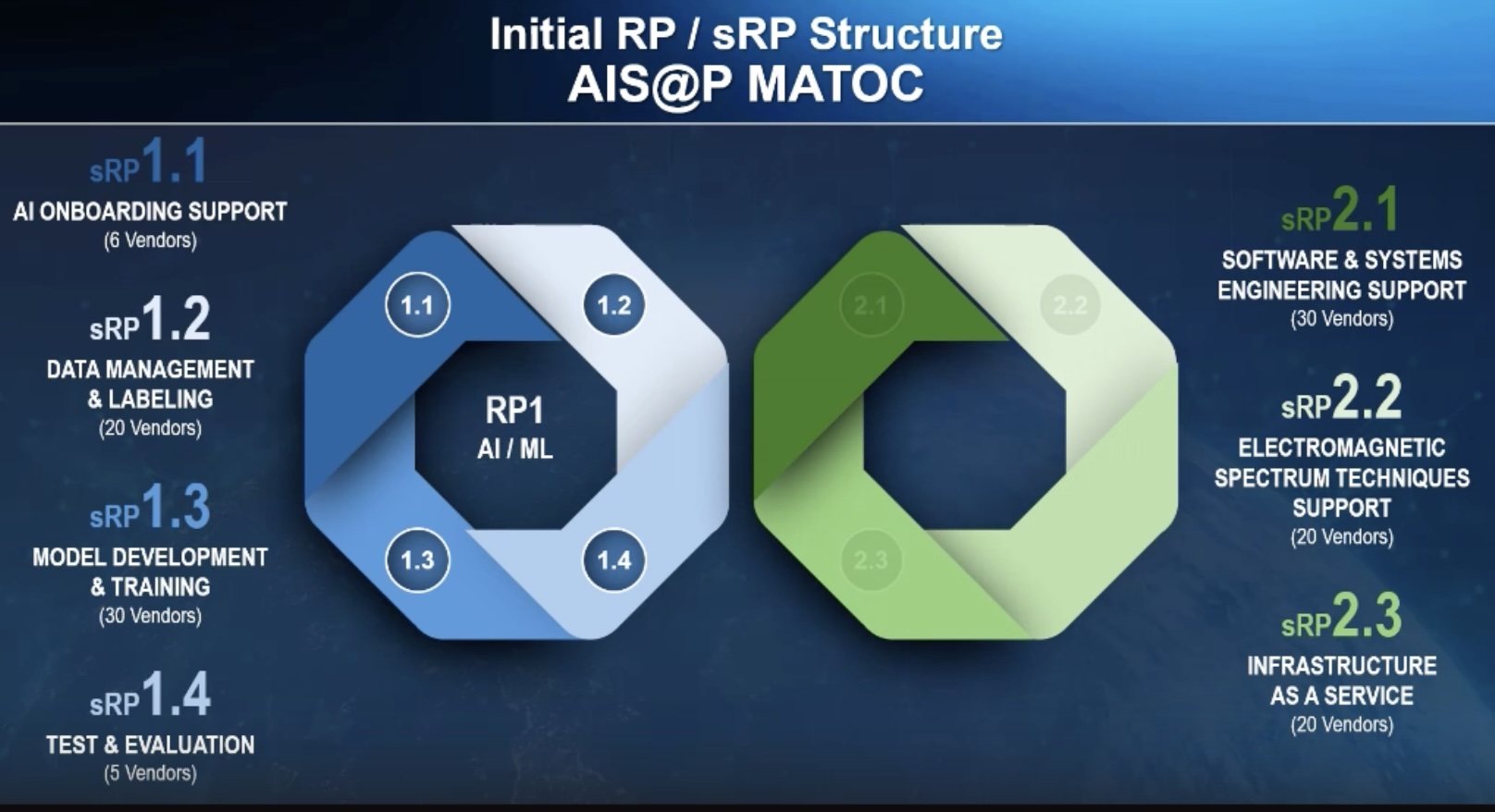
Currently, the plan is for seven pools. Four will cover aspects of AI: onboarding (reserved for small businesses); data management and labeling; model development and training; and test and evaluation. Three will apply to software more broadly: engineering support, electromagnetic spectrum support (including highly sensitive electronic warfare techniques), and infrastructure as a service (IaaS). A single company may belong to multiple pools, but it has to qualify for each one separately; that means submitting a separate proposal, white paper, tech demo, and past-performance data tailored to each pool’s specific technical focus.
Once the pools are filled, the Army can begin issuing individual task orders (TOs), which could be for everything from licensing off-the-shelf software to developing new cutting-edge tech. Each TO should cover six months of work, with options to renew. In all other respects, the task orders can vary widely, using different contract types, security rules, intellectual property agreements and technical standards.
The vendor pools won’t be static, officials emphasized: The Army reserves the right to “offramp” underperformers and to bring on promising new vendors at any time. This process, which officials called “perpetual onboarding,” will open to newcomers sometime in early FY26, Perkins said. The Army may even add new pools as new technology needs emerge.
Constant communication between industry and the Army is essential to making all this work, officials emphasized over and over again.
“We’ve asked for feedback and you haven’t been shy to give that,” Barker said. “You’re making us better … I appreciate the fact you give it to us straight.”