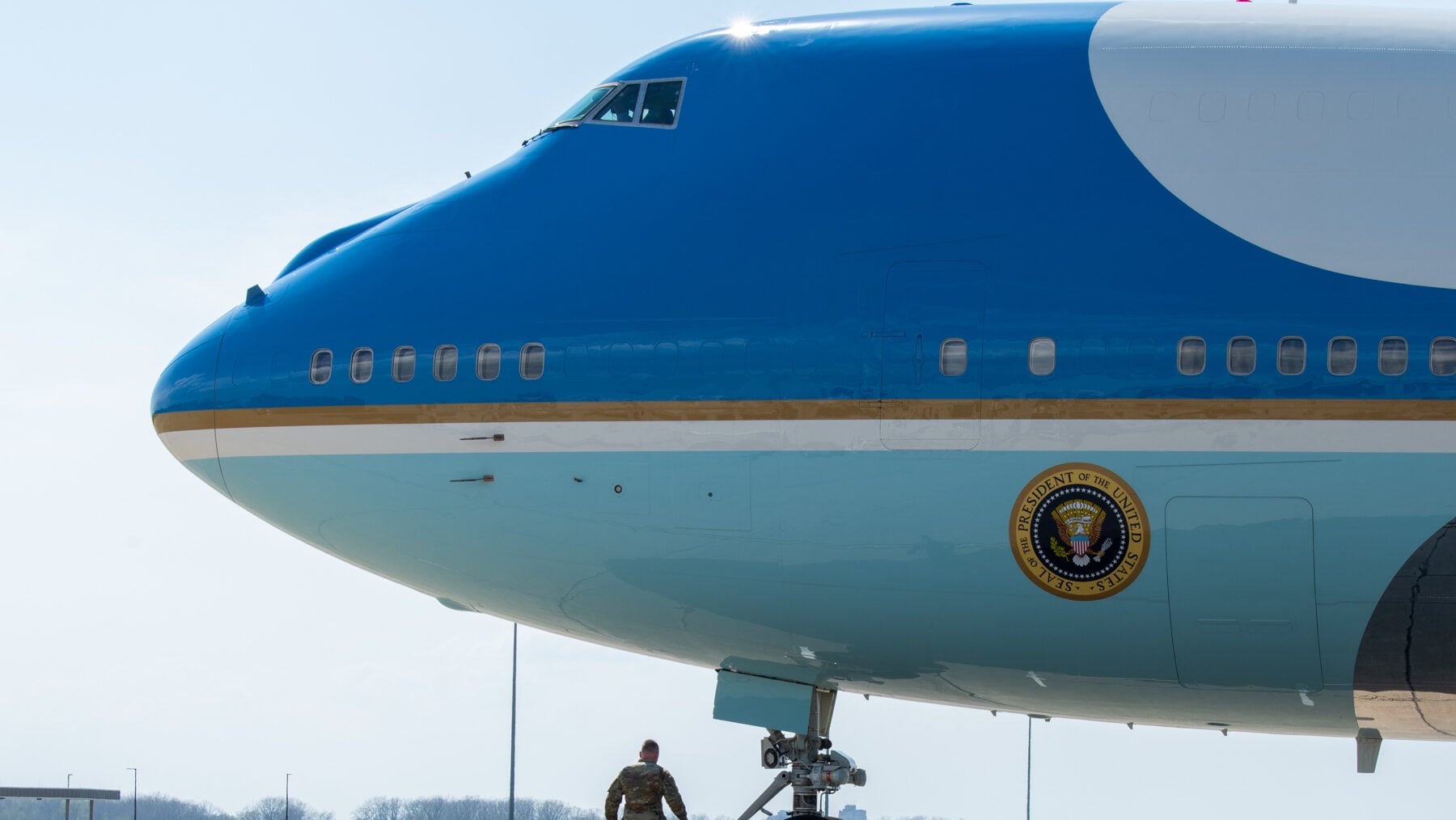
PARIS AIR SHOW — Boeing is “very close” to locking in the final design for two new Air Force One jets, with recent changes made to the aircraft’s requirements that could allow it to deliver “years” earlier than previously feared, the head of its defense unit said today.
“Over the last four or five months, we’ve made more progress than we’ve made in the last four years. … We have been able to see our way through some of these requirements that were just physically impossible to do,” Steve Parker, the interim CEO of Boeing’s defense business, said during a roundtable. “We’re very close to locking in the design and completing it. We’ve got a couple more conversations … with the Air Force and the administration on configuration, but just making really, really good progress.”
Boeing’s effort to turn two 747 jumbo jets into new Air Force Ones, formally known as VC-25B, has been beset with technical challenges that have spawned ever-increasing schedule delays. Delivery of the first jet, initially projected for 2024, had slipped several years, with a source telling Breaking Defense in December that the latest estimate was 2029.
Early into his second term, President Donald Trump — who personally brokered the Air Force One contract with Boeing during the first Trump administration — tasked Elon Musk with helping the planemaker figure out how to cut down that timeline by removing overly onerous technical requirements. Air Force officials, citing a Boeing schedule estimate, told lawmakers in May that efforts to relax requirements for the aircraft could speed up the delivery schedule to 2027.
While Parker declined to give specifics on delivery timing during today’s roundtable, he said that the company has “pulled this back years to the left from where it was.”
“The administration has been very, very helpful,” Parker said. “Clearly, Elon was part of that, but the administration is much more than anyone, and that continues as we go forward.”
While Boeing continues work on Air Force One, the Trump administration has jumpstarted a secondary effort that would take a 747 gifted by Qatar and turn it into third presidential transport aircraft that would potentially be available to Trump before VC-25B. L3Harris is reportedly set to modify that aircraft.
RELATED: Before lawmakers, Hegseth refuses to disclose cost, schedule to convert Qatari jet to Air Force One
When asked about potential budgetary impact to the VC-25B program as a result of adding a third Air Force One plane to the mix, Parker deferred comment to the White House.
“We will support the president in whatever way we need to. But all I’m focused on is the first two VC-25Bs.”
Despite Boeing’s difficulties on VC-25B, the company recently landed a huge win in the form of the Air Force’s Next Generation Air Dominance program, now known as the F-47. It is also engaged in the race for the Navy’s sixth-gen fighter, known as F/A-XX, with Northrop as its only competition. However, a contract award is currently on hold due to concerns about whether industry can handle building two sixth-generation fighters at the same time, Navy Secretary John Phelan told lawmakers last week.
Those concerns are not shared by Boeing, with Parker saying that the company can “absolutely” handle producing two next-generation fighters and has invested almost $5 billion for new facilities in St. Louis, Mo., and Mesa, Ariz., with the intention of executing both programs.
“From day one, the capital investment was for both programs. We’ve done the same with our technology, we’ve done the same with our staffing. I can’t go into any staffing numbers, but we have a very large number of folks working on both programs,” he said. “So yeah, absolutely, we can do it. And so can the industrial base, and so can the engine manufacturers. So I don’t see that as being an issue.”
Parker also downplayed the threat of a “fifth-gen plus” version of the F-35, which Lockheed Martin CEO Jim Taiclet has pitched as a lower-cost alternative to sixth generation jets. Lockheed lost the Air Force’s Next Generation Air Dominance competition to Boeing’s F-47 and is no longer engaged in the Navy’s F/A-XX competition.
“I get it when other companies have shareholders to answer to when they’ve been knocked out of both six-gen fighter programs,” Parker said. “But at the end of the day, I think the US Air Force selection of the F-47 and our industry partners to produce tells you all you need to know. Only a sixth-generation aircraft specifically developed, designed to meet the requirements of today [and] of the future — that’s the only sensible solution.”
PHOTOS: Paris Air Show 2025

 Gallery