PARIS AIR SHOW — The French military has bought a set of new Mataris loitering munitions from defense firm KNDS as the government seeks to scale up production in the wake of the Ukraine war, the company told Breaking Defense during this week’s Paris Air Show.
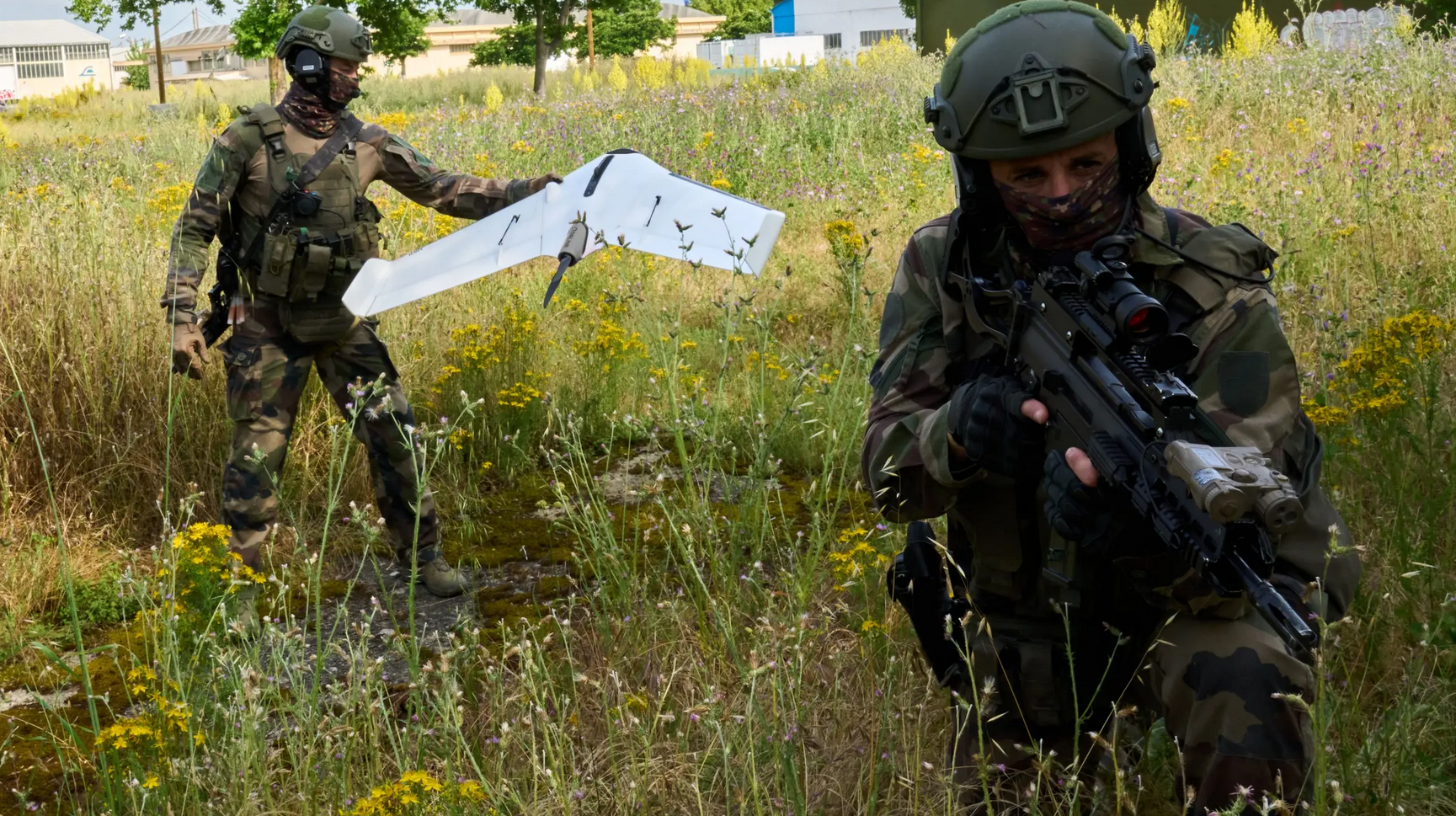
KNDS (formerly Nexter) showcased its Mataris family of systems at Le Bourget, while announcing that France has procured 17 of the MV-100 Veloce 330 for testing and training by the Air & Space Force, Navy and Army. The MV-100 Veloce 330 is developed in partnership with EOS Technologie, a French fixed-wing drone manufacturer intended for military missions.
The effort falls under France’s “Larinae” project, launched in May 2022 by the French Defense Innovation Agency (AID) and the defense ministry’s procurement agency, to find domestic loitering munitions with a 50 km (31 mile) range and autonomy of at least 60 minutes.
Speaking to reporters, Olivier Travert, KNDS’ chief sales officer, said the effort design exceeds those requirements.
According to company literature, the 12-18 kg thrust jet turbine engine has a range of 100 km (62 miles), a maximum altitude of 6,000 m (19,685 feet), a cruising speed of 200 km/h (124.27 mph) and a top speed of 400 km/h (248.55 mph). The platform has a wingspan of 3.3 m (10.83 feet) and can be assembled by two operators in under 10 minutes; it also has alternatives to GPS, in case that system is blocked by electronic warfare.
The munition is a 2.5 kg derivative of KNDS’ Bonus technology (Bonus is the shell fired by the Caesar truck-mounted gun) “which can destroy any type of vehicle,” Travert said, “because it explodes a short distance away from the vehicle and releases an armour-piercing charge which cannot be stopped by cope cages.”
Jean-Marie Zuliani, president of EOS Technologie, explained that the 17 MV-100 Veloce 330s bought by the French armed forces do not have a warhead “because they are being used to train the operators who have to learn to use a UAV that flies as fast as a jet.”
He added that “these are not just demonstrators, but we are using the comments and suggestions we receive from the operators to help us improve the product. In order to shorten the development cycle, our contract includes a clause requiring us to provide an improvement modification every two or three months until the end of this year when the product must be entirely finished.”
Zuliani said the doctrine of use would probably evolve once the French armed forces started using this loitering ammunition operationally, “but for the moment it is equipped with a parachute so that the UAV can be recuperated.” He specified the weapon could be armed and disarmed remotely, and that there was always a human in the loop to make the final decision as to whether to destroy the initial target or not based on the real-time video images returned to the control-center by the on-board camera.
Asked by Breaking Defense whether these loitering munitions will be produced in Ukraine, the two offered a short silence followed by one saying, “We’d prefer to remain discreet on this subject.”
Far less discreet is the news that another member of the Mataris family has been deployed in Ukraine over the past few days.
The MV-25 Oskar is a fixed-wing system developed in partnership with French-firm Delair, who was the lead on this project. The Oskar was developed in the framework of the AID’s Colibri project to develop a low cost loitering munition to be used beyond 5 km (3 miles) from the launch point.
According to Travert, after the Colibri demonstration, the DGA decided to order its industrialization.
Developed for anti-personnel and anti-light vehicle missions, this loitering munition was designed to have a 25km (15.5miles) range with a flight endurance of 45 minutes but, according to Bastien Mancini, Delair’s president, it has proven to be able to almost double this range at 40 km (25 miles).
The platform is based on the Delair UX11 with a 1.1 m wingspan (3.6 ft) hand-launched by the operator who also fits the 550 g (19.4 ounce) explosive incendiary fragmentation warhead before take-off, as the two are packaged separately for security. Made of ruggedized polystyrene, the wing has a very low radar signature, a jam-resistant data link, can navigate in a GNSS denied environment and provides real-time video to the operator up to impact. An attack can be aborted and the system returned to loitering mode until a target is re-engaged.
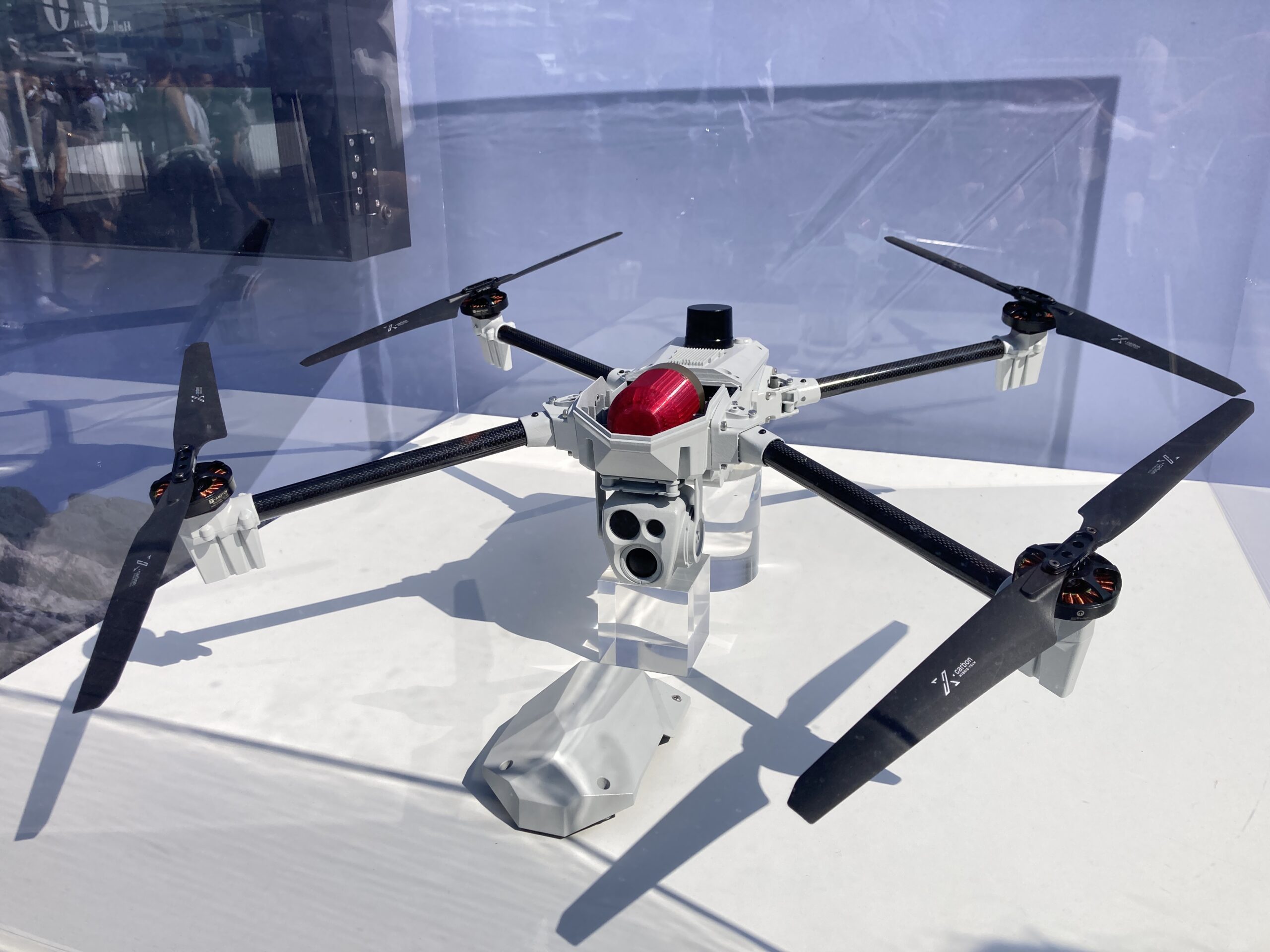
The third member of the Mataris family is the MX-10 Damocles, also developed in partnership with Delair, to neutralize infantry and light-vehicles. It is a quadcopter that carries a 550 g explosive incendiary fragmentation warhead up to 10 km (6.21 miles) with a flight endurance of 40 minutes.
Like Oskar, it has a jam-resistant data-link, provides real-time video up to impact, can navigate in a GNSS denied environment and allows the operator to abort an attack.
A contract from the DGA was signed in July 2024 for 2,270 Damocles to be delivered in tranches over the next seven years. The first, firm tranche is for 460, of which 30 will be delivered next month. But the DGA has warned that it would like 2,000 of these to be produced a year with the possibility of this rate being increased.
The fourth member of the Mataris family is the MT-10 currently being developed by KNDS on its own. It is the still-under-development system, for the moment, and looks like a small cylinder containing the 550 gram explosive incendiary charge launched by a tube. Once airborne, the cylinder deploys two sets of counter-rotative rotary wings set one above the other which allows it to travel up to 10 km for 30 minutes.
Designed for operations in both urban and open-field environments, the system can be either vehicle-mounted or carried in a backpack.
In some ways, it’s ironic that KNDS staffers are developing these weapons, as the company’s bread and butter has been exactly the kind of armored vehicles which these types of munitions are designed to destroy.
Asked about that discrepancy, one staffer at the company’s booth smiled and responded, “That’s the advantage of developing these munitions: in parallel we’re figuring out how to protect armored vehicles from them.”
PHOTOS: Paris Air Show 2025

 Gallery