
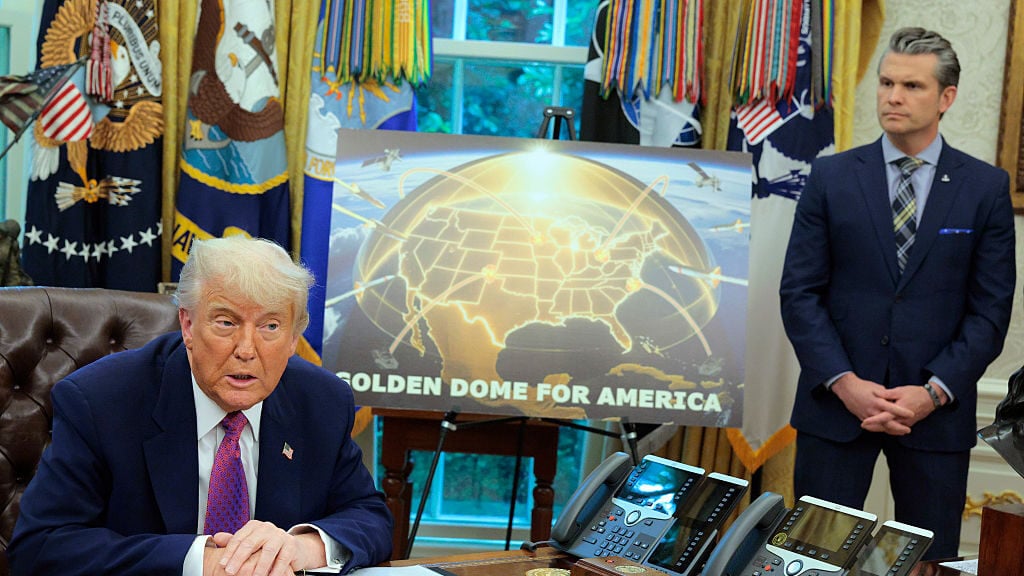
PARIS — US firms have not been shy about their desire to cash in on President Donald Trump’s Golden Dome homeland defense initiative. But ironically, companies used an international gathering — this year’s Paris Air Show — to start laying out their visions.
At forums and in interviews with Breaking Defense, industry officials stressed that while they don’t know exactly the shape of Golden Dome, themes are emerging starting with an emphasis on using existing technologies as the core of the project.
Speaking to Breaking Defense, Raytheon president Phil Jasper was direct, saying “As you build out that architecture, what we believe is, start with the fielded, battle-tested systems that are out there today.” Among the systems he noted apply to Golden Dome are platforms like NASAMS and THAAD.
“There already is, you know, significant stock held by the United States Army” with systems like THAAD, Lockheed Martin Missiles and Fire Control President Tim Cahill said during a roundtable at the air show. “So it’s not like we have to wait for production. There are assets that, if they chose, they could deploy and put in place immediately.”
Leonardo DRS President Bill Lynn echoed those comments, noting that long-running investments pioneered before Golden Dome was conceptualized could be easily pivoted to meet the need. He pointed to technologies like the company’s work with the Space Development Agency, as well as counter-UAS systems, as pieces that could be incorporated into Golden Dome by a simple rebranding.
“We’re turning those investments towards the Golden Dome focus,” Lynn said, citing the firm’s over-the-horizon radar as another example. “When we started that, nobody said ‘Golden Dome.’”
Still, existing systems won’t be enough to meet the goals laid out so far — especially the most eye-catching part of Golden Dome, the space-based interceptor.
Asked whether his firm is interested in developing a space-based interceptor, Tom Laliberty, Raytheon’s president of Land & Air Defense Systems, said in a media roundtable, “there are some things that we’re working on that I shouldn’t talk about here.” (When it was noted that wasn’t a “no,” Laliberty smiled and said, “Not a ‘no.’”)
Asked the same question, Lockheed President of Rotary and Mission Systems Stephanie Hill quickly and directly replied: “Yes.”
A Focus On Integration
While it’s not clear how much of its kit will end up in Golden Dome, Lockheed executives were open about their broader pitch: Let the world’s largest defense firm, one used to working with other companies, take the lead on integration.
“The integration is going to be the key, and that’s something that Lockheed Martin does every day. That’s what we do,” Cahill said during the roundtable, where he was joined by Hill. “This is a natural for us. So we’re excited about what the opportunities are going to be and look forward to supporting the United States government to achieve its aims.”
Hill pointed to systems such as the company’s Air6500 effort for Australia as a model that could work as an open-systems architecture that others could plug into.
“The most important thing is going to be that we establish an open architecture, the right architecture, and it has to be completely open in order to be able to ingest this capability. Because if it’s not, the integration is going to take too long, and it won’t be as effective,” she said.
Laliberty also said that open architecture was likely to be necessary for Golden Dome to work, but stopped short of pitching his firm for the lead integrator role.
Instead, he noted that multiple weapon systems are interoperable thanks to data links, such as Link 16, so “they’re all inherently able to participate in these kinds of networks. … We very much have a mind towards open architecture, and a very open mind towards working with additional players in the defense industry as more and more players come on.”
And though newer defense tech firms like Anduril, Palantir and Elon Musk’s SpaceX are reportedly frontrunners for Golden Dome, Jasper emphasized that the entirety of American industry spanning startups to legacy primes will be needed to make the project a reality.
“In order to fully build out Golden Dome, it’s going to require commercial companies, non-traditional defense companies, traditional defense companies, primes, subs,” he said. “I mean, it’s going to require everybody for this to be successful.”
Added Lockheed’s Hill, “We’re engaging partners to bring the right solution at speed for our nation. I think that Palantir and Anduril and others like them are going to play a role in Golden Dome. As I said, it’s going to be, kind of, all of industry in there.”
Many Questions Remain
The industry executives were all in alignment in another way: They all agreed that more information is needed before Golden Dome can kick into high gear.
“I think it’s early yet on Golden Dome,” Jasper said. Pointing to industry days that have been cancelled by the Missile Defense Agency, he added, “I think that’s just because everybody’s still trying to feel their way through this in terms of, how do we do it?”
Some of the project’s murkiness likely stems from budget uncertainty. The first $25 billion down payment for the $175 billion Golden Dome is supposed to come from Trump’s reconciliation megabill. Bureaucratic turf wars likely played a role too, where the Space Force — as opposed to the Missile Defense Agency (MDA) — appears to have won out in not only helming the project, but also overseeing a key feature in the development of space-based interceptors.
“They have not formally or informally told us what the structure might be,” Cahill said. “They’re laying out the organization, and they’re going to let us all know what it looks like.”
Still, MDA will serve a prominent role, and appears to be charged with managing the contract vehicle that could make Golden Dome a reality. Called the Scalable Homeland Innovative Enterprise Layered Defense, or SHIELD, the $151 billion 10-year indefinite delivery, indefinite quantity contract calls for fielding “an advanced, multi-domain defense system” capable of handling all types of airborne threats, according to a pre-solicitation notice issued by MDA in May.
Even with the announcement of the SHIELD effort, industry doesn’t seem certain the contract vehicle will ultimately be what’s used to deliver Golden Dome.
“The question is, is that actually going to be the vehicle that they use?” Hill said. “We don’t know.”
When he announced plans for the air defense shield in May, Trump also set an ambitious timeline: just three years for the system to be operational. It’s something many analysts are skeptical about, but unsurprisingly, industry was not looking to criticize or question that possibility.
Asked about whether Trump’s timeline is feasible, Hill once again pointed to the need for set requirements. But after that?
“And once we get that, that’s a question that will be better answered. I think the question that you’re asking about, can you do it in three years? Absolutely.”