
WARSAW — As DSEI gets underway in London, a number of European firms are still watching the ink dry on new agreements with Polish firms inked in the last week.
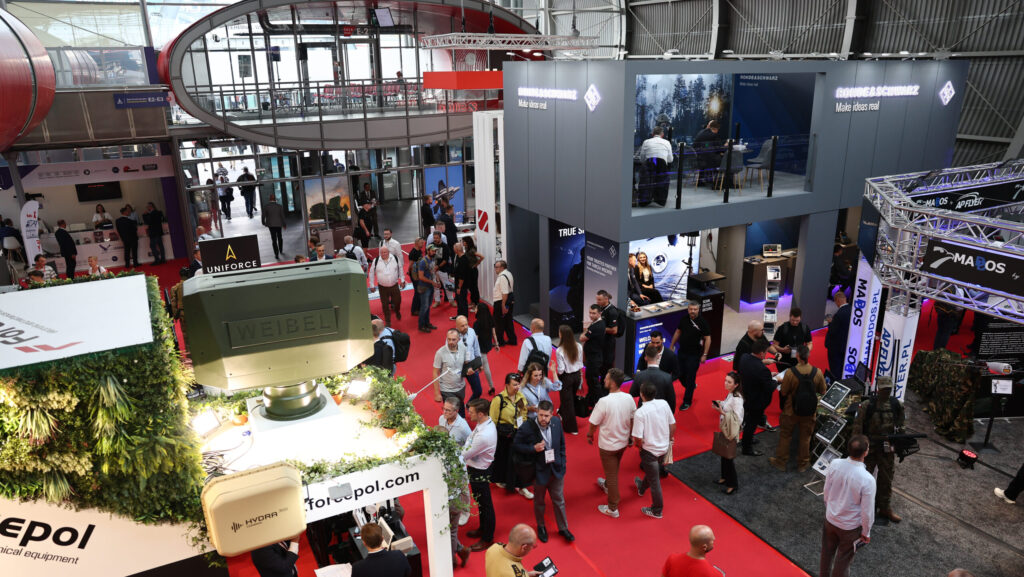
This year’s International Defence Industry Exhibition (MSPO) in Poland saw a number of firms from the host country signing teaming agreements with foreign industry. It’s a sign that Poland remains a major target for defense firms hoping to cash in on Europe’s increased defense spending, and also a sign that the government’s desire for “Polonization” is being heard loud and clear.
“We are becoming increasingly self-reliant in defense manufacturing. We are not just purchasing weapons, but bringing production to Poland,” Deputy Prime Minister and Minister of National Defence Władysław Kosiniak-Kamysz said during one such signing ceremony.
“We are not only purchasing abroad, but thanks to these contracts, we are bringing production to Poland. We are producing more and more in Poland, and Polish private companies will experience significant growth. I will support both public and private industry in promoting security,” he added.
Here are a few of the most notable agreements signed during last week’s show.
WB Group and Hanwha Team On Missiles
WB Group made a splash when it announced the creation of a joint venture with South Korean giant Hanwha, to produce missiles for the K239 Chunmoo multiple launch rocket system.
Known as HOMAR-K in Poland, the Chunmoo will now be armed with indigenously procured CGR-080 missiles through the joint venture.
WB Group is a major manufacturer and supplier of defense electronics and C4ISR systems, and is especially known for its UAVs. It has branches in the US, India and notably, in 2025, began production of its FlyEye UAV at one of WB Ukraina’s plants.
The agreement was signed by Jaeil Son, president and CEO of Hanwha Aerospace, and Piotr Wojciechowski, president of WB Group. To underline the importance, they were joined by Poland’s Kosiniak-Kamysz, Deputy Minister and Secretary of State at the MND Paweł Bejda, the head of the MND’s Armament Agency, Brig. Gen. Artur Kuptel as well as Hyunki Cho, Vice Minister of South Korea National Defense, and Guckcheol Bang, vice minister of the Defense Acquisition Program Administration (DAPA).
“This is arguably the most important event of this year’s MSPO. We are gaining the capability to produce missiles for the Homar-K launchers. It’s a milestone,” Kosiniak-Kamysz during the ceremony.
Known as Hanwha WB Advanced Systems, the joint venture will create approximately 250 jobs in Poland, alongside a phased technology transfer program, supported by a quality management system and workforce training. Additionally, the company will develop —in line with Polish defense procurement rules and Republic of Korea export control regulations — a roadmap for new rocket types adapted to the future needs of Poland and allied nations.
Initial serial production of CGR-080 missiles, described by the Koreans as a “next-generation ammunition” with an estimated range of approximately 80 KM, is expected to ramp up progressively and reach an advanced stage before the end of 2028.
“This is a significant investment. The plant’s construction costs exceed zł1 billion ($275 million). The investment will create new jobs and introduce a range of technologies. The joint venture is being developed on a partnership basis, and as partners, we will jointly implement projects,” Wojciechowski, the WB Group CEO, told Breaking Defense.
“The goal is to increase security, as the missiles will be manufactured domestically. The ammunition will be produced entirely in Poland, involving not only the WB Group but also a large number of local entities. The project also includes the development and implementation of new missiles, aligned with the needs of the Poland’s Ministry of National Defense,” he added.
Later the same day WB Group announced it signed an agreement with Saab, in the presence of Peter Sandwall, State Secretary to Sweden’s Minister for Defense Pål Jonson. The two companies aim to explore potential cooperation in areas including UAV systems, naval solutions and border protection systems.
WB Group also announced a cooperation agreement signed with Polish Armaments Group (PGZ), formalizing the long-standing relationship between the largest state-owned and largest private entity in the security sector. The document was signed by Piotr Wojciechowski and Adam Leszkiewicz, CEO of the PGZ. This agreement will lay the foundation for future industrial and technological cooperation in a more coherent and strategic form.
GE Engines
GE Aerospace and the Military University of Technology (Wojskowa Akademia Techniczna, WAT) in Warsaw signed a Memorandum of Understanding (MoU) on the first day of MSPO, to discuss opportunities to expand engine training and education to the F110-GE-129 engine that powers Boeing’s F-15EX fighter jet and the establishment of an Aircraft Engine Additive Manufacturing Laboratory in WAT.
“As Poland determines its next-generation fighter jets and their engines, GE Aerospace wants to be ready to help train the technicians and military personnel on our advanced F110 engines that power Boeing’s F-15EX fighter jet,” said Scott Keating, Regional VP/GM Sales, Business Development Europe at GE Aerospace. “This MOU agreement with the WAT will ensure our training readiness as well as enable WAT to benefit from GE Aerospace’s deep domain experience with Additive Manufacturing as they work to grow these capabilities in Poland.”
GE Aerospace and WAT are already collaborating on the AH-64E Apache offset program, and under the signed agreement, they intend to expand this partnership. If the newest agreement is finalized, GE Aerospace will provide course material and training on the F110-GE-129 engine to WAT and work together to develop training curriculum on the engine.
PGZ Goes Fishing With Fincantieri And Naval Group
Fincantieri and PGZ signed an MoU, broadly on modernization, under which both companies will explore joint opportunities in the design, construction, and through-life support of advanced naval platforms, including on the Orka submarine acquisition program.
Together, they aim to develop joint opportunities not only for the Polish Navy but also in broader international markets.
“Poland is a key strategic partner for Fincantieri, and we are proud to contribute to the country’s ambitious naval modernization plans,” said Pierroberto Folgiero, CEO and Managing Director of Fincantieri. “With a legacy of more than 180 submarines built and a proven track record in advanced naval platforms, we bring unparalleled expertise to support the Orka program and to develop a long-term industrial cooperation with PGZ and the national defense industry.”
Naval Group also reached an agreement with PGZ, signing an Industrial Cooperation Agreement focused on advanced manufacturing related to the construction of submarines and other highly specialized vessels — with the potential for Polish industry to become part of Naval Group’s broader supply chain.
French Ammo Production On The Table
KNDS France announced that it is offering Poland the opportunity to reach a production of 200,000 155mm shells per year, and is considering a partnership with PGZ. Both companies have been engaged in discussions for the past two years over the deal.
The KNDS proposal would enable a broad transfer of intellectual property to Polish industry, under which PGZ and its subsidiaries (Mesko, Nitro-Chem, Dezamet, Gamrat) would focus on producing existing designs rather than creating new ones. According to KNDS France, Poland could reach full production capacity in less than three years.
Northrop and the E-2D
Poland has been a priority target for American defense firm Northrop Grumman for several years, and the company used the show to sign a new MoU with Wojskowe Zakłady Lotnicze No. 2 S.A. for future cooperation on the E-2D Hawkeye early warning and command aircraft. It also provides a framework for cooperation in knowledge transfer, workforce development, and future joint technological initiatives.
The MoU was signed by, among others, Jane Bishop, Quinn Canole and Krzysztof Krystowski on behalf of Northrop Grumman and Jakub Gazda, CEO of WZL2 and WZL2 board member Zbigniew Matuszczak.
“We are extremely pleased and honored to be collaborating with such a technologically advanced partner. We are aware of the broad spectrum of projects Northrop Grumman offers. We may be starting with just one, but we hope that in subsequent iterations of our meetings, work that has been taking place regularly for some time now, we will also develop specific actions that will allow WZL2 to develop even faster,” said Gazda.
“We believe WZL2 is the most suitable partner for us in the E-2D early warning and reconnaissance aircraft program, which we are proposing for Poland,” Krystowski said. “If Poland decides to purchase the E-2D aircraft, its integration with Integrated Battle Command System (IBCS) will improve Polish defence capabilities also in the field of ground based defence.” The IBCS is a Northrop-designed system already purchased by Poland.
Northrop Grumman representatives emphasized that WZL2 has extensive experience in the aviation field, making them an ideal partner for potential repairs, modernization, and even component production for the E-2D.
Collaboration in the field of unmanned aerial vehicles is also being considered, and it’s possible there may be some synergies to be found on the F-35, of which Poland is a purchaser and Northrop a supplier.
Airbus and PGZ
In an attempt to entice Poland to buy its H145M training and multirole helicopters, Airbus Helicopters signed a cooperation agreement with the country’s largest defense contractor PGZ and several of its affiliates, dedicated to local maintenance services.
Under the agreement, the two companies will “establish a framework” for the company, PGZ and Poland’s state-owned research and development firm ITWL to “collaborate on the maintenance and completion of the H145M at WZL1, integrating Polish capabilities” on the twin-engine rotorcraft. Additionally, the move will develop “new, sovereign defense capabilities for the Polish Armed Forces,” added Airbus.
Future Task Force
Outside of its big foreign announcements, WB Group also prepared an internal pitch before the fair, outlining their Future Task Force plan. Although it hasn’t been approved by the government, the plan covers the new structure of the general-military battalion of the Polish Armed Forces, allowing for “preparation for the nature of conflicts, not just those that have occurred, but also those that will occur” and take into account the experience of the war in Ukraine.
Under WB Group’s plan, the military would develop an unmanned-manned platoon, consisting of a command vehicle and three manned-unmanned combat vehicles: Warmate-TL reconnaissance-attack loitering munitions launchers, ZMU-05 remotely controlled weapon station with machine guns and optional anti-tank missiles, and an automated mine-laying system (BAOBAB-K module / MN-123 mines or equivalent). All FTF elements are integrated via a national, low-emission, encrypted communications system including elements manufactured by the WB Group (U-GATE personal Command and Surveillance System with Perad tactical MANET radios and Topaz Integrated Combat Management System), operating both via Warmate/Flyeye/FT-5 UAV signal retransmission and using fiber optics and a MESH network, with ability to switch to “stand-by” mode with limited connectivity.
Situational awareness would be provided via WB Group’s EYEQ — a C4ISR system using artificial intelligence algorithms. It is used to recognize, identify, and assess threats in real time on a multi-domain, network-centric battlefield and supports targeting processes based on defined Rules of Engagement.