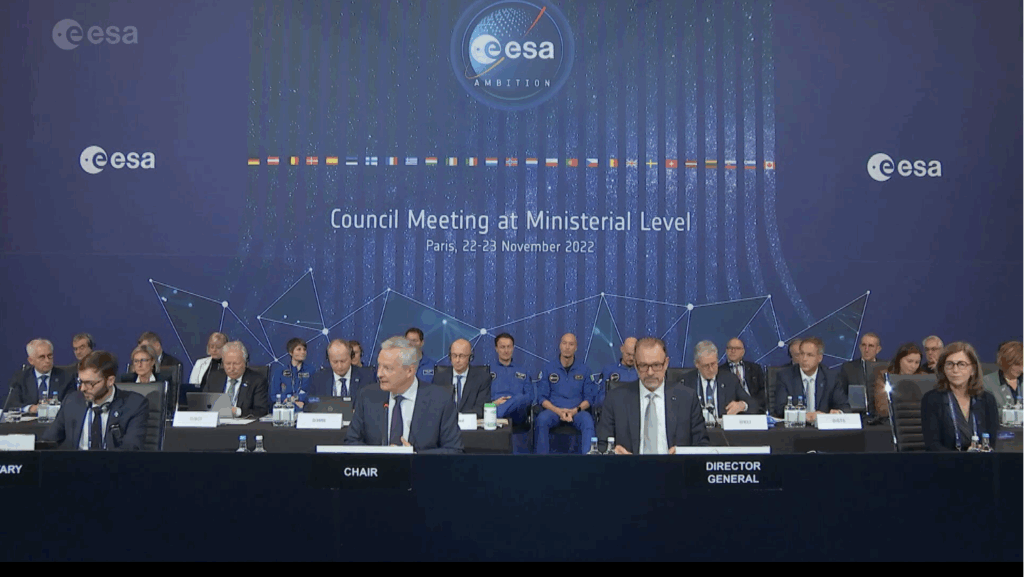
WASHINGTON — The Nov. 26-27 meeting of the European Space Agency’s (ESA) Council of Ministers is shaping up to be a watershed moment, with senior space officials from the 23 member states set to vote on a package of projects explicitly designed to bolster Europe’s defense capabilities.
If the proposal from ESA Director Josef Aschbacher is approved, it would be a historic first — since its founding in 1975 the agency has assiduously disavowed any connection to military space activities, instead insisting on a strictly civil mission.
“In a nutshell, there is a general wake-up call in Europe after the war in Ukraine for the need for more autonomy. Countries are investing more in defense (NATO, etc.) and as part of it in space,” one European space official told Breaking Defense. “[T]here is a shift towards security activities triggered by the new U.S. policies and their impact in Europe.”
In particular, the ESA ministerial meeting will debate Aschbacher’s proposal to slate €1 billion ($1.1 billion) for a basket of preliminary activities supporting a fledgling European Union initiative to develop a constellation of electro-optical and radar intelligence, surveillance and reconnaissance (ISR) satellites.
ESA is independent from the 27-member EU; not all members of ESA are members of the EU and vice versa. For example, the United Kingdom is an ESA member despite having withdrawn from the EU in 2020, and Canada is an associate member participating in some projects.
Called the European Resilience from Space (ERS) program, Aschbacher’s proposed initiative would represent a first tranche of activities to support the Earth Observation Governmental Service (EOGS), according to an Oct. 28 ESA press release following the Space for European Resilience conference in Brussels.
The EOGS is being proposed for funding by the European Commission, the executive branch of the EU, and the union’s ruling council of ministers will vote during its Dec. 18-19 meeting on whether to include the effort as part of its three-year EU Multiannual Financial Framework.
The project is expected to be approved, especially given that on Oct. 23 the EU Council approved a new five-year plan for building up defense capabilities, called Preserving Peace — Defence Readiness Roadmap 2030, that includes the development of a “European Space Shield” among its four pillars.
“In this moment of rapid change, there is a critical need to synchronise European initiatives by aligning space for defence competencies, avoiding duplication and pooling resources for scale,” Aschbacher told the Space for European Resilience conference, sponsored by the EU, ESA and the European Space Policy Institute. “We still remain too fragmented to guarantee Europe with genuine, comprehensive and autonomous space resilience. We have an opportunity to change that, and we must.”
Ashbacher first revealed the fledgling ERS plan on May 14 during the Cysat 2025 conference in Paris. In particular, he stressed at the time that the effort is being put together “hand in hand” with the European Commissioner for Defence and Space Andrius Kubilius.
“This new initiative … is not just another initiative,” he said. “It is a response. It is also forward looking. It is a capability, a European vision of strategic resilience.”
ESA has been supporting other EU space projects that inherently have dual civil and military use cases, including the flagship project to build a Starlink-like satellite communications and internet network in low Earth orbit, called Infrastructure for Resilience, Interconnectivity and Security by Satellite, or IRIS2.
An ESA spokesperson told Breaking Defense that the agency also has granted “over 350 contracts involving more than 300 economic operators (industry, research centres, academia),” under the Navigation Innovation and Support Program (NAVISP), designed to continue development of technologies for independent European positioning, navigation and timing capabilities.
“The total value of the projects has been €330 million ($382 million), including €75 million ($87 million) funding from industry,” the spokesperson said.
In a handful of speeches over the past six months, Anschbacher has been promoting the ERS plan while providing few details — but also has stressed that individual ESA member states may choose whether or not to participate. Further, he has reiterated that it is not ESA’s intent to operate any future military satellites.
“I want to be clear that I am not at all suggesting a Europeanisation of space for defence across the board. ESA will never replace national efforts or sovereign capabilities. Key space capabilities for security should absolutely remain under national control,” he told the Brussels conference.
“However, ESA can play a vital role through a pooling and sharing model, where each contributor retains full control of their systems while benefiting from others’ excess capacity, and vice-versa,” he added.
The European space official said that just exactly how ESA and member states would be involved remains to be determined.
“[W]e will have a role certainly at technical level (design, development, etc.) but the system will belong to the EU,” the official stressed.
Thus, it is the EU, if it signs off on the new constellation, that will set requirements — requirements that ESA member countries may or may not decide to support.
Further, the official added, nothing is certain until the ERS program is “approved and funded and the governance defined” at the ESA ministerial meeting.