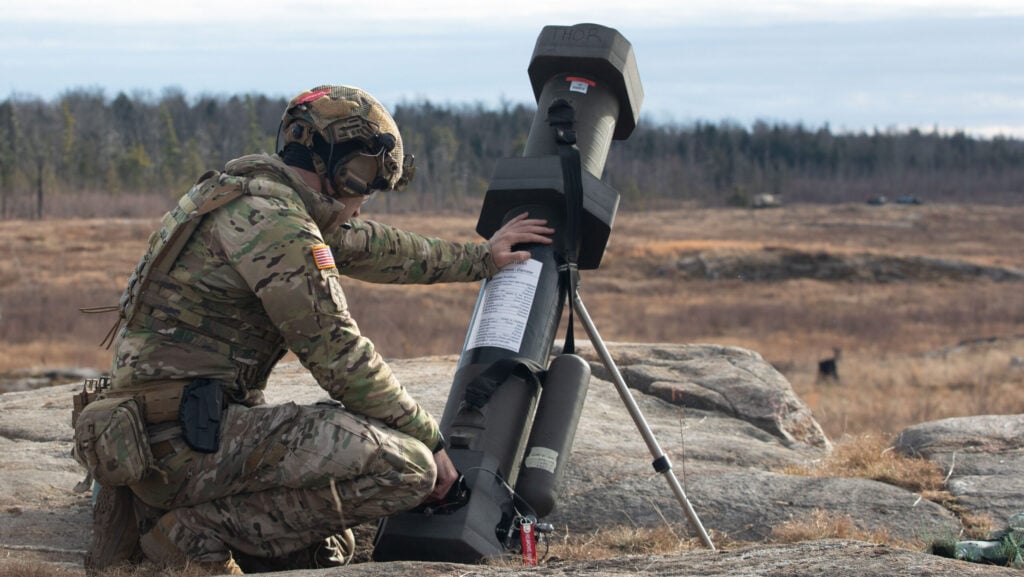
JERUSALEM — A recent, nearly $1 billion contract between the Army and a team-up of Israeli firm Uvision and US-based Mistral Inc. for loitering munitions is, Uvision hopes, the beginning of a longer-term relationship under the service’s Low Altitude Stalking and Strike Ordnance (LASSO) program.
The Uvision-made Hero 120 loitering munition “is combat-proven and fielded, and we take those lessons learned around the world and they get fed back into the system and we continuously to improve the capabilities, and we are uniquely positioned as Army moves forward to meet them,” Jarmin Blanton, vice president of Business Development, Sales and Marketing at Uvision, said in an interview.
The company announced on Oct. 3 it and Mistral had won a multi-year $982 million Indefinite Delivery, Indefinite Quantity contract “to procure, field, train and sustain” the HERO 120 under the Army’s Lethal Unmanned System program. But Blanton said the company thinks the drone would be a good fit for the LASSO program, which he said would make it a more permanent feature of US Army operations in the future.
LASSO is run out of Program Executive Office — Soldier, which in 2023 described it as a “man-portable, tube launched, lethal payload munition, unmanned aerial system.”
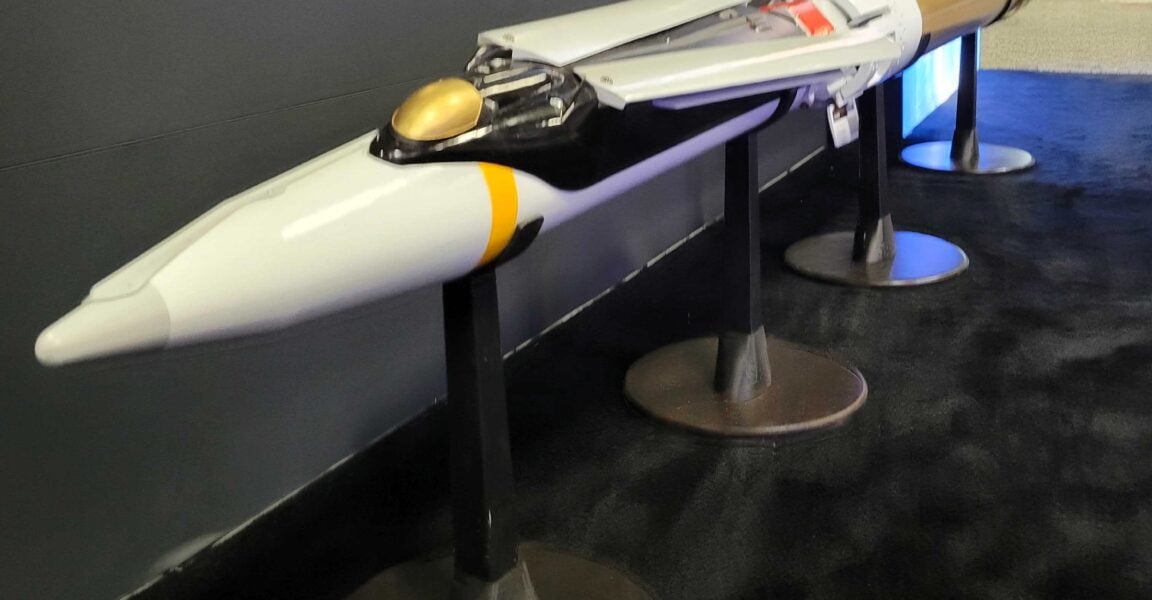
The Hero-120 was previously acquired by US Special Operations Command (SOCOM) in a $73 million deal with Mistral and Uvision in 2024. The company says the munition, which is shaped like a missile with a cruciform wing that deploys after it is launched, uses a 4.5 kg (nearly 10 pound) warhead and has a range of around 40 to 60 km (25 to 37 miles) and 60 minutes of loitering time. The company describes Hero 120 in a statement as a “mid-range loitering munition optimized for precision engagement of armored and high-value targets.”
Blanton described the munition as “a soldier-portable munition to defeat tanks, and other targets; for the infantry battalion and brigade level for Infantry Brigade Combat Teams (IBCT).”
Ran Gozali, CEO of Uvision Group, noted in the company’s Oct. 3 announcement that “this award reflects the growing demand for loitering munitions and validates the operational value of the HERO 120 and the HERO family of systems.”
The award to Mistral and Uvision follows a prior, also nearly $1 billion award for loitering munitions from AeroVironment for its Switchblade platform — an award Mistral had protested.
The Army is in the midst of an aggressive push for unmanned systems, including loitering munitions, after seeing the tactics’ lethality on the battlefields of Ukraine.
As such, Blanton said Uvision expects to start delivering the platform to the Army at the “beginning” of 2026, “and the systems will then go out to infantry brigade combat teams and deliver hardware and training and logistics and support.”
But the platform is not a static one. Blanton said Hero 120 is “combat proven and fielded, and we take those lessons learned around the world and they get fed back into the system and we continuously to improve the capabilities and we are uniquely positioned as army moves forward to meet them,” Blanton said.
Like other Israeli systems, the Uvision family of systems seeks to be modular and plug-and-play. Blanton says the system is “agnostic to radio, warhead and launcher. We listen to where the customer wants us to go and partner to make our supply chain more robust … our system is composed of American technology and an American supply chain.”
Changes are also dictated by the modern battlefield. Blanton said that one issue is working in GPS-denied environments or contested environments, meaning places where adversaries might have air defenses or ways to stop modern munitions. Another issue for these types of weapons is swarming technology.
“We are working on collaborative behaviors and more robust [systems] less susceptible to jamming and interference and making systems modular and plug-and-play so you can adapt when the adversary changes,” he said.
PHOTOS: AUSA 2025
 Gallery