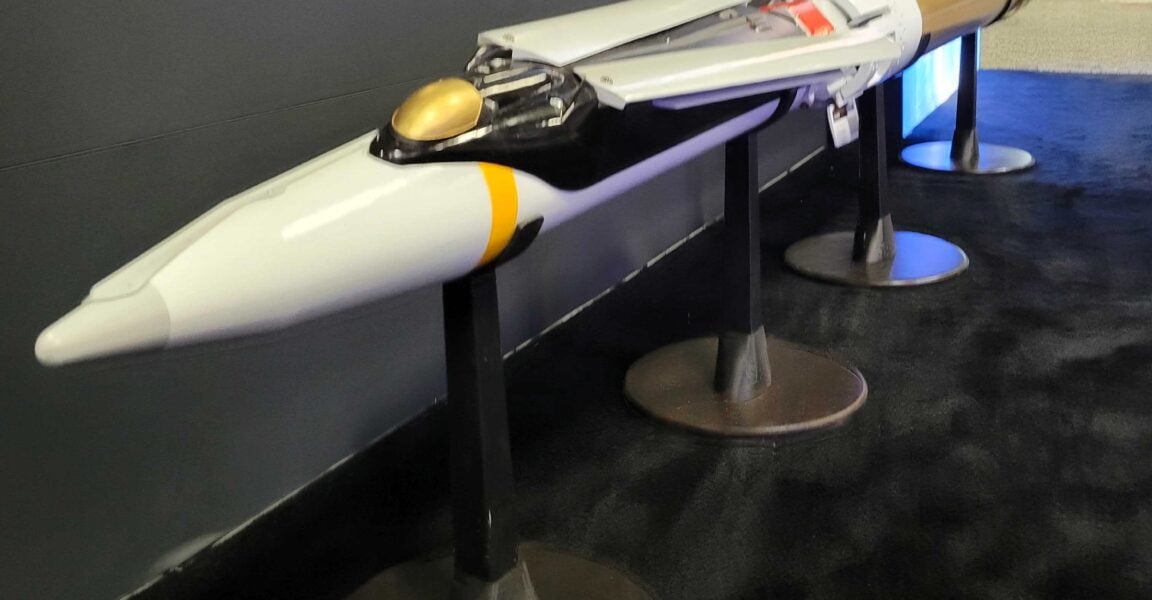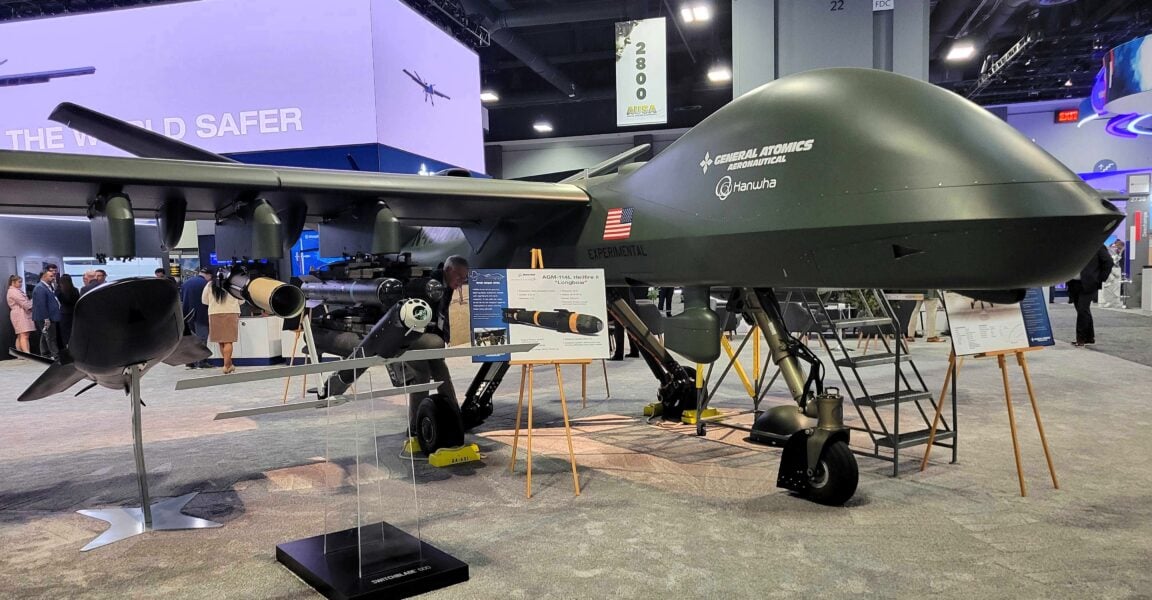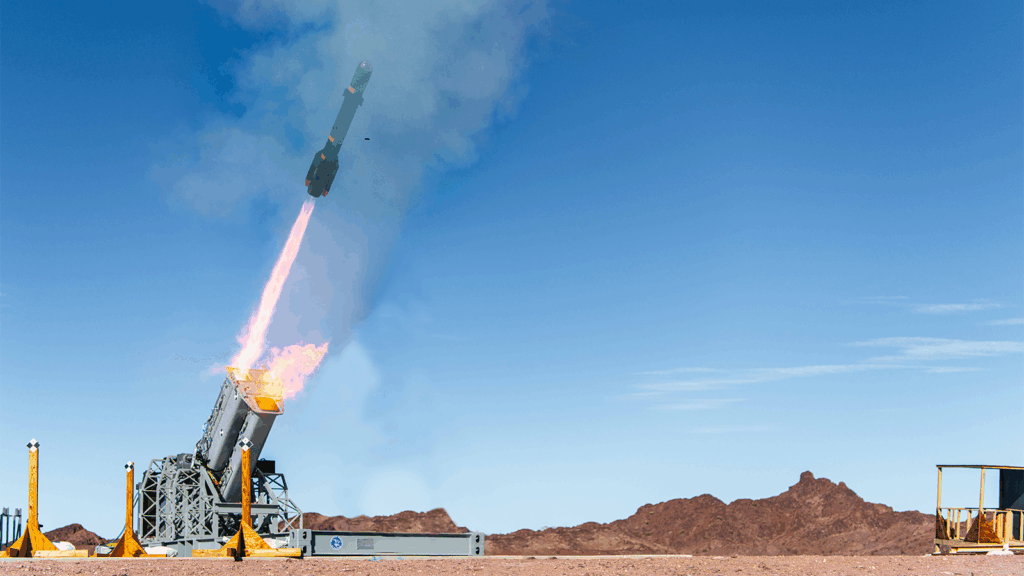
AUSA 2025 — Lockheed Martin has test-fired its widely used Joint Air-to-Ground Missile from a new quad-pack launcher designed to fire the JAGM straight up, the company announced today.
Lockheed executives are optimistic their new JAGM Quad Launcher (JQL, pronounced “jackal”) will open up new sales in the rapidly growing counter-drone market, especially for naval forces, they said. At an average of $212,000 per missile (as of 2022 figures), JAGM is admittedly too expensive to efficiently counter large swarms of small drones, the execs acknowledged. But it’s still a lot cheaper than a Patriot, SM-6 or other high-performance interceptors, so they think it should readily find a niche, especially against mid-size drones. (Firing off a JAGM is also cheaper than repairing or outright replacing a naval patrol vessel, for example, after it was hit by a drone).
“JAGM [is] another arrow in the quiver for our customers,” said Casey Walsh, Lockheed’s director of multi-domain missile systems. “In this case, [we’re] targeting naval defense, ship defense for counter-UAS, as a primary market space for this JQL product.”
“There’s a lot of requirements floating around for counter-UAS needs on different US platforms,” added Lockheed’s launch systems director, Edward Dobeck. “Quite frankly, there has been a lot of interest in the international communities that have some of the smaller vessels,” which can’t carry full-size anti-missile systems.
JQL’s first live fire, at the Army’s Yuma Proving Ground in Arizona on Aug. 28, was only at a 45 degree angle and hit a stationary, decommissioned tank, Dobeck said. Another live fire is scheduled for November, this time against a drone in flight, and the company told reporters that it’s already in talks with potential customers.
“But in China Lake, where we are doing the November shot, it’ll be a UAV that we that we target,” Dobeck continued — and the launcher will fire straight up.
The Army has already successfully hit a drone with JAGM, along with several other types of missiles fired by AH-64 Apaches, in a recent demonstration at Marine Corps Air Station New River in North Carolina. That itself is a significant achievement for a missile originally designed first and foremost as a tank-killer.
But the horizontal launch rails used on helicopters and other ground-attack aircraft aren’t ideal for warships and ground vehicles, in part because they can only fire forward unless they’re mounted on bulky rotating turrets. Naval architects in particular prefer vertical launch systems (VLS), compact tubes that let a missile launch straight up and then rapidly veer off in any direction.
The tricky part of vertical launch is what to do with the missile’s flaming-hot exhaust, which can burn a hole in the deck if allowed to blast straight downward. Lockheed, however, has decades of experience with vertical launch systems of various sizes, notably the Navy’s mainstay Mk 41 VLS and the Army’s new Typhon MRC — both of which are built in the same Moorestown, NJ, factory as JAGM. The company uses ablative shielding, heat-resistant composites, and a form of fireproof plumbing called a “gas management system,” essentially a high-tech U-bend that diverts the hot exhaust so it shoots straight up alongside the missile itself.
Based on the test shots, Lockheed expects to make some software updates to improve JAGM’s counter-drone performance. But, it emphasizes, the missile will retain its full range of capabilities, including the ability to target moving ground vehicles and naval vessels with its dual seekers (one radar, one laser; Lockheed’s also flight-tested a third, infrared seeker). As long as the firing platform has an adequate targeting system — which isn’t guaranteed — the quad-pack JAGM should be able to take on everything from drones to tanks to ships.
PHOTOS: AUSA 2025

 Gallery