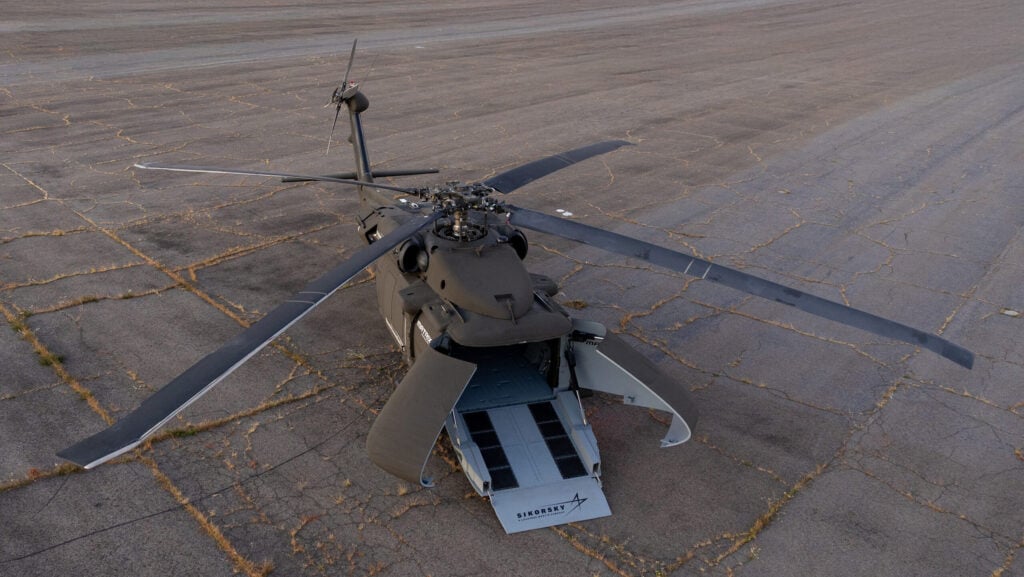
AUSA 2025 — Sikorsky today unveiled its S-70 unmanned aerial system, also called the UHawk, that takes the pilot completely out of an old Black Hawk UH-60L to turn the helo into a large drone.
There’s currently a prototype model of the new Group 5 UAS, and Sikorsky plans to begin flight testing next year, a company executive told reporters ahead of today’s announcement.
“We’re introducing our newest member to the Black Hawk family of systems,” Erskine “Ramsey” Bentley, director of strategy and business development for Sikorsky Advanced Programs, said. “Basically what we’ve done is we have taken a [UH-60L] Black Hawk, and using our MATRIX autonomy system, have turned this aircraft into a UAS.”
Bentley explained that the concept of the S70 was drawn up between Army leaders and Sikorsky executives during last year’s AUSA conference, and within a year a prototype was created with internal funds from the Lockheed subsidiary, as the aircraft is not part of a current Army requirement.
The prototype was created from an older model UH-60L that the company bought back from the Army, Bentley said. The move comes as the Army has been divesting the UH-60L models as part of the service’s larger aviation re-modernization plan.
The Army previously experimented with pilotless Black Hawks, including through a Defense Advanced Research Projects Agency program called ALIAS. But Bentley described the UHawk as an airframe modified from the ground up to take advantage of remote flight.
Sikorsky engineers have “completely redesigned” the front end of the UH-60L by putting in clamshell doors and a ramp, Bentley said, which makes “the entire cabin and cockpit area [available] for either a logistics operation or mission support operations.” This enables soldiers to be able to drive unmanned ground vehicles (UGVs) up through the front of the aircraft and then in the back of the aircraft, around 40 to 50 various launched effects capabilities can be stored in a “quiver.”
“So as the Army is conducting an air assault, you would envision the UHawk flying ahead of the soldiers. As the UHawk comes into the landing zone area first, it dispenses launched effects out of the sides of the aircraft, out of our launched effects quiver,” Bentley explained. “Then when it lands, it disembarks the UGV, and then the aircraft departs, and this is done ahead of any soldiers putting boots on the ground.”
Apart from assault missions, Bentley said the robo-helo can also conduct cargo missions, as the aircraft can fit three Joint Modular Intermodal Container (JMIC) containers and carry 7,000 pounds internally and simultaneously carry 9,000 pounds on the external cargo hook. It can fit a HIMARS pod down the center of the aircraft, he added.
In terms of how the S70 is operated, it can be controlled on a tablet via a “minimally trained” operator, Igor Cherepinsky, the director of Sikorsky Innovations, told reporters last week. Depending on the mission, the operators can determine how much control they want to have over the aircraft through the MATRIX autonomy system.
“If you tell it to go from airport A to airport B, for example, and it knows it’s in civil airspace, it will take the right routes, follow the right civil procedures. If it knows it’s a military airspace, it will do what it thinks is right for military airspace,” Cherepinsky said. “It is highly autonomous, but in some cases it may not be exactly what you want. So we’re providing this level of adjustable autonomy.”
In terms of where the S-70 goes from here, the executives said they will know more after the flight testing is completed next year. Right now, their main focus is the Army as their primary customer, but they said it can be used by other services and by civilian organizations for humanitarian missions, for example.
“We see this aircraft being used across the Army for contested logistics mission support, but also [for] international customers,” Bentley said. “We see this also in use with disaster relief and other commercial and civilian applications, like wildfire suppression.”
Looking way into the future, Cherepinsky said it’s not out of the realm of possibilities to convert the M variant of the UH-60 Black Hawk into something like the S-70 model as well.
“It all depends on the economics and price point,” he said. “Right now we’re looking at [the UH-60Ls], but who knows.”
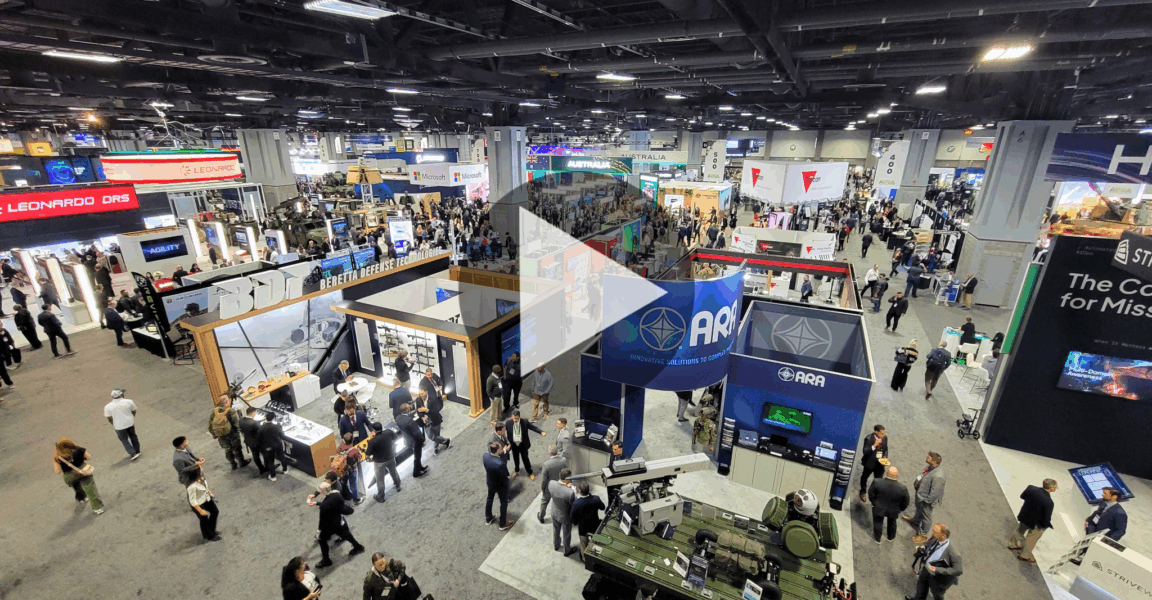
PHOTOS: AUSA 2025
 Gallery