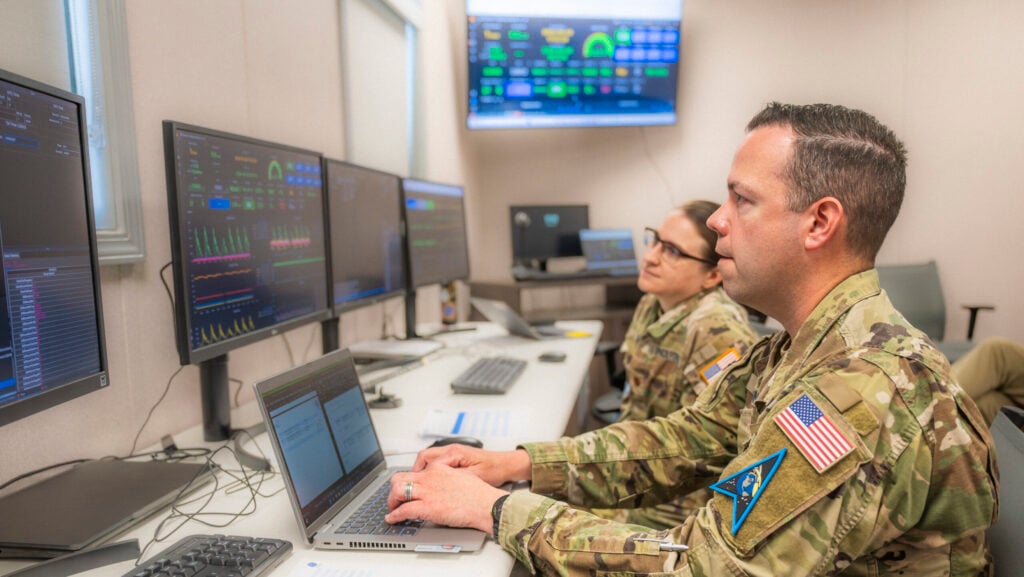
SPACEPOWER 2025 — The Space Force is putting top priority on training Guardians for fighting and winning in space, using both virtual environments and, in the future, a dedicated fleet of live satellites.
“There are two things that I want to focus on in training in my two years that I will be in command. One is orbital warfare. The adversaries desire to attack us in space from space, and they’re already practicing,” Gen. Gregory Gagnon, new(ish) commander of Combat Forces Command, told reporters on Dec. 10 during the Space Force Association’s Spacpower 2025 conference.
“The second thing that I want to practice is … Space Force integration with the Navy, the Air Force and the Army, so that we can develop the ability to support them, but also think through that warfighting in space will be part of the fight, and we will have to coordinate resources and objectives cooperatively so that the joint force wins,” he said.
Gagnon took up his post in September, at the same time the Space Force changed the the name of the former Space Operations Command (SpOC) to Combat Forces Command. The command’s job is to “is to build those forces, forces that are combat ready and ready to win,” he said.
“So I train, organize and equip forces to win in war and protect the peace,” Gagnon added. “I need to afford our operators more opportunities for orbital warfare training.
In addition, Gagnon, who comes from an intelligence background, said he intends to use his “personal time to help cyber [operators] assure our systems and our networks so that we are not at risk of any cyber vulnerabilities, because cyber is very important in space.”
Red Vs. Blue, And Synthetic Environments
During the roundtable, Gagnon bemoaned the fact that at the moment, “40 percent of my units do not have a realistic trainer in order to practice on them” despite spending “significant money” on the Operational Test and Training Infrastructure (OTTI).
At the same time, Gagnon said, the Space Systems Command (SSC) OTTI program executive officer, Col. Corey Klopstein, has made good progress acquiring hardware, necessary communications links and setting up a network operating system called Space Warfighter Operational Readiness Domain (SWORD).
The next step is for industry “to come with their virtual and constructive models” of satellites and weapon systems “that we can put inside the synthetic environment,” he said.
Further, Gagnon said that after about two and half years of work, the National Space Intelligence Center in Dayton, Ohio “has been building models of the adversaries threats so that we can play red against blue.” That work, he noted, will bear fruit for creating realistic training environments over the next year and a half.
He explained that one value of a robust virtual environment is that it allows Guardians to exercise real world scenarios against an adversary without that adversary being able to watch.
“I don’t want him to know my moves, because I want my moves to win,” he said.
Virtual environments also have the “benefit” of teaching capabilities such as jamming without disrupting commercial space operations, Gagnon said.
Live Training With Real Satellites
At the same time, he stressed that live training on actual satellites also is important.
“So one of the things in the future that we hope to have is satellites that are trainers. The Space Force we have is not the Space Force we need. We have bought the Space Force that we can have, but we have not fortified the Space Force with an entire set of training satellites. We need to do that that will build the Space Force we need,” Gagnon said.
While the Space Force already does some level of training with live satellites, for example teaching Guardians the physics of space and command and control operations, that is limited and usually involves satellites that have been repurposed after ending their operational life, according to officials at Space Operations and Training Command (STARCOM) who spoke to reporters Dec. 12 at the Spacepower conference
“We’ll call them the hand-me-downs,” said STARCOM Chief Master Sergeant Karmann-Monique Pogue.
Gen. James Smith, STARCOM commander, explained that his shop is responsible for getting troops up to speed for Combat Forces Command.
“We take the kit, the equipment from SSC, we take the Guardians off the street as civilians or whatever, we merge all that together, and we deliver combat credible space forces to Gen. Gagnon. And then he trains them in a specific weapon system, makes them ready, and then hands them off to the combat command commander,” he said.
Smith said that work is ongoing “to build a live range so that we do have satellites that can be what we would call a target satellite, or … a threat replication kind of satellite.”
But, he said, “until we have that on orbit range ready to go, we are going to have to do a lot of that in the virtual space.”
Live training, Pogue said, allows Guardians to train for unplanned operational contingencies — unlike using scripted scenarios in virtual environments and simulators.
“We’re great at training for the known, but that live [activity] allows our Guardians to train for the unknown,” she said.
Smith said that System Delta 81, the unit under the OTTI office responsible for developing training equipment for both STARCOM and Combat Forces Command, is actually building three training ranges for STARCOM: an “orbital range, an electronic warfare range and a cyber range.” (Klopstein is double hatted as the OTTI head and commander of System Delta 81.)
Each of those ranges is on a different developmental timeline and different budget, he said, but all are being stood up in increments — with new capabilities being added with each new increment.