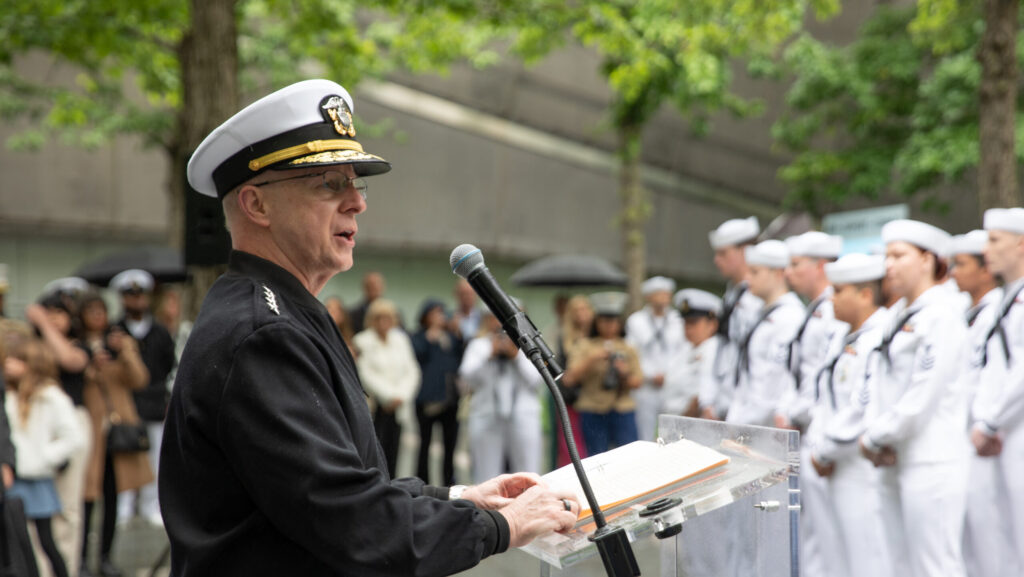
SURFACE NAVY 2026 — US defense spending needs to be rebaselined to at least 4 percent of the nation’s gross domestic product to enable the Navy to meet current readiness demands and to expand its fleet of warships to contend with future threats, its top admiral said today.
Asked how much the Navy budget needs to grow to accommodate new ship classes envisioned as part of the Golden Fleet — including the Trump-class battleship and frigate redesign — Chief of Naval Operations Adm. Daryl Caudle demurred from providing a specific dollar figure and instead spoke broadly on military spending.
“My recommendation from a military perspective is we ought to lock in a new normal, that I think kind of keeps us above 4 percent [GDP]. And we know the deterrent effect of that, and the readiness delivery of that kind of number is healthy for the United States,” he told reporters during a media roundtable today.
“I think money spent in the defense sector is good money spent,” he added. “It creates incredible jobs. It creates American security. It lets us prosper. It lets our machine work here in the United States to be most effective. Is that expensive? Yeah, it is.”
The US defense budget currently approaches $1 trillion, about 3.3 or 3.4 percent of nearly $30 trillion in GDP, according to the World Bank. Should President Donald Trump succeed in pumping an additional $500 billion into the fiscal 2027 defense budget as he recently suggested, it would make the defense budget about 5 percent GDP.
While Caudle didn’t get the specifics for any jump for the Navy’s budget, he noted that the service has maintained a fleet of about 300 ships despite a long-held congressional requirement to build up to a fleet of 355 vessels.
“We need to make a dent into that,” he said. “I think the chairman, and I think the secretary of Navy and the secretary of War agree that that the Navy needs a budget commensurate with its mission set.”
In December, Trump announced plans for the Navy’s “Golden Fleet,” which would include a new battleship class bearing his name that would be much larger and have more firepower than a next-generation successor to current destroyers, a frigate based on HII’s Legend-Class National Security Cutter used by the Coast Guard, and would also include a suite of unmanned systems.
In his speech at the Surface Navy Association’s annual conference earlier today, Caudle said Golden Fleet “is an ‘and’ initiative, not an ‘or’ wish list.”
To be able to execute those ship building projects will require a change in the way the Navy and industry do business, Caudle told reporters.
“That’s through improving supply chain, long-lead time, material purchasing, workforce, improvement with recruiting, retention and training — so all the things that we’re working on to just raise the general ability and capacity of our existing yards to do the job they need to do. But then there’s going to be some paradigm shifts with things like modularity,” he said.
Caudle said the US maritime industrial base is “at just the tip of the iceberg” on modular shipbuilding, which breaks the construction of a ship into discrete modules that are put together during final assembly. While the practice is common among some foreign shipbuilders, US shipbuilders are just starting to adapt to a modular workflow.
The US industrial base is “not completely optimized” for modular shipbuilding, but the approach could allow the Navy to bring more shipbuilders on board to helm war ships, increasing the pace of construction, Caudle said.
“Say that one of the yards down on the Gulf Coast starts building the frigate [as its prime contractor],” Caudle said. “Nothing prevents other Gulf Coast shipyards — which there are many, … I want to say that [there are] probably 20 plus — can’t be in the business of building some part or whole of a module for that frigate.”
Foreign shipbuilders could also help add capacity for naval shipbuilding needs, said Caudle, who added that he would support a reassessment of the Jones Act, the US law that requires that goods shipped between American ports must be transported on US-built vessels.
“When we know we have a workforce challenge in the United States. I think the capacity that foreign builders can bring to bear is extremely important to think about,” he said. “That might look like some auxiliary ships that we could get approval to do in totality. And it could be combat ships that could be done in part. And then, you know, we finish the combat system and the high-end sensor package and ordnance systems and all that, either in the United States or with the partner.”
Bringing in foreign shipbuilders would involve some difficulties, Caudle acknowledged.
“When you work with a foreign partner, they either have to have exquisite access to our supply system, and that’s the IT system and the infrastructure to order parts and tap our supply system, or they’re going to use their own indigenous system,” which could result in language and cultural challenges, he said.