GLOBAL FORCE 2026 — In the wake of an Army call to industry that could shake up its quest for a Bradley replacement, a senior Army official said to expect more like it as the service reviews longstanding programs in its ground vehicle portfolio.
“If you look at how quickly things are changing, from a technology perspective, who is actually interested in this defense space that is constantly evolving and changing, I think we’re doing ourselves a disservice if we only wait every five years to take a look at the market,” John Jolokai, executive director and senior contracting officer for Army Contracting Command – Detroit Arsenal, told Breaking Defense.
Last month the Army published a Request for Information from industry that sought “innovative solutions for the rapid design, production, and delivery of ground combat vehicles.” Specifically it asked for tracked vehicles with a weight at 40 to 80 tons and calls for speedy timeline with the possibility of acquiring 10 prototypes later this year with “continuous production” of up to 2,500 vehicles per year.
Though it did not mention the XM30 Mechanized Infantry Combat Vehicle program, which the service had been pursuing as a Bradley replacement, sources and analysts told Breaking Defense at the time the RFI could signal the Army’s willingness to reexamine the program and potential alternatives.
“We are actively assessing multiple, competing designs for the XM30 to foster a truly competitive environment,” Army spokesperson Maj. Pete Nguyen told Breaking Defense on Feb. 27. “We continue to look for partners who can deliver cutting-edge solutions now, not decades from now. This is a deliberate and necessary step to ensure we assess and select the best approach to deliver a world class vehicle today and into the future.”
However, a senior executive at American Rheinmetall, who along with General Dynamics Land Systems is working on the XM30 program, said he’s “not too concerned” about the RFI and said the company is on track to deliver two prototype vehicles to the Army this summer.
“I took those comments to mean the Army is always looking for alternatives and options, so I’m not too concerned, because I don’t really think there’s anybody out there who’s got a system that’s as far along as what both us and General Dynamics have spent the last several years designing,” Jim Schirmer, senior vice president of sales and marketing, told Breaking Defense at the AUSA Global Force conference ealier this week.
“So I think we’re further ahead than anybody else. So if somebody’s got something, bring it. I’m not too worried about that, but I do think the Army’s trying to find ways to do business better and faster,” he added.
An executive from GDLS told Breaking Defense that the company is also still operating business as usual and is prepared to deliver its prototypes to the Army on time as well.
Common Tactical Truck, Maybe Not So Common
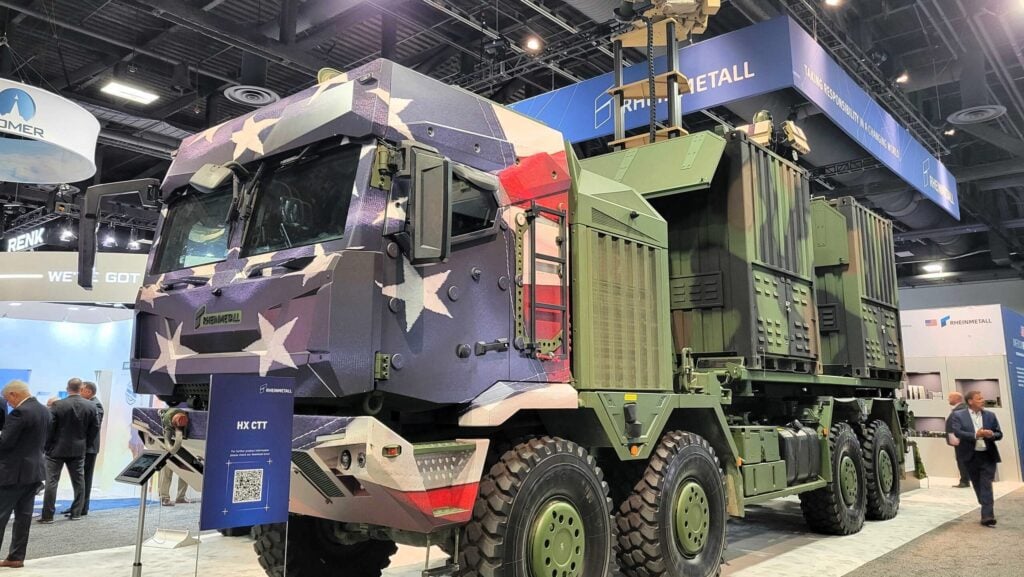
When it comes to other programs that could potentially see a reworking, Jolokai pointed to a recent commercial solutions opening (CSO) for the Army’s Common Tactical Truck program — the service’s aim at modernizing its Heavy Tactical Vehicle Fleet. According to the Army, the new CTT will replace the Palletized Load System, the Heavy Expanded Mobility Tactical Truck and the M915 Line Haul Tractor.
Previous solicitations for the CTT program were already open to finding commercial solutions, and OshKosh, Mack Defense, American Rheinmettall and Navistar Defense were awarded Other Transaction Authorities in 2023 to develop prototypes for the program. In August, the companies involved in the prototyping program told Breaking Defense that they were awaiting a final RFP from the Army. However, in September, the Army announced it would not be moving forward with the RFP, but did not provide reasoning behind the decision.
An Army spokesperson from the Capability Program Executive for Combat Logistics told Breaking Defense this week that the shift to a CSO model will speed up the CTT’s acquisition timeline.
“The Army intends to leverage commercially available solutions to deliver capabilities to the warfighter more quickly. This shift in acquisition strategy allows us to capitalize on industry strengths,” the spokesperson said in an email. “The acquisition shift will accelerate the production of CTTs, pending available funding. The timeline for fielding CTT vehicles will be coordinated across the Army enterprise.”
Further, this change in acquisition structure could also mean the Army will procure more than one type of CTT for the six different mission areas it’s looking for the truck to fulfill, which is a pivot from what the service originally asked for.
“While ideally we would have the same vendor [for] a Common Tactical Truck across all six variants, we have given ourselves room, and we’re inviting industry to tell us, ‘Hey, I really think my sweet spot are these two of the six variants, right, or this one, or all six, right?’” Jalokai said.
But awarding multiple vehicle variants may take the “common” out of the CTT, Schirmer said.
“If you want a common tactical truck that has the same engine, transmission, suspension, etc, across that family, you’re going to get more than you need for some missions in order to get enough for the ones that are the hardest. If they’re going to break that up and award different companies based on who’s optimized, it’s not going to be common. That’s okay. That’s an approach.”
Further, an acquisition notice for the program posted Thursday said that there will be “[m]ulti-vendor consideration,” and “[p]rogram quantities may be divided among multiple vendors if multiple contracts are awarded.” The notice added that the Army is looking for an initial projected quantity of 758 systems over five years, pending available funding.