PARIS — War robots took over exhibitors’ stands at the 2026 Eurosatory edition, with at least 50 unmanned ground vehicle makers in attendance and more than a dozen systems of various sizes on display.
Many of the offerings came from various European or American firms, but experts say the country at the forefront of these technologies is, without a doubt, Ukraine.
“Ukraine leads in this space because it has an invaluable three years of battlefield testing and experimentation, which in turn have enabled the development of robust tactics and dedicated organizational structures, like new units, to employ UGVs,” Federico Borsari, fellow at the Center for European Policy Analysis, told Breaking Defense.
The war-torn country recorded its largest presence at France’s largest defense trade show last week, with over 40 manufacturers participating, several of which were showing combat robots for the first time publicly.
“The kill-zone in Ukraine can be anywhere between 15 and 50 kilometers [nine to 30 miles] in some areas — people, tanks, etc. Nothing can operate and or has a high survival chance there; that’s why we rely on UGVs so much,” said Ivan Sybyriakov, senior manager of the Unmanned Systems Center at SPETS Techno Export.
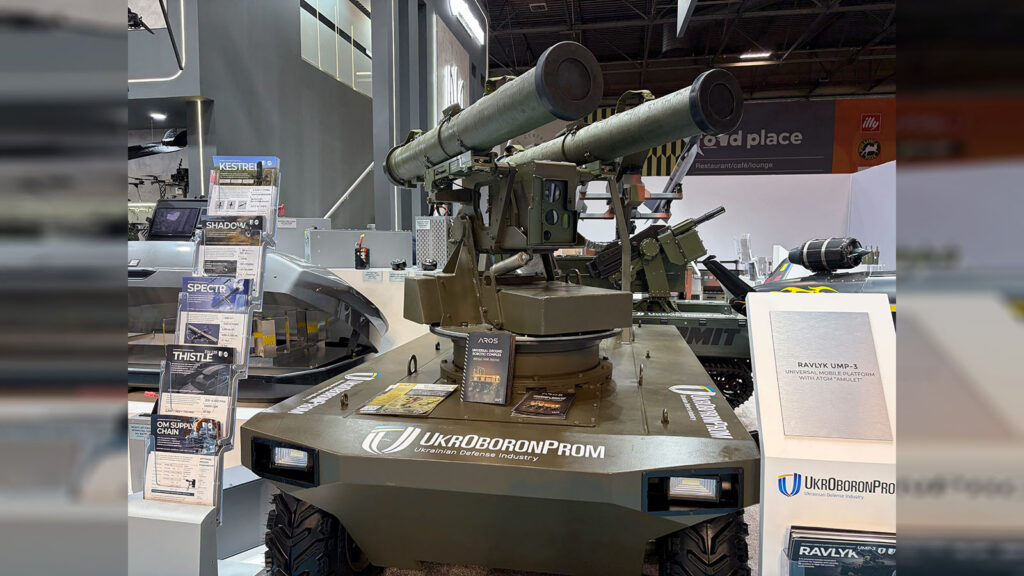
Center stage at the state-owned arms manufacturer Ukroboronprom was the Ravlyk UMP-3, armed with Ukrainian-made anti-tank guided missiles. The UGV has been in use with frontline units for nearly two years now, carrying loads of up to 200 kilograms (441 lbs), according to promotional material.
For Ukraine, which needs as many soldiers as it can to sustain its war efforts, Sybyriakov said that ground robots can transport far more equipment than would normally require several troops to carry, freeing them from direct exposure to fire and redirecting their efforts elsewhere.
Another European-made UGV to make its debut at the show was the CL2X produced by Italy’s IDV, formerly Iveco Defense Vehicles, that was acquired in March by Leonardo.
The platform, still under development, was far larger than other uncrewed ground systems on display. It was armed with Leonardo’s Hitfist 30 unmanned medium-caliber turret, designed to fire 30mm air-burst ammunition. According to the manufacturer, it has a firing rate of over 150 rounds per minute against a wide range of aerial threats, including drones and helicopters. While it does not yet have a launch customer, the company is currently exploring manned-unmanned teaming.
A newcomer was UK-based VisionWave, which debuted its Varan UGV, advertised as being designed to operate specifically in GPS-denied and jammed conditions. By relying on passive interception, that is, using cameras, thermal imaging and 3D vision for navigation, the manufacturer reports that it does not emit any detectable signal as “any emission is a targeting signature,” it said in a press release.
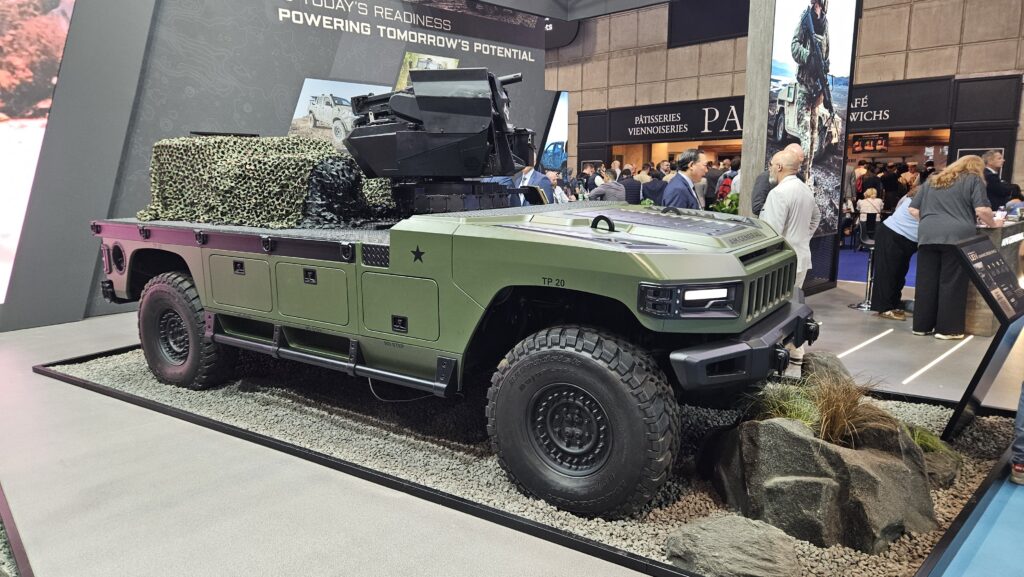
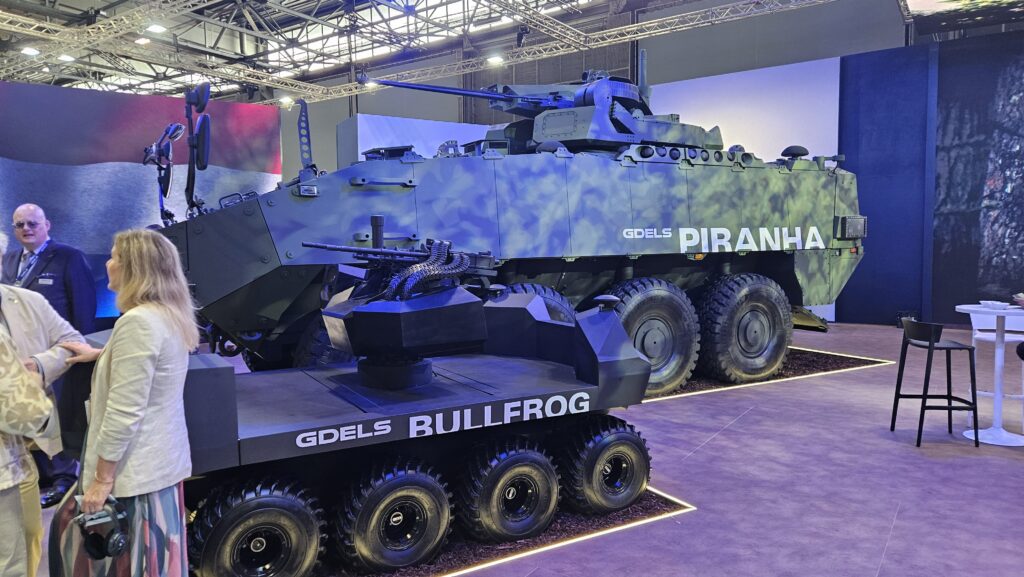
And of course larger, traditional defense firms are getting into the UGV market, including AM General, which brought an unnamed UGV to the show, as well as General Dynamics European Land Systems, which showcased the Bullfrog.
Too Much Too Soon?
While combat robots certainly appear to be proliferating at the industry level, with many companies now focusing on or offering UGVs, Borsari said that formal military adoption remains an unsettled matter.
“Their integration in meaningful numbers by militaries is not there yet,” beyond Ukraine, he said. “It’s fair to say the UGV segment is rapidly growing, but the offer clearly exceeds demand currently, where there’s a gap between what the industry proposes and the demand from forces.”
RELATED: Unmanned ground vehicles face a rare market challenge in South America: Horses
There also remain challenges to the use of these technologies. For instance, a number of manufacturers at the show told Breaking Defense that their vehicles use Starlink as one of their main communication systems. Last month, as part of NATO’s Crystal Arrow exercise in Latvia, several operators reported that Starlink-equipped UGVs would have their line of sight and signal blocked when deployed in dense forested areas, where the trees act as a natural barrier.
However, based on their presence at Eurosatory, a multitude of industry players are betting that the technical challenges will be overcome and demand will remain.