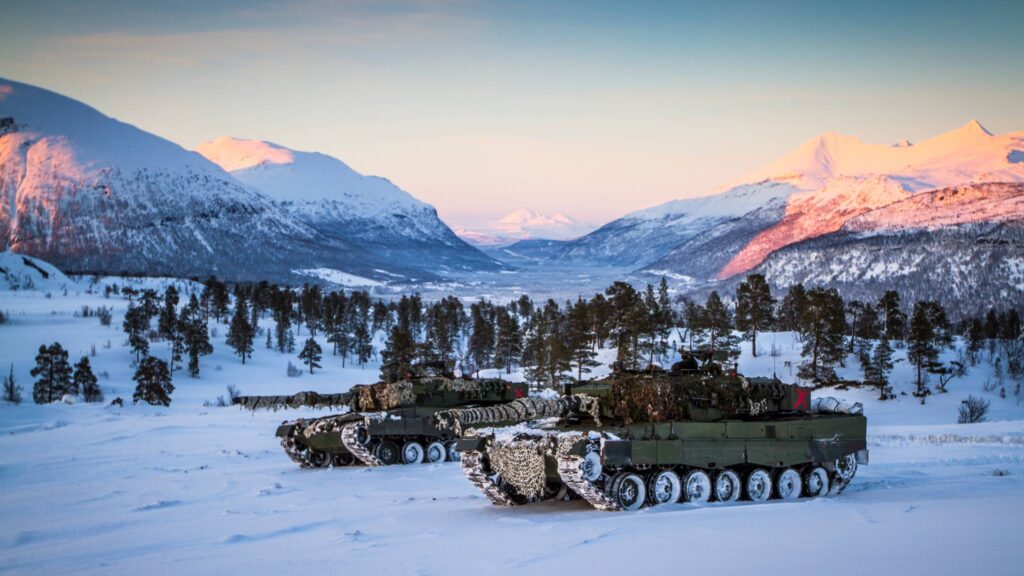
America’s allies in NATO are keen to demonstrate that they have not only heard President Donald Trump’s message on burden-shifting, but that they are working to operationalize it in practice. That is how I found myself spending a week in Norway with the Atlantic Council as part of their most recent study trip. I, along with colleagues from the Hill, federal government, and other think tanks travelled first to Oslo and onto Bergen, where Norwegian officials and private sector representatives briefed us on their country’s defense plans and preparations.
The government undoubtedly hoped that we, as participants, would walk away confident that Norway was taking its own national defense seriously and working to assume greater responsibility for military matters within NATO. And indeed, we did. Norway is a stalwart ally, having been a founding member of the alliance, and today sets a high bar for the contribution to the defense and deterrence mission.
However, in demonstrating Norway’s preparedness and shouldering of the burden, officials also unintentionally highlighted the sheer breadth and depth of challenges facing the other NATO member states in the months and years ahead — member states that enjoy, if any, of Norway’s comparative advantages.
Looking ahead to the Ankara Summit, NATO delegates and national politicians would do well to focus not just on who is spending what percent of GDP on defense, but rather on the underlying challenges that will affect each country’s ability to confront the new geostrategic environment.
Political Unity
Norway, it was often remarked to us, is a small country in terms of population — just under six million — but geographically expansive. If you flip the country on a map, its northernmost point would reach to Rome. Population wise, it is largely, though not entirely homogenous, and as such has enjoyed comparably stable politics. This is not to say that there are not partisan differences (indeed, the debate about whether the country should join the European Union was top of mind), but on the matter of defense, there is near unanimity in support for increased spending.
Our delegation was welcomed into the Norwegian parliament, meeting with a former prime minister and special advisors to the leading political parties. All agreed Norway needed to spend more on the military and continue to support Ukraine; and all indicated that doing so was taken for granted across the political spectrum. There was no hedging about general support or shifting coalitions.
Contrast this with the United Kingdom, where I’m presently writing this piece. It will, possibly as soon as mid-July, have its seventh prime minister in a decade, a development that partially came about because of the government’s inability to decide how much it should spend on defense. Across the English Channel, France will hold its own elections in April 2027, ones that will see the Rassemblement National (RN) surely present a compelling challenge to the status quo. Germany will also go to the polls next year, which could see the far-right AfD take additional ground. Both the RN and AfD are skeptical of increased defense spending (and their country’s roles within NATO) and could well challenge the ability of Paris and Berlin to meet the Hague Summit’s target of five percent of GDP spending, or any increased defense spending for that matter.
Fiscal Strength
Norway enjoys an over two-trillion-dollar sovereign wealth fund, the Government Pension Fund Global, which is nearly double the size of Saudi Arabia’s more well-known Public Investment Fund.
The government is legally allowed to draw down just three percent to support the federal budget. This buffer affords Norway a measure of fiscal flexibility and a reduced sense of urgency that no other country in NATO enjoys. On defense, Oslo’s Long-term Defence Plan was already set to see it spend $167 billion between 2025 and 2036, but it announced in March of this year that it would add another $12 billion on top, easily taking it beyond 3.5% by 2035 — a decade after the Hague commitment.
Of the three largest non-American economies in NATO (France, Germany, and the UK), only Germany appears financially solvent enough to assume significant increased defense spending, and even there it is on shaky grounds. French investments are scattered across multiple domains, so it gets less depth for each euro spent. And London’s fiscal house is in shambles with a rising debt-to-GDP ratio and ballooning social welfare spending that no one yet has been willing or able to tackle.
Standardization, Interoperability, And The Defense Industrial Base
Norway’s Navy is planning for a massive overhaul. Over the next decade it will retire many of its existing classes and adopt a standardized set of just two: an ocean-going and coastal patrol class. It is also retiring the Ula-class submarines and buying the 212CD (common design) from Germany — advanced air-independent propulsion (AIP), quiet running platforms.
Norway is also buying the Type 26 anti-submarine (ASW) frigates from the UK as part of a £10 billion strategic partnership — that is, of course, if the UK has the shipyard capacity to produce hulls necessary for both countries, of which there is some doubt. The Norwegian crews of the 212CD and Type 26 will be cross-trained with German and British crews, respectively. This will make interoperability significantly easier across the NATO partner navies. For example, the 212CD will use English as the common language inside the submarines, not German or Norwegian.
Contrast this with the situation elsewhere in the alliance. I was recently told that French ground crews were not allowed to maintain Polish C-130s under French risk rules, despite the platforms being identical. At present, there are nearly 30 different variants of a main battle tank across the European members of NATO. And some 155mm rounds are electronically tethered to specific gun platforms, making them non-interoperable across allies. The US is also introducing the 6.8mm rifle round into the Army, a caliber for which there is no production line in NATO. Standardization and interoperability are crucial to not just smooth operations, but also as a core feature of deterrence — if NATO allies can swap out kit, it means they can work better, faster and more easily together, and more as one rather than 32 different members.
Standardization and interoperability do not lead to a lack of competitiveness. Ironically, it could well mean more. If Europe’s national defense industrial champions are working from the same hymn sheet, it opens larger markets within the alliance. Here, the European Union may play a useful, if unexpected role via its SAFE loan program: forcing inter-European cooperation may force interoperability in a way that NATO’s capability targets have yet to achieve.
Yet, keeping these companies churning means entering into long-term contracts, something that many governments in NATO are still reluctant to do, as we were told by Norwegian defense primes — with governments choosing instead to emphasize firms’ pursuit of shareholder value instead of sustained production capacity.
Strategic Stability
Throughout the Cold War, Norway maintained a balance of defense, deterrence and reassurance with the Soviet Union. The Kola Peninsula, where Russian bases hold the largest concentration of nuclear weapons, is just 10 kilometers from the Norwegian border. Oslo was keen to avoid that land border becoming unstable as NATO worked to secure its frontier. Today, the strategic situation is more worrying.
Tactically, Russia clearly feels secure. It only has a fraction of the troops it once had on the Kola Peninsula, with most ground forces and naval infantry deployed to support ongoing operations against Ukraine. NATO is not going to move on Kola unless war were to break out.
But strategically, Moscow’s position is much different. It is constructing facilities for an expected post-conflict repositioning of personnel and assets back to the High North. Moscow’s strategic calculus grew more complex with the addition of Sweden and Finland to NATO. While that provided NATO with strategic geographic depth, for Moscow it doubled the length of its frontier with the alliance.
The weakening of its ground forces meant that the distance between conventional conflict and potentially nuclear confrontation was much shorter, Norwegian representatives told us. As NATO aims to rearm and build out its forces, strategic stability and signaling must be kept in the back of the alliance’s mind. NATO (1) can support Ukraine (2) while re-arming, and (3) while working to ensure the risks of escalation are maintained; indeed, it must do all at the same time. The alliance is doing the first rather well, and it’s starting the second; but it’s doing very little on the third point.
With Friends Like These…
Repurposing the old quip about friends and enemies, with an ally like Norway, who needs to worry about Russia? If NATO had 32 members (yes, US included) as equally focused on defense and deterrence, and as politically capable, fiscally solvent, and thinking tactically and strategically, the path toward the alliance’s future would be as smooth as the waters around Bergen during our recent harbor tour.
Sadly, we do not have 32 Norways. We just have one. But there are lessons that other allies can and should take from Oslo that would help strengthen the alliance writ large.
Joshua C. Huminski is the Senior Vice President for National Security & Intelligence at the Center for the Study of the Presidency & Congress, a George Mason University National Security Institute Senior Fellow, and an International Fellow with the London-based Council on Geostrategy. He is currently writing a book on the future of European defense. He can be found on Twitter @joshuachuminski.