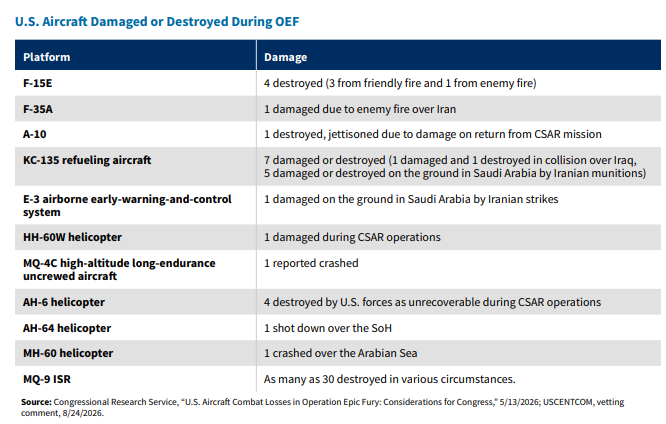
WASHINGTON — A new report by the Pentagon’s Inspector General has outlined the costs of Operation Epic Fury. Among them: “hundreds” of buildings and “dozens” of aircraft left damaged or destroyed, over 400 servicemembers wounded and the expenditure of $22 billion in munitions that has left “strategic inventory shortfalls” for the US military.
The report, released today, provides the clearest accounting of the materiel damage that has occurred to US military assets since the start of the conflict with Iran. The report only covers from the launch of military activities on Feb. 28 to June 30, meaning that damage totals will increase the next time the IG issues a similar report.
The IG cited the most recent cost estimate as $33.4 billion as of June 29. That number includes $7.4 billion in “cumulative obligations” for the operation, $22.3 billion in used munitions, and $3.7 billion in equipment losses.
That total does not include the costs of infrastructure damage, which are likely to be significant: “Iranian strikes damaged and destroyed hundreds of buildings and structures at U.S. bases in Kuwait, Bahrain, Qatar, UAE, Saudi Arabia, Iraq, Oman, and Jordan during the conflict,” per the IG report.
Last week, the Navy’s acting secretary Hung Cao said Iran “blew the hell out of” a key naval base in Bahrain, and officials have said they may not repair everything damaged from Iranian strikes.
Key operational costs include “airlift operations ($929.6 million), the Flying Hour Program ($691.1 million), mission and other ship operations ($647.7 million), base support ($405.0 million), and maneuver units ($385.3 million).”
On the personnel front, 417 service members were wounded and seven were killed during the operation.
One of the key questions surrounding Epic Fury has been the heavy use of American munitions and what impact that could have on the US stockpile. Officials, including both President Donald Trump and Defense Secretary Pete Hegseth, have pushed back on the idea that the operation is causing concerns about the stockpile depth.
The IG report appears to be the first official, public notice that DoD officials are, in fact, worried: “The Office of the Under Secretary for Acquisition and Sustainment (OUSW[A&S]) said that the munitions expenditure in OEF has resulted in strategic inventory shortfalls and revealed industrial base bottlenecks for munitions resupply.”
Those bottlenecks largely are around the slow speed of production, an industry-wide issue. A&S officials specifically called out to IG investigators “the production of solid rocket motors, the availability of high-grade explosives and propellants, and the recruitment of skilled manufacturing labor” as key issues.
Notably, the IG says that “The full OEF mission statement is classified,” at a time when White House and Pentagon leadership have taken criticism for shifting goals and rationales of the operation.
Breaking Defense Video