NATIONAL HARBOR, Md. — The Space Force plans to begin launching a new satellite constellation that can track ground targets from orbit by 2028, according to a top service official.
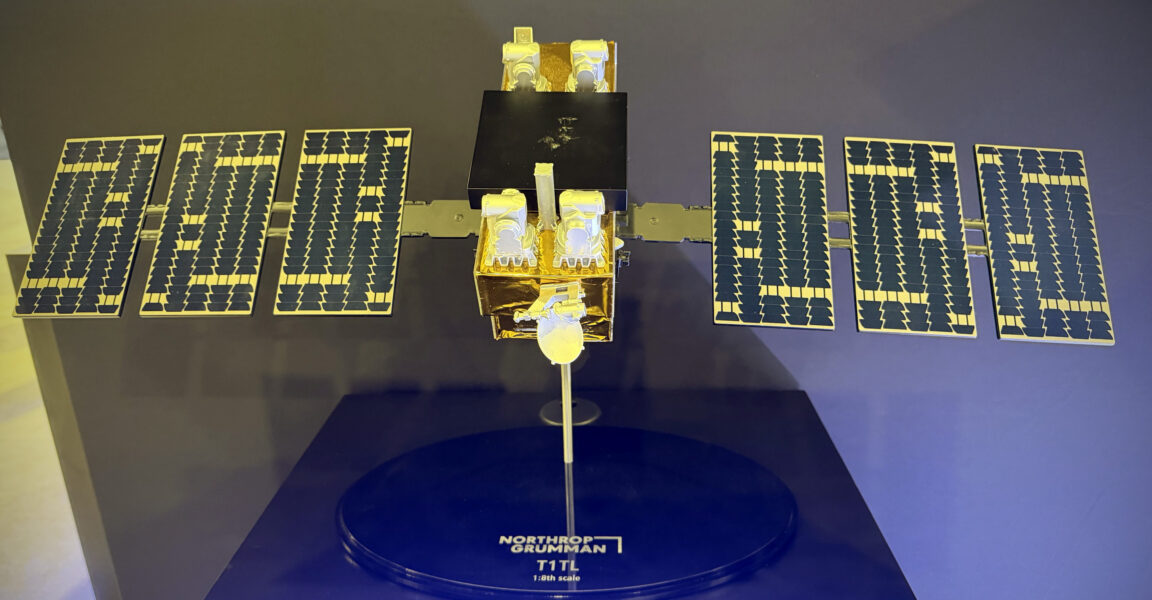
Speaking with reporters at the Air & Space Forces Association conference here, Space Force Lt. Gen. Gregory Gagnon revealed that the Resilient Radar System-Ground, or RRS-G, program will go up “in the next two years.” The satellite system is built by Northrop Grumman, the general said.
Officials have previously discussed plans to get Ground Moving Target Indicator (GMTI)-capable birds on orbit by 2028, but until now have not disclosed the name for the specific program or the company building the satellites.
“We have a deep, operational understanding of the threats our warfighters face and are focused on delivering capability at the speed and scale required to stay ahead of them,” a statement from Northrop reads. “Any questions on specific programs are best directed to the Space Force.”
Currently ground targets are primarily tracked by sensors aboard manned and unmanned aircraft, but the Pentagon has long-sought to shift that mission, plus the tracking of aerial targets, to space-based platforms.
“The Space-Based Ground Moving Target Indicator provides resources to acquire a next-generation radar satellite system for resilient day-night, all weather detection, tracking, and imagery of ground and maritime targets,” a Space Force spokesperson told Breaking Defense. “The space-based GMTI program focuses on achieving target detection, custody, and sensor-to-shooter timelines necessary for dynamic targeting and long-range strike within highly contested and non-permissive environments.”
Gagnon, the commander of the Space Force’s Combat Forces Command, said that the service last month established its first “space-based sensing and tracking unit” dubbed the 77th Surveillance Squadron. The unit was stood up, the general explained, “to start the process of ground moving target indicator [missions], which is from the RRS-G constellation.”
The Space Force has partnered with the National Reconnaissance Office for the GMTI mission, and the service is working in parallel to develop satellites that can do the same for airborne targets. The first among many satellites for the air tracking mission, known as AMTI, will be launched this month, Air Force Secretary Troy Meink said on Monday.
The Space Force plans to have an initial AMTI constellation working by 2028, following a multibillion-dollar award in May to SpaceX. It’s not clear when a GMTI constellation may be operational.
The Space Force’s baseline fiscal 2027 budget request includes $1.02 billion for GMTI procurement, while separately asking for over $7 billion in reconciliation funds for the AMTI mission. The service is also requesting roughly $1.1 billion — using combined baseline and reconciliation funding — under a separate R&D effort.
Gen. Stephen Whiting, commander of US Space Command, said today at the AMOS conference in Maui that he met with NRO officials this week to coordinate on MTI operations both in the air and on the ground.
“I think we have a good plan with the Space Force and across the department to bring those capabilities to fruition at US Space Command,” he said. “When those systems are ready to be operational, they will be presented to us, and we will be responsible for their oversight and defense of those capabilities. We’re developing the concepts of operations now for what that will look like in partnership with the other combatant commands and elements of the intelligence community that that have equities there as well.”
CASR: Coming Soon
In a separate roundtable today, Col. Timothy Trimailo, the head of the Space Force’s Commercial Space Office, said the Space Force would soon move to put commercial vendors on contract to provide space domain awareness services. Space domain awareness, or SDA, broadly refers to the ability to track and discern intent of objects in orbit.
The Space Force last year awarded pilot contracts to four companies for SDA work under the service’s Commercial Augmentation Space Reserve (CASR), which essentially aims to augment military tech with commercial capabilities in wartime. The “first step” for CASR, according to Trimailo, is to dole out contracts for operational SDA work. Those contracts will be awarded “very soon” according to the colonel.
Trimailo spoke broadly about what kinds of services CASR might pursue after the SDA mission, saying only that officials are “looking across a wide range of missions” given “a lot of demand” to examine various needs “that might be suitable” for a similar CASR arrangement.
“We’re trying to get some momentum here, and we are going to deliver operational capability through these contracts,” he said.
Theresa Hitchens contributed to this report from Maui.
UPDATED 9/17/2026 9:04 a.m. ET: This report has been updated to include additional comments from a Space Force spokesperson.
PHOTOS: AFA 2026

 Gallery