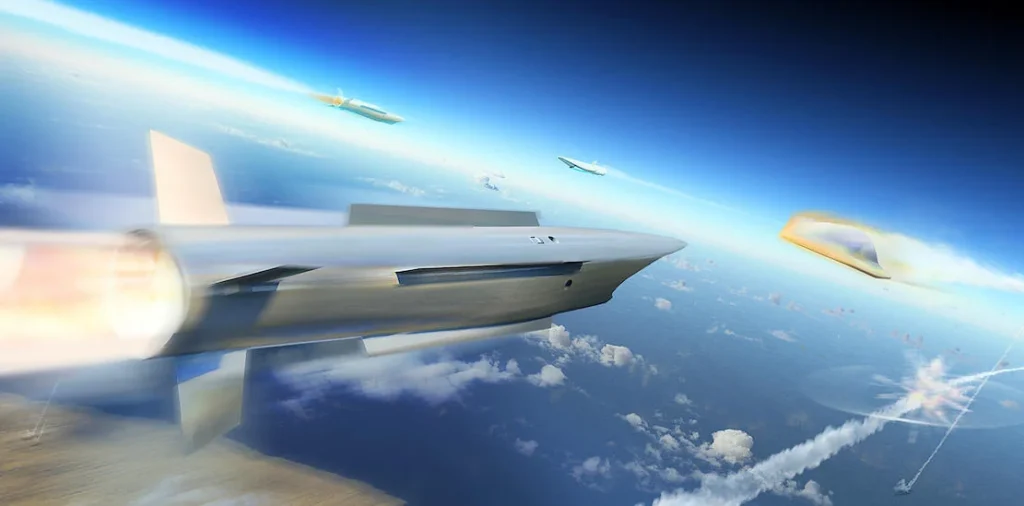
PARIS — Europe is quickly approaching a critical decision point that will help direct its strategy for defending the continent against hypersonic missile threats in the 2030s and beyond.
At the end of the month, the European Commission is expected to downselect either the Hypersonic Interceptor Defence (HYDEF) or Hypersonic Defence Interceptor System (HYDIS) consortiums for the second phase of its Endo-Atmospheric Interceptor (EATMI) program — an effort that aims to develop air defense systems to counter advanced missile threats.
While HYDEF is focused on developing the foundational technologies for a highly maneuverable interceptor, HYDIS has advanced a more defined missile design, known as Aquila.
China and Russia continue to rapidly develop hypersonic missiles, with Chinese systems presenting a growing challenge to European defenses. The weapons can fly at speeds of at least Mach 5 and can maneuver during flight, making their trajectories difficult to predict and giving air defense systems less time to detect, track and intercept them.
To date, both HYDEF and HYDIS consortiums have conducted parallel assessments and design work in support of the first phase of the EATMI program. The Nov. 30 deadline will require the European Commission to move forward with just one provider.
The first phase of EATMI officially wrapped up at the end of October after both consortia’s concepts passed preliminary requirements reviews in the summer. The second phase, expected to begin in 2027, will focus on maturing interceptor technologies and advancing the preliminary design of the complete weapon system.
The European Commission is targeting a system-level demonstrator at technology readiness level 6 by 2030, followed by a development and industrialization phase ahead of an expected in-service date around 2035.
The HYDEF consortium includes the government participation of Spain, Germany, Poland, Belgium and Norway, with an industrial consortium comprising companies from each country. The effort is led by Spanish Missile Systems (SMS), with Diehl Defence acting as technical coordinator. Other participating companies include Nammo, Navantia and GMV.
HYDIS currently includes France, Italy, the Netherlands and also Germany, along with a group of supporting companies comprising MBDA, Saab, Thales and Leonardo, as well as the Netherland’s TNO and Sweden’s FOI government research and development agencies.
The participating companies are organized into teams covering a range of technology areas, including onboard terminal guidance sensors; lethality; communication and datalinks; propulsion systems; aerodynamics and thermal domain; guidance, navigation and control; interceptor maneuverability; and more.
Speaking to the media at the Euronaval expo in Paris on Wednesday, an MBDA official representing HYDIS confirmed that the program’s second phase will focus on moving beyond technology readiness level 3 and toward a “full system demonstrator by the end of the decade.”
Should it be selected, the HYDIS consortium will continue development of the Aquila interceptor, including the capability to launch from surface vessels using the MK41 vertical launch system. Additional focus areas will include affordability and scalable production.
As for HYDEF, the consortium was unable to provide additional details regarding planning for the second phase. However, a Diehl Defence spokesperson told Breaking Defense that the team had completed its first development phase on schedule, with August’s preliminary requirements review and the end-of-October project milestone confirming that all subsystems had exceeded their initial technical maturity targets.
“Building on these results, the HYDEF follow-on consortium is ready to continue development under EATMI and deliver this critical capability for Europe,” the spokesperson added.
As for HYDIS, the consortium confirmed that it plans to continue designing Aquila — a four-stage hypersonic stratospheric interceptor capable of intercepting threats travelling up to Mach 17 at high altitudes.
“We expect the winning solution to be available to European countries [by the end of the decade],” Lionel Mazenq, vice president for incubator programmes at MBDA, said at Euronaval.
Mazenq compared the program’s requirements to the United States’ Glide Phase Interceptor program (GPI) — led by Northrop Grumman and developed in cooperation with Japan — which is designed only to intercept hypersonic glide vehicles.
“The European solution will be the only one to deal with both threats,” Mazenq claimed, adding that the European interceptor will form part of a wider, integrated air and missile defence network.
According to MBDA, the HYDIS solution could provide Europe with “regional shield protection,” covering a 100-kilometer (62-mile) radius with a single launcher. That could mean just one launcher could be deployed to protect the whole of the Netherlands, Mazenq said.
He also illustrated a “continental barrier against hypersonic threats,” suggesting a network of interceptor launchers could be used to protect Europe’s eastern border.
MBDA confirmed that the launchers will need to be networked to a single radar. The company also described ongoing cooperation with the European Space Strategy to use satellite constellations to detect and track missiles from space.
Should it be selected for EATMI Phase 2, the HYDIS follow-on consortium will include an expanded group of European countries. As of September, an additional 13 nations had signed letters of intent or support as part of the consortium’s bid process including Belgium, Denmark, Norway, Sweden, Finland, Estonia, Lithuania, Poland, Czechia, Slovakia, Romania and Croatia.
The European Defence Fund (EDF) has pledged €100 million (approximately $112 million USD) for the second phase of the program. Additional funds are expected from the winning consortium. MBDA’s Mazenq confirmed that 11 nations from the HYDIS 2 DP consortium will contribute an additional €133 million (approximately $149 million USD).
Breaking Defense Video