WASHINGTON — After six years of theorizing, wargames, and discussion, Multi-Domain Operations has finally matured from a futuristic concept to a practical handbook on waging great-power war.
On Oct. 11, the Army will formally issue the new edition of Field Manual FM 3-0, Operations. It’s a top-to-bottom rewrite that is shorter, more streamlined, and tightly focused on how commanders can execute multi-domain operations, not in years to come with as-yet unbuilt tech, but with the Army that exists today.
What’s new here is not the multi-domain concept itself. The idea in essence calls for ever-closer, increasingly computerized coordination amongst the armed services across all five “domains” — land, sea, air, space, and cyberspace — to defeat high-tech nation-states like China. Instead, what’s new in FM 3-0 is its all-out effort to explain multi-domain in traditional military terms, and a conscious effort to make it applicable to the present day, rather than some vague future conflict.

“We were thinking about putting it out sooner,” the Army Chief of Staff, Gen. James McConville, told Breaking Defense in a recent exclusive interview. “[But] we waited a little bit just to make sure we could get the lessons learned from Ukraine. “
RELATED: Firepower & People: Army Chief on keys to future war (exclusive)
“Now,” McConville continued, “just like [new] weapons systems, we want to get into the hands of our soldiers and commanders, and let them work the doctrine and work at it in training centers, and make sure we have it right. And as we get lessons learned, we will update the doctrine.” It’s a perpetual cycle of learning, where insights from theory inform practice and lessons from practice reshape theory.
The prior edition of FM 3-0, released this month in 2017, included a few short sections on “multi-domain battle,” as the Army initially called the concept before critics argued it focused too narrowly on the physical clash of arms as opposed to the logistical, strategical, and political context of combat. But most of the 2017 text was actually a holdover from earlier editions.
The 2022 field manual, by contrast, is a complete rewrite, infused from start to finish with the imperative to conduct multi-domain operations. It even includes, for the first time, a full chapter on the Army’s role in maritime theaters — like the Pacific — in support of the Navy and Air Force, for example by providing island-based air and missile defense.
“It makes multi-domain operations no longer a future concept but the operational concept,” said Richard Creed, head of the Combined Arms Doctrine Directorate at Fort Leavenworth, Kan. A retired Army colonel and veteran of Bosnia, Iraq, and Afghanistan, Creed has worked on the development of multi-domain operations from a broad concept circa 2016 to today’s detailed, executable doctrine.
“It’s got to be executed by the force that we have now,” Creed told Breaking Defense. “You go to war with the Army you have.”
New Tools, Ancient Techniques
So when you strip away the high-tech futuristic chrome, what are Multi-Domain Operations, anyway? The new field manual answers: in modern conflict, everything.
“All operations are multidomain operations,” FM 3-0 declares. “Army forces employ organic capabilities in multiple domains”: tanks and trucks and foot troops on land, of course, but also helicopters and Patriot missiles in the air, hackers in cyberspace, and even Army watercraft at sea. “And,” the manual goes on, “they continuously benefit from air and maritime strategic transportation and [from] space and cyberspace capabilities that they do not control, including global positioning, satellite communications, and intelligence, surveillance, and reconnaissance.”
In other words, FM 3-0 tells officers who might be skeptical about new-fangled ideas, multi-domain operations isn’t some radical departure: It builds on how you already operate every day. Nor does it create some new dependency on the other services: You depend on them already — and they depend on you.
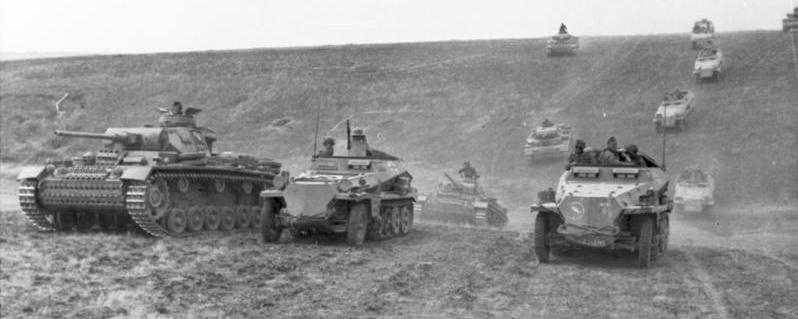
What’s more, the field manual defines multi-domain operations in very traditional terms, “as the combined arms employment of joint and Army capabilities.” For those not steeped in military history, “combined arms” is one of the oldest concepts in the book, dating back to whatever Neolithic warlord first told the tribesmen with spears to protect the ones with bows and arrows. It’s how Alexander the Great conquered Persia, crushing Darius between the marching anvil of his Foot Companion phalanx and the hard-riding hammer of his Companion cavalry. It’s how the Nazis blitzed Poland, France, and Russia, using the then-revolutionary radio to coordinate foot troops, panzers, and Stukas.
What’s different today, Creed believes, is that commanders need to expand the traditional idea of combined arms even further, to include drones, satellites, cyber hacking, and information.
In particular, what the new manual calls the “information dimension” is described as omnipresent and all-pervasive, not the esoteric specialty of cyber geeks or psyops spooks. In previous Army practice and doctrine, Creed said, “we used to talk about the ‘information environment’ as a subset of the overall operational environment, and the problem with that is it tended to lead to stovepiped approaches.”
Historically, US soldiers tended to treat “information” as a specialized sideline, a technical annex to the main plan, or what one old-school commander called incomprehensible “dolphin speak.” In the new field manual, by contrast, “information becomes the purview of everybody instead of just technicians,” Creed said. “When I physically do something… there’s an information effect from that.”
True, “there’s this big technical piece of it,” Creed added. “[But] the content — unless you’re writing malicious code — [is] designed to influence or inform people.”
Every physical action creates information, because people perceive it happening and draw conclusions about it, right or wrong. Patrolling villages in Afghanistan wasn’t just about finding Taliban to shoot: It was also about providing the local population with a reassuring physical presence. Even in an all all-out conventional war, a military operation can be largely or entirely about conveying (dis)information to the enemy. Consider Patton’s First US Army Group in 1944, a decoy formation that deceived the Nazis about where D-Day invasion would come ashore. Or there’s the Doolittle raid on Tokyo in 1942, which did little physical damage but provoked a Japanese overreaction that led to their defeat at Midway.
So in addition to the five domains defined by Defense Department-wide doctrine — land, sea, air, space, and cyberspace — the new Army field manual describes three dimensions: physical, information, and human. Every physical action creates new information, which in turn affects how human beings make decisions, which in turn causes them to take different physical actions.
“There’s a human, physical, and information dimension of each of those domains,” Creed said. “Technical capabilities are hugely important… we don’t downplay that…. but conflicts are waged by human beings.”
That is an age-old truth about the nature of war — but it’s one the US military has all too often overlooked. Historically, Americans tend to focus on the quantifiable: tons of supplies delivered or ordnance dropped, body counts in Vietnam and “SIGACTS” (significant activities) in Afghanistan, targets struck in “kinetic” operations or village wells dug in “non-kinetic” ones.
Especially for warfare on the land, where seven billion humans live, you can’t reduce combat to a video game, a technical exercise in “plinking” targets. “A targeting approach to conflict just simply doesn’t work,” Creed said. “You have to account for the people that are executing it, the people that you’re fighting against, and the people that you’re fighting amongst.”
“The utility of lethal force extends into the information and human dimensions,” the new FM 3-0 says, “where it [can] influence enemy behavior, decision making, and will to fight.”
This isn’t a new idea in the history of war — but it’s new to many in the US military, and the new field manual aims to drive the idea home with real-world applicability. The way FM 3-0 restructures Army planning, Creed said, “there’s no way, now, to avoid accounting for those three dimensions.”
What’s more, he argued, “that model works at whatever echelon you’re talking about” — from a corps to a platoon — “and it works in any context: competition below the threshold of armed conflict, crisis, or in a conflict itself.”

Hot War, Cold Peace
“Competition below armed conflict” is the Army’s new doctrinal term for what military planners once referred to as “Phase 0,” what Communists consider “political warfare,” and what civilians often misinterpret as “peace.” It’s the constant push and pull between rival powers using all available means: diplomacy, ideology, information and misinformation, economic might, proxy warfare, espionage, and military power — sometimes simply as a passive deterrent, sometimes maneuvering in an overt threat, and sometimes limited violence “short of war.” In the field manual’s framework, such unceasing but constrained competition sometimes escalates to a point of crisis and, potentially, from there to open war.
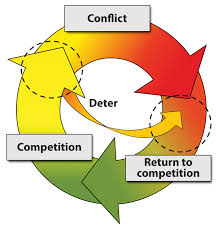
Many of America’s adversaries see this process as a smooth continuum with no clear firebreaks along the way. “China imposes low levels of violence and new types of violence (including space and cyberspace attacks against government, economic institutions, private industry, and infrastructure) that do not trigger significant military responses,” the new FM 3-0 warns. “In these cases, China sees itself in a state of war with its adversaries, but its adversaries do not. Such a disparity in perspective is dangerous.” But because US law and custom draw a sharp distinction, the new field manual has separate chapters on competition, crisis, and conflict.
The 2017 edition, by contrast, devoted three whole chapters to various aspects of “large-scale combat operations.” Many critics charged the Army was willfully forgetting the painful lessons of post-9/11 counterterrorism and counterinsurgency, just as it had forgotten the lessons of Vietnam.
“That was the basis of the most skeptical questions we received in 2017,” Creed said: “‘Hey, you guys are focusing on large scale combat operations, and you’re walking away from counterinsurgency.”
The 2022 edition of FM 3-0 acknowledges that “the most common force of conflict, the most likely form of conflict that Army forces are going to conduct based on the historical record, is irregular warfare,” Creed said. “We’re not walking away from any of that, it’s just that’s not the focus of this particular book.”
Other manuals — both existing and forthcoming — delve into counterinsurgency, advisor brigades, and special ops, Creed explained, as well as the tactical details of conventional battle and the strategic missions of the Army. For the new and streamlined FM 3-0, he said, the focus is on what the Army calls operational art, the middle ground between strategy and tactics that orchestrates a given theater of war. These are big wars against high-tech foes, with chaos and casualties to match.
“While the overwhelming majority of operations conducted by Army forces occur either below the threshold of armed conflict or during limited contingencies, the focus of Army readiness is on large-scale combat operations,” the new field manual says in its first chapter. “The tradeoff is acceptable because conducting irregular warfare with forces prepared for large-scale ground combat incurs less risk than conducting large-scale ground combat with forces unprepared to do so.”
“These operations typically entail high tempo, high resource consumption, and high casualty rates.”
In plainer words: The Army needs to prepare for the worst case, because the probability of a big war may be low, but the stakes are terrifyingly high.
AUSA 2022

 Gallery