Air Warfare

Army picks Anduril for counter-drone fire control system

Anduril’s win paves the way for the defense tech firm to replace Northrop Grumman’s FAAD C2 system, which provides a common picture for operators to detect and defeat air-based threats.

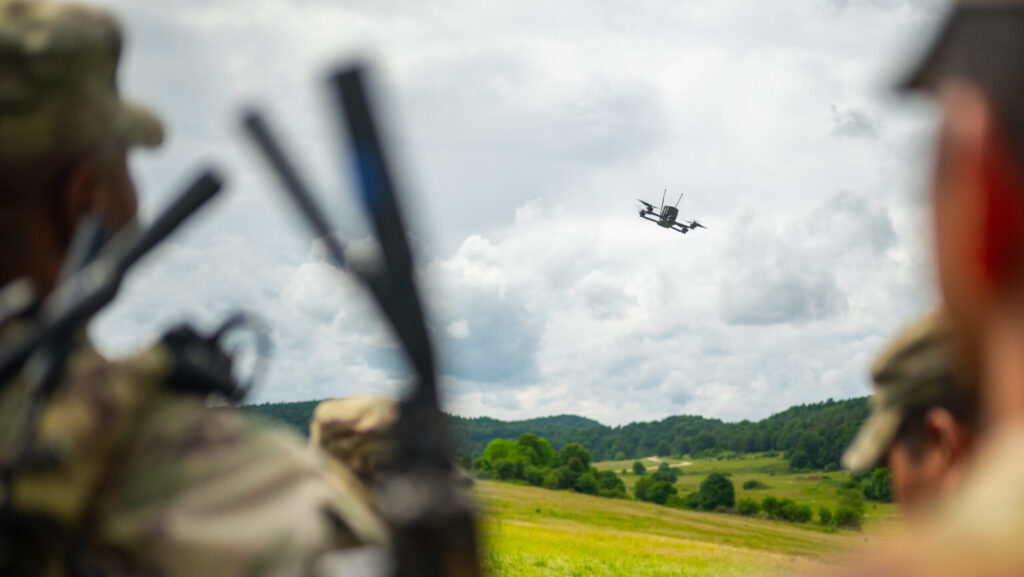
U.S. Army Soldiers assigned to 3rd Squadron, 2nd Cavalry Regiment conduct various tests on new counter-unmanned aerial system technologies during Project Flytrap at Joint Multinational Readiness Center, Hohenfels Training Area, Hohenfels, Germany, June 5, 2025. (U.S. Army photo by Spc. Elijah Magaña)

AUSA 2025 — Anduril has prevailed in an Army and Defense Innovation Unit competition to provide a new system for managing defenses against drone threats, the Army announced Wednesday.

In a press release disclosing Anduril’s win, the Army said the company will furnish the service with a modernized fire control system for counter-drone operations, also known as c-UAS. A fire control system fuses together sensor data to ensure an operator can effectively strike a target.

“The Army will continue working closely with Anduril to refine and integrate this cutting-edge technology into its C-UAS architecture, ensuring the highest level of protection for our warfighters,” the service said in the announcement, without disclosing the contract value. Anduril did not respond to a request for comment by press time.

The company’s selection comes amid an Army plan to hold “recurring” competitions for counter-drone technologies, ranging from equipment that could be carried by the common soldier to electronic warfare systems. Officials have reportedly said they want the new fire control system to handle a wide variety of short-range air defenses, but are focusing initially on the counter-drone mission.

“We need to ensure that we continuously outpace the threat,” Col. Guy Yelverton, the project lead for the Army’s counter-drone product office, said during a Monday panel discussion at the annual AUSA conference in Washington. “So we will have these competitions at least at an every two-year cycle, to make sure that we know and understand the capabilities out there from our industry partners, and that we continue to provide our warfighters the best capability so that we outpace that threat that’s evolving.” 

In an apparent preview of the Anduril win, Yelverton said the winning fire control solution would replace the FAAD C2 (Forward Area Air Defense Command and Control) system currently provided by Northrop Grumman. The Northrop system combines sensor data to provide a comprehensive picture of the air space that can then direct a range of defenses to knock down an inbound threat.

Northrop previously revealed it was competing to replace its FAAD C2 system with a new offering dubbed AiON, though it’s not clear what other firms bid in the competition.

“We are incredibly proud of the groundbreaking innovation and dedication demonstrated by our talented team in developing and successfully testing AiON, our next-generation counter-drone system. In just a few months, we delivered a cutting-edge capability that enhances warfighter protection in dynamic and evolving threat environments,” Kenn Todorov, vice president and general manager of command and control and weapons integration at Northrop, said in a statement to Breaking Defense.

“We see significant future opportunities to partner with other customers and allies who recognize the critical need for innovative solutions like AiON,” Todorov added.

PHOTOS: AUSA 2025

PHOTOS: AUSA 2025

A view of a show floor at the 2025 Association of the US Army's Annual Meeting & Exposition in Washington, DC, Oct. 13, 2025. (Rachel Cohen/Breaking Defense)
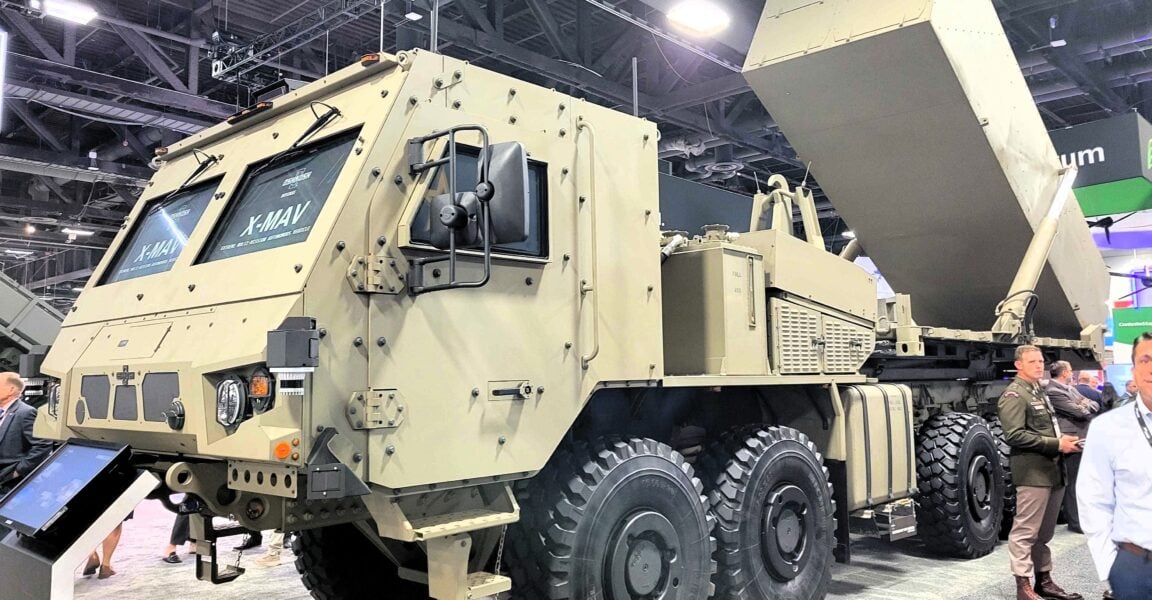
Oshkosh Defense debuts its Extreme Multi-Mission Autonomous Vehicle (X-MAV), an "autonomous-capable launcher solution that is engineered to support the future of long-range munitions," Oct. 13, 2025, at the Association of the US Army's Annual Meeting & Exposition in Washington, DC. (Rachel Cohen/Breaking Defense)
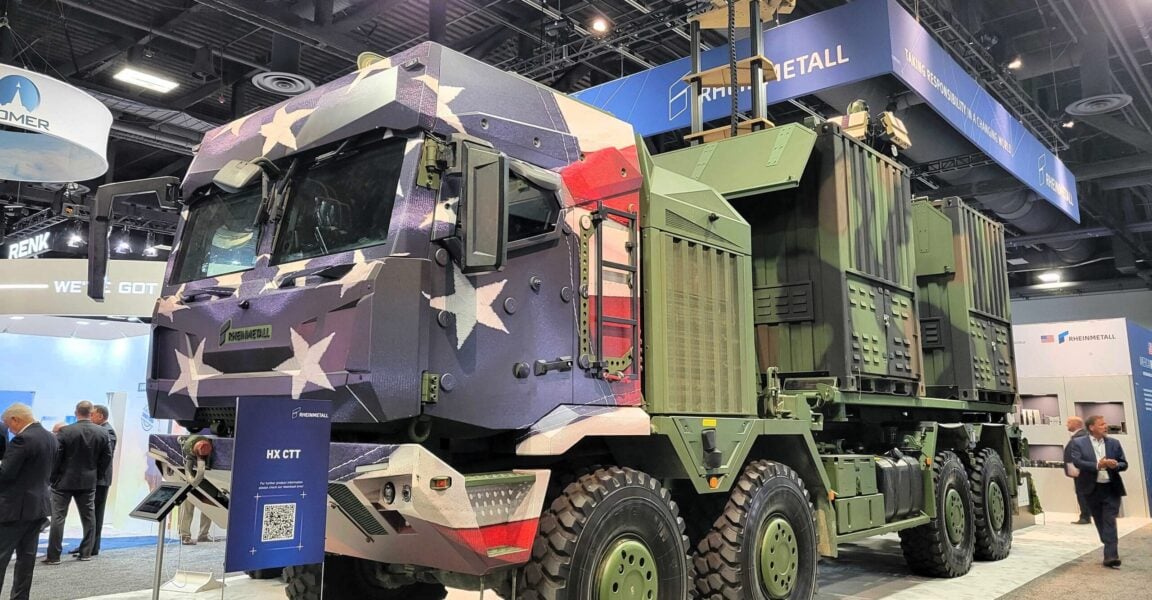
Rheinmetall brought its HX Common Tactical Truck, built in partnership with GM Defense, to the Association of the US Army's Annual Meeting & Exposition, Oct. 13, 2025. (Rachel Cohen/Breaking Defense)
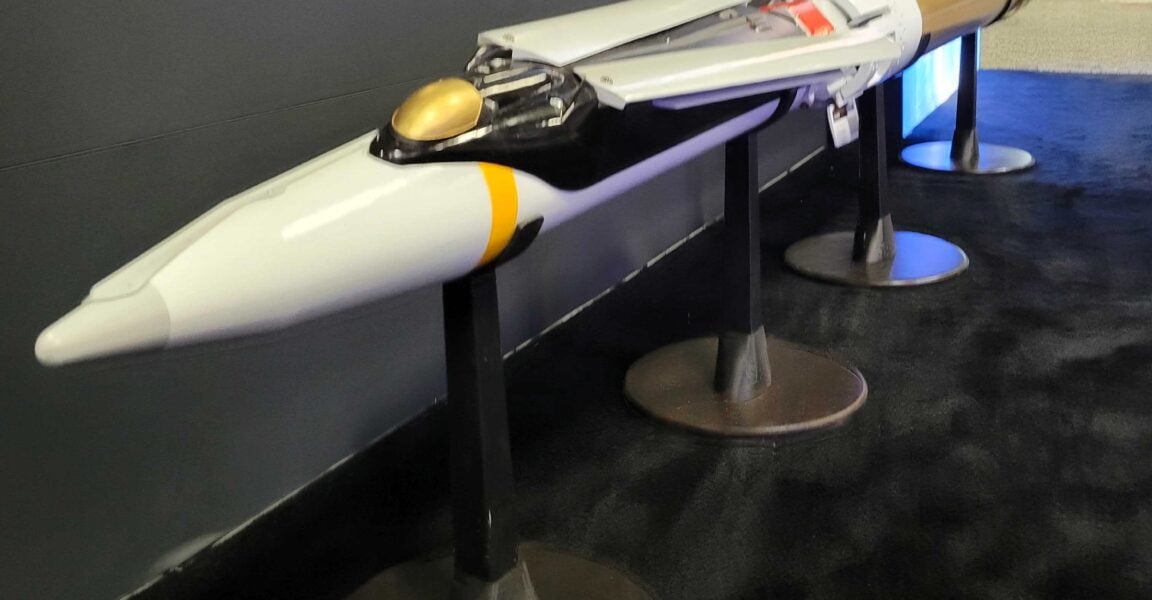
Saab's Ground-Launched Small Diameter Bomb is based on Boeing's SDB and Lockheed Martin's Multiple Launch Rocket System. (Rachel Cohen/Breaking Defense)
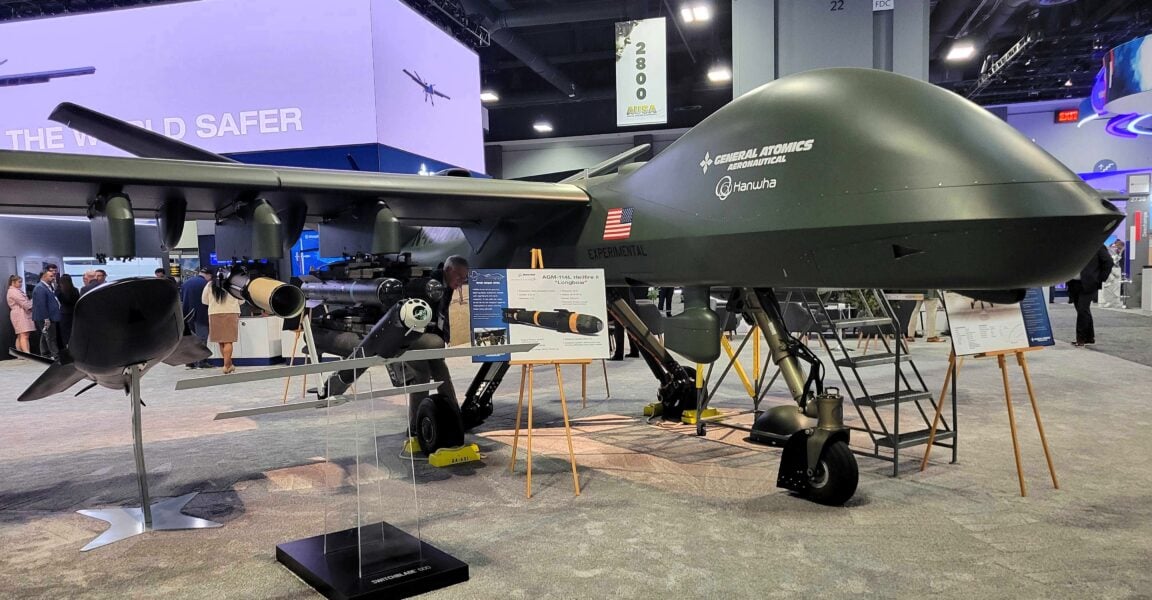
General Atomics Aeronautical Systems and Hanwha Aerospace are collaborating on a short takeoff-and-landing version of the MQ-1C Gray Eagle drone. (Rachel Cohen/Breaking Defense)
Rafael's Iron Beam is a 100kW-class laser weapon on track for operational use this year. (Aaron Mehta/Breaking Defense)
Honeywell's SAMURAI anti-drone system is one of myriad counter-drone technologies on display at AUSA 2025. (Daniel Woolfolk/Breaking Defense)
Hanwha Defense USA pitches its 155 mm, 52-caliber K9 Thunder self-propelled howitzer at the Association of the US Army's Annual Meeting & Exposition in Washington, DC. (Rachel Cohen/Breaking Defense)
Conference attendees try out Trijicon's firearm sights and scopes. (Aaron Mehta/Breaking Defense)
Attendees roam the halls of the Walter E. Washington Convention Center in downtown Washington, DC, Oct. 13, 2025. (Daniel Woolfolk/Breaking Defense)
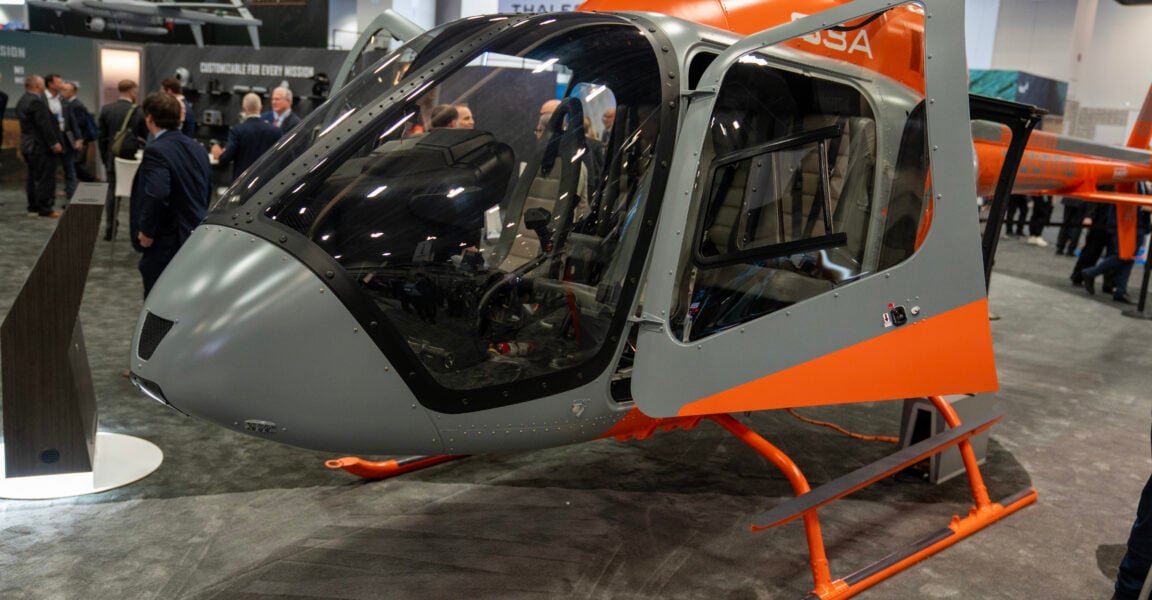
The Bell 505 Jet Ranger X is a contender for the Army's Flight School Next program. (Daniel Woolfolk/Breaking Defense)
GM Defense's Infantry Squad Vehicle-Utility is based on the Chevrolet Colorado ZR2 and can be adapted to carry mortars, counter-drone equipment and more. (Aaron Mehta/Breaking Defense)
Name a more iconic duo. I'll wait. (Aaron Mehta/Breaking Defense)
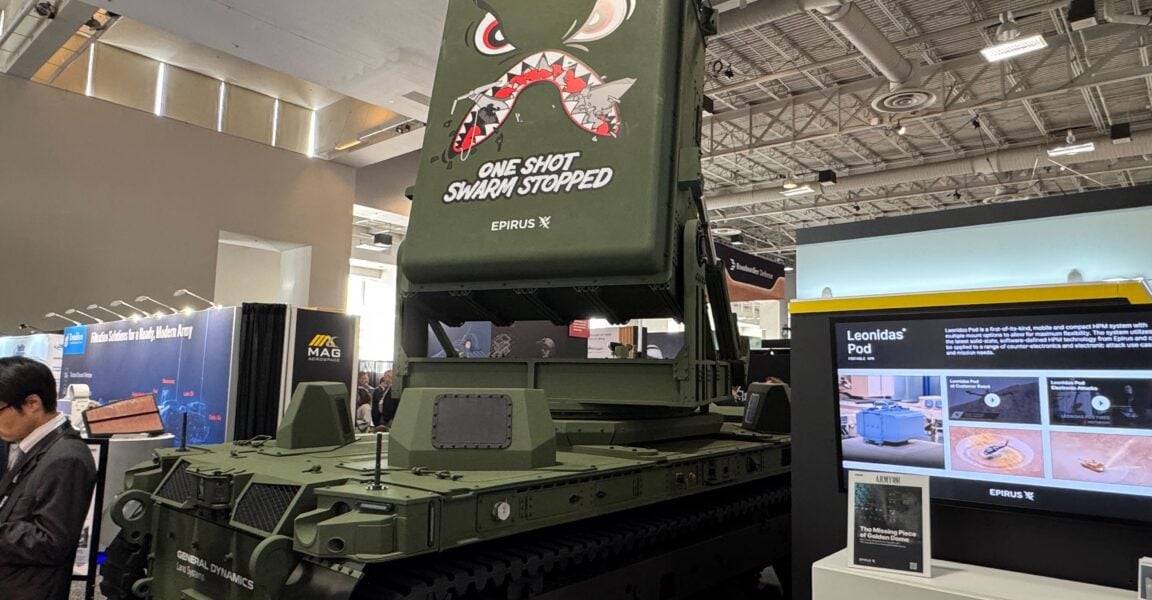
Epirus’s Leonidas high-powered microwave system is mounted on top of a General Dynamics land vehicle. (Michael Marrow/Breaking Defense)
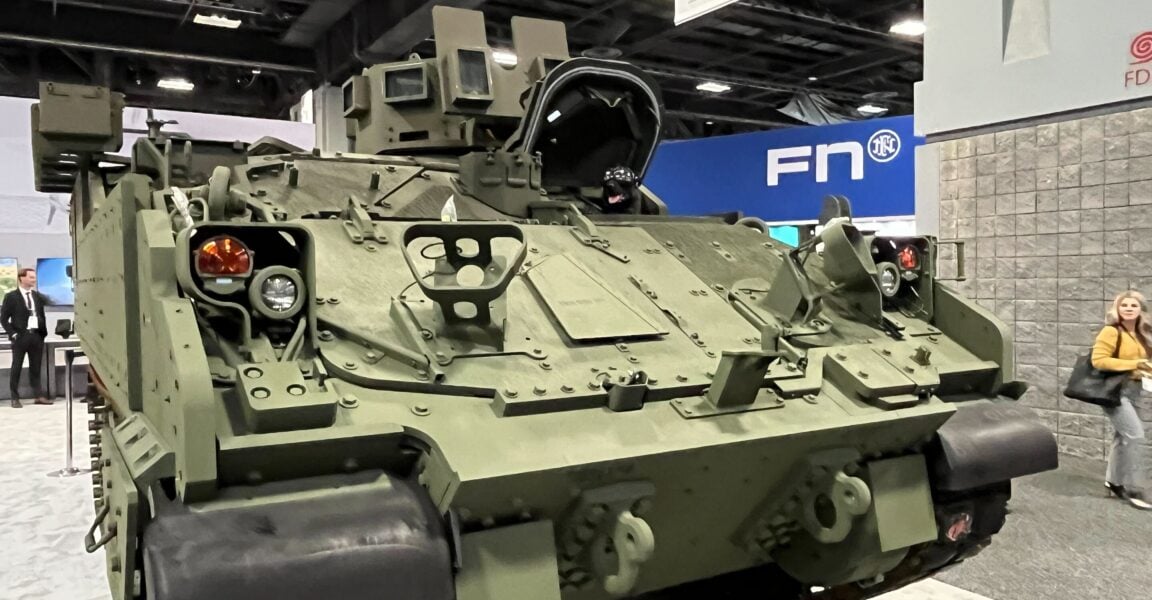
A four-legged attendee checks whether the infantry carrier variant of BAE Systems' Armored Multi-Purpose Vehicle can also carry canines. (Sydney Freedberg/Breaking Defense)
It wouldn't be a defense trade show in 2025 without a robot dog on hand. (Aaron Mehta/Breaking Defense)
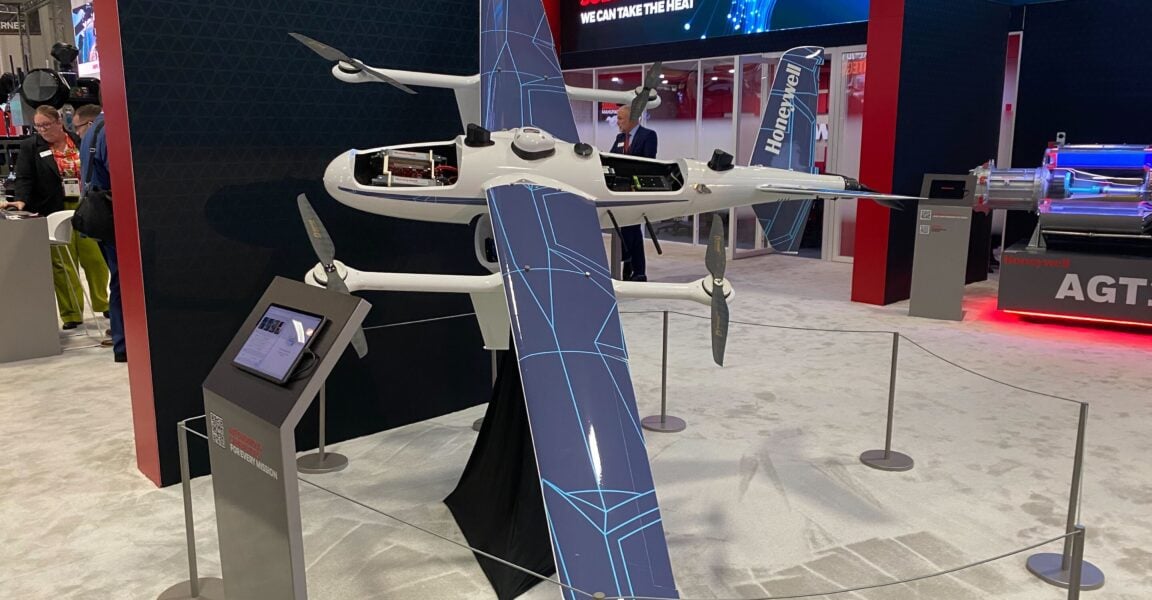
Honeywell showcases a hybrid quadcopter/fixed-wing drone on the show floor. (Aaron Mehta/Breaking Defense)
RTX displays its missiles and a Lower Tier Air and Missile Defense Sensor. (Aaron Mehta/Breaking Defense)