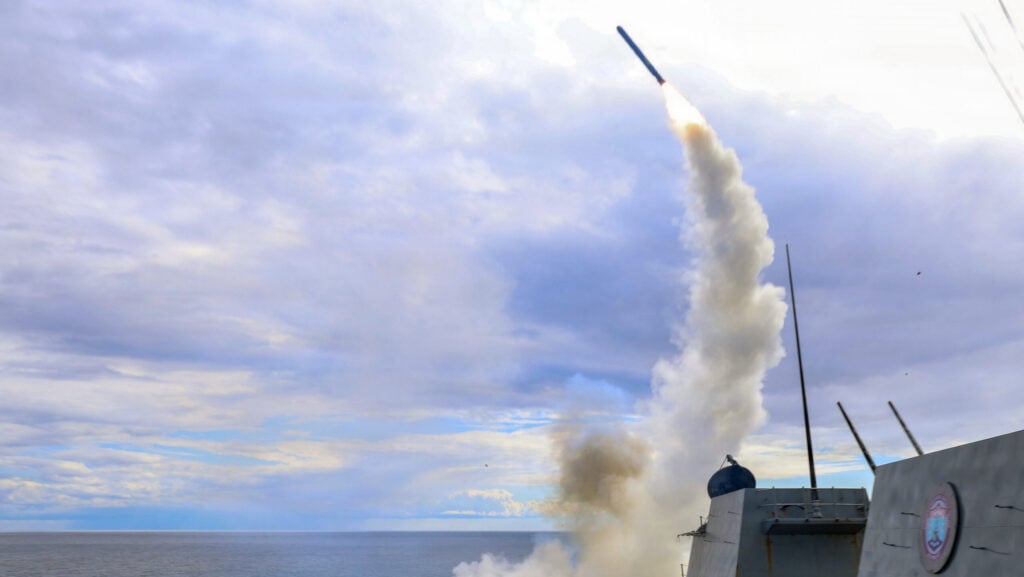
Over the last ten days, Iran fired hundreds of ballistic and cruise missiles, and countless drones. A relatively small number have gotten through, suggesting that the US and its partners have fired hundreds of interceptors in turn. On the offensive side, the US has struck over 6,000 targets within Iran. It is reasonable to surmise that in doing so the US forces may have expended many hundreds, even thousands, of precious long-range missiles. When the totals are revealed, they could be shocking.
Pentagon officials say that the United States has enough for “the task at hand,” and some developments give reason for optimism. On March 4, Gen. Dan Caine, the chairman of the Joint Chiefs of Staff, noted that the United States had achieved a degree of air superiority that permitted a “munitions transition from standoff to stand-in weapons.” Moving to more plentiful and cheaper gravity bombs is a welcome development. That strikes have slowed the rate of Iranian missile fire by more than 90 percent, per Pentagon figures, further alleviates the rate of defensive interceptor launches.
But saying we have sufficient stocks for the task at hand is not the same as saying there is enough for other objectives, most notably deterring aggression by China. The context here is how many of these precious stocks of weapons have been used over the last 18 months, and how the US for years has failed to buy enough in the first place.
The situation is unsustainable. It courts running out of ammunition, what in military circles is called “going Winchester.” The solution is likely to require Congress to step up and pass a major budget supplemental.
Let’s start with recent efforts. Remember, these expenditures over Iran follow the defense of Israel in June 2025, when American and Israeli air defenders expended hundreds of interceptors, including between 30-49 percent of THAAD deliveries, and 20 percent of SM-3s. Neither the US nor Israel can afford another war that chews up hundreds of missile defense interceptors.
Similar concern relates to strike capability. For years, US policymakers have elected to use long-range standoff weapons when it seemed less necessary, such as when 1,000-km range Tomahawks were used against the Houthis in Yemen, and — even more inexplicably — against terrorists in Nigeria with no air defenses.
The recent employment of these weapons would be less of a problem had the US not allowed insufficient inventory goals and meager procurement for years.
After Russia’s 2022 invasion of Ukraine, Kyiv’s top requests for aid consistently fell into two categories: long-range strike, like ATACMS, and missile defenses, like Patriot. Military planners worldwide began revising old calculations for munition inventory objectives. A year ago, the US Army quadrupled its acquisition objective for PAC-3s from 3,376 to 13,773.
Deputy Secretary of Defense Steve Feinberg had the foresight in early 2025 to begin architecting a munitions ramp-up. After months of negotiations with industry about maximizing production, the Pentagon concluded a handful of strategic framework agreements for seven offensive and defensive missiles.
The plans call for quadrupling THAAD production from 96 to 400, moving PAC-3 rates from 600 to 2,000, significantly increasing Standard Missile output, and going to 1,900 AMRAAM missiles. Tomahawk production would expand to 1,000 per year, after the administration requested funds for just 57 Tomahawks in its last request.
The Pentagon is moving in the right direction, but the clock is ticking. Strategic framework agreements are not contracts. The underlying bids have an expiration date, and, if the contracts are not soon finalized, the deals could falter.
And that’s the problem: The money isn’t there to put all these missiles, which would be needed in any conflict with China, on contract.
The fiscal 2026 appropriations will allow some contracts to be let, but the bill’s report warned that its additions fell far short of the Pentagon’s $28.8 billion supplemental request for munitions alone, which had come over late to the negotiations on Capitol Hill.
Funding from the recent appropriations bill will, for instance, probably buy between 300-350 PAC-3s. If a $200 million allocation from last year’s reconciliation bill were to go to PAC-3, it would add fewer than 50 more.
Press reports suggest that a $50 billion supplemental has been floated to cover Iran conflict. That figure is almost certainly too low. The cost of countless sorties into Iran and the replacement of munitions could each tally double digit billions. Other expenses include replacing jet fuel, combat pay, facility repair, more drone defenses like Coyote, and replacing THAAD radars that were attacked. All this is on top of the yet-unappropriated $28.8 billion munitions supplemental request.
House Appropriations Committee Chair Tom Cole has reasonably expressed doubt that spending cuts can suffice to offset the cost of the war. Weeks ago, before the war with Iran began, House Armed Services Committee chair Mike Rogers called for hundreds of billions in a new reconciliation bill. The reconciliation approach was difficult last year and could be even harder now.
The dismal prospect of what it might mean to go Winchester with missile defenses or long-range strike has begun to sink in. Regardless of one’s views of the Iran conflict, avoiding that situation will requires immediate action by Congress, the Pentagon, and defense industry. The rates of production in the framework agreements announced in recent months will now, almost certainly, need to be revised upwards. It may not be enough for 2,000 PAC-3s to be produced per year by 2030. It may not be enough to get to 1,000 Tomahawks per year by then.
There is no sugarcoating this situation. The scale of recent munition expenditures and the degradation of US missile defense capability may well undercut deterrence in the Pacific for the remainder of this decade. It is difficult not to worry that they could encourage China to jump through the proverbial Davidson window. Immediate actions are necessary to preclude that.
The first step will be a munitions supplemental ample to cover both replenishment and expansion. Then the building can begin.
Tom Karako is a senior fellow and the director of the Missile Defense Project at the Center for Strategic and International Studies.