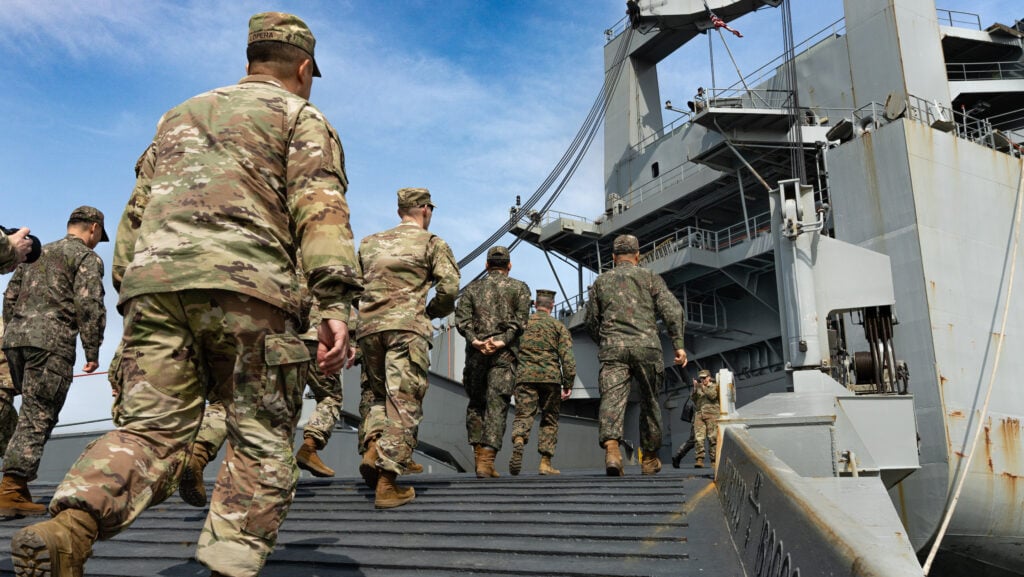
GLOBAL FORCE 2026 — A year after the head of Army Material Command said there were potential plans to sunset the service’s only floating Army Prepositioned Stock (APS), the “jury’s still out” on whether or not the APS will be fully disbanded, though the Army has started to offload much of the floating cache’s equipment to friendly territory in the Indo-Pacific.
Last year, Lt. Gen Christopher Mohan told Breaking Defense the Army was considering jettisoning the mobile cache in the Indo-Pacific, known as APS-3, in favor of dispersing the equipment throughout the INDOPACOM theater, noting the idea was “pre-decisional” at the time. The reasoning behind the potential decision derived from the Army “doubling down on the INDOPACOM from a theater standpoint,” he said then.
But over a year later, the Army has dispersed much of APS-3’s equipment, Mohan told Breaking Defense Wednesday.
“The idea is to put much of that ground based, and we started doing that in several countries overseas,” Mohan said in an interview. “The end state will be that we will have a much, much reduced APS afloat.”
While service leaders continue to deliberate on the overall fate of APS-3, the Army has steadily shipped those arms and equipment to bases in South Korea and the Philippines. Before it began its offloading, the mobile cache consisted of seven ships full of equipment. Mohan did not disclose how much equipment is currently left on the cache and declined to comment on how much more will be offloaded.
When it comes to the decision of if the APS-3 will be fully dispersed, Mohan said there has been “no major decisions at this point” and that it is still “in adjudication” at the highest levels of the Department of the Army.
Currently, there are seven APSs aligned with different regions around the globe, including APS-4 for Northeast Asia and APS-5 for Southwest Asia. The other APSs are located in the continental United States, Europe, Africa and Central/South America.
Asked about future plans for any other APS sites, Mohan said to expect to see “a continued move to reevaluate and disperse APS.”
“What we’ve learned in past exercises and operations is [that] APS is incredibly important, but also that you can have almost too much APS, because then it’s hard to manage. It’s very expensive to maintain,” Mohan said. “So we’re doing a lot of work to figure out what the right mix of what APS looks like, and both strategy and resource informed is what we’re after.”