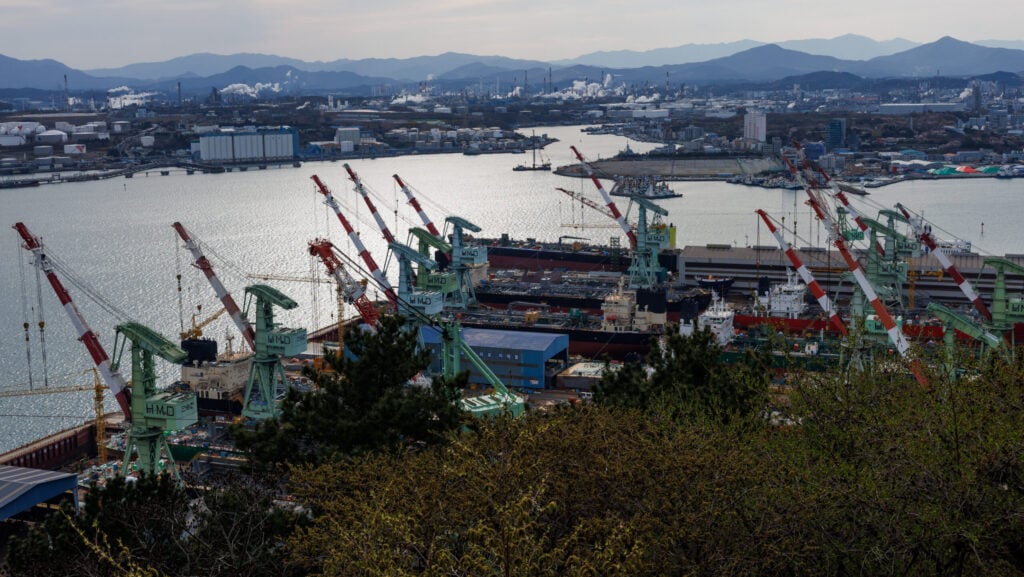
WASHINGTON — A Pentagon request for $1.85 billion in reconciliation funding could be used not just to study whether foreign shipbuilders could construct a warship for the US Navy, but also to begin bankrolling the first vessel built in Japan or South Korea, an Office of Management and Budget official told Breaking Defense.
The money in question is a request for an upcoming reconciliation bill to include $1.85 billion in Navy research and development funds that would be used on “two separate study and procurement efforts” aimed at investigating the ability of allied shipbuilders to build future cruisers, destroyers and frigates, according to an overview of the Pentagon’s mandatory funding request.
“The fact is, no one spends $1.85 billion studying something. That money is there for procurement of assets,” an OMB official told Breaking Defense in an interview. “The OMB director has made that clear, I’m making it clear. We’re here to seriously look at procuring assets sooner rather than later.”
“In the case of frigates, that would purchase an entire frigate, depending on who the manufacturer is,” the official said. “And even with regard to cruisers or destroyers … if you look at the average cost of destroyer construction in Japan and Korea, $1 billion is a fairly nominal cost associated with destroyer construction.”
“This actually gets at what we’re looking at, on adding competition and capacity in the United States. Japan and Korea are both building advanced surface combatants at a much lower cost than what we’re seeing here in the United States,” the official added.
The acknowledgement could ignite a legislative fight with Congress, after lawmakers made clear in hearings with Navy leaders in recent weeks that they remain skeptical that foreign companies should be tapped to alleviate capacity pressures on heritage US shipyards.
Lawmakers are also concerned that the inherent flexibility of reconciliation funding — which is not subject to the same oversight as normal discretionary appropriations — could allow the administration to use the $1.85 billion in ways that Congress did not explicitly authorize.
“That’s the difficult part with reconciliation, and it’s something that we went through with [the One Big Beautiful Bill],” a congressional staffer told Breaking Defense.
“To go ahead and say that we need to start [building ships] overseas is certainly premature, and really that doesn’t hurt the primes as much as it hurts their supply chains and their subcontractors,” the staffer added. “People forget that less than five years ago we were in a supply chain crisis that we’re still trying to dig out of.”
Shaking Up The Paradigm
The Navy and Coast Guard rely on eight domestic shipbuilders — five of which are owned by HII and General Dynamics — to construct its surface combatants and auxiliary ships, according to the Congressional Budget Office. But despite nearly doubling the Navy’s shipbuilding budget over the past two decades, workforce challenges, supply chain fragility, and aging infrastructure and capacity constraints at the major shipbuilders have hindered Navy efforts to boost ship production, the Government Accountability Office reported in 2025.
The Trump administration wants to reverse the trend of ever-expanding shipbuilding delays and ballooning costs by injecting foreign investment into the current industrial base, which the OMB official said would boost capacity and competition in the US.
“There’s a lot of concern from the major naval shipbuilding shipyards in the United States about, ‘Well, why aren’t you just giving those orders to us?’” the official said. “We just doubled the shipbuilding budget [of] … the United States Navy. They are already one to four years behind schedule on every major program. If I just keep giving them money, they’re just going to go farther and farther behind. This is the only way to shake up the paradigm.”
Should the administration press forward with procurement of a foreign surface combatant, the OMB official underscored that production of US warships abroad would only be a temporary measure, with foreign shipbuilders required to set up new yards in America.
OMB’s vision is that the hull, mechanical and electrical (HM&E) structures of the first ships, “maybe two” vessels total, would be produced abroad in either Japan or South Korea, with the combat systems integration being led by an American defense contractor, the official said.
“Those ships could be delivered to the United States while — and this would be contractual — while those parent shipbuilders are making their investments here in the United States, whether that’s a brownfield yard, [meaning] they buy an already existing shipyard and modernize it, or they establish a new greenfield shipyard where no shipyard existed previously,” the official stated.
The administration previously used this strategy in agreements with Finland for icebreakers, resulting in what the administration has dubbed the “Finland model.” Under the terms of one deal, Rauma Marine Constructions will build two arctic security cutters (ASCs) in Finland while standing up ship production in the United States with Bollinger Shipyards in Louisiana, which would build the next four vessels. Meanwhile, Davie Defense, the American sister company to Canada’s Davie, will build two ASCs at Helsinki Shipyards and three domestically.
The administration is engaged in discussions with South Korean shipbuilding companies Hanwha, HD Hyundai and Samsung Heavy Industries, as well as Japan’s Mitsubishi Heavy Industries, Kawasaki Heavy Industries and Japan Marine United (JMU) Corp., about potential ship construction for the US Navy, the OMB official said. (USNI News first reported that the Navy would specifically assess South Korean and Japanese shipbuilding designs under the purview of the study.)
“They’ve embraced modernization, robotics. They’re doing more in terms of production in a quicker fashion at a lower cost than what we’re seeing [in the US],” the official said.
For example, JMU has laid the keels for two Aegis System Equipped Vessel (ASEV) cruisers within the past year, and plans on delivering those ships in 2028 and 2029.
“This is a new program, newly stood up, new design, they’re going to have it in the water in essentially less than five years. Whereas what we’re seeing with some of our major programs is we’re stretching out years, in terms of build,” the official said. For example, Arleigh Burke class destroyers are currently “anywhere from 14 months to nearly 42 months behind schedule.”
The Navy also hopes to procure auxiliary ships from foreign builders, and the service has requested in a legislative proposal to receive authorization for up to two vessels in the fiscal 2027 National Defense Authorization Act, according to the Navy’s shipbuilding plan.
The OMB official said auxiliary ships like console tankers and roll on/roll off vessels are “standard commercial designs” that are less complex than warships.
“Our idea would be for them to build the first couple overseas while they make their initial investments in a US brownfield or greenfield yard, and then to take up the remainder of a multi-year procurement contract, probably a 10-ship block buy that would … be built here in the United States, utilizing US workers and a US supply base,” the official stated.
The Navy referred Breaking Defense to OMB when asked for comment on whether funds for the study would go toward procurement efforts. However, the Navy’s top two leaders have recently addressed the question of buying foreign-built ships.
During a Senate Appreciations Committee hearing on May 21, Acting Navy Secretary Hung Cao, pushed back on the assertion that the Navy wants to buy into foreign yards, claiming instead that the US wants foreign yards to invest in the US — like South Korean shipbuilder Hanwha did when it acquired a shipyard in Philadelphia in 2024.
“That’s why to be able to have them invest over here. I mean my Toyota is not built in Japan, it’s built in the United States,” Cao told lawmakers. “So, have them build their factories over here, sir. Hanwha’s dramatic commitment to invest in the Philly shipyard is just one of many such investments.”
Meanwhile, Chief of Naval Operations Adm. Daryl Caudle said that potentially using foreign shipyards would get a “full hard look” from him and his military advisors, and acknowledged bringing foreign ships into the US Navy’s arsenal would require a close examination at how to use and maintain those ships with the rest of the fleet.
“This is a complex topic. I need ships, I need them now, I need capacity,” Caudle told lawmakers on the Senate Armed Services Committee on May 19. “We have workforce limitations here. We have an industrial base that can’t support the load without being creative on modularity and these new construction techniques. This is an all-hands-on-deck thing.”
While the Trump administration’s push to revitalize American shipbuilding has boosted funds to buy new vessels from US makers — including the Golden Fleet initiative that will add a battleship to the Navy’s inventory — senior officials have sharply criticized US shipbuilding companies for being overly focused on profits and too slow to modernize.
OMB director Russ Vought warned US shipbuilders at a major Navy conference in April that if they did not deliver ships at cost and on time, “we will get them from other shipyards.”
He also took aim at corporate executives’ statements on quarterly earnings calls about record shipbuilding backlogs, stating that those backlogs are only as large as they are due to shipbuilder’s inability to deliver vessels on schedule.
“Backlogs are leading to a fleet-wide operational death spiral,” Vought added. “From our perspective, long backlogs are to us, within OMB, key indicators of corporate underperformance.”
Asked about whether the Trump administration is seeing any improvements in shipbuilders’ performance, the OMB official noted that CEOs have spoken about increased rates of ship production during earnings calls.
“But here, where I sit in OMB, I’m waiting on the Navy to send that data over,” the official said.
‘Worst Idea’: Pushback From Congress
While some lawmakers acknowledge the Navy must cast a wider net to build the fleet it needs, the White House will likely have an uphill battle selling the plan to Congress, based on comments made before Breaking Defense spoke with the OMB official.
Virginia Sen. Tim Kaine, the top Democrat on the Senate Armed Services Committee’s seapower subcommittee, said that he generally agrees with Vought’s message to shipbuilders, and that he’s shared his stance on the issue with Defense Secretary Pete Hegseth.
“I said, listen, you’re blowing some cobwebs out of the system when it gets to acquisition, and that’s good,” Kaine told Breaking Defense. “You’re bringing in more innovators and newcomers — and, yes, the incumbent providers, we still have to rely on them – but they need to cast their arms wider to include more innovative new companies in their own supply chains, and think about ways to partner together with them.”
Even so, Kaine said there should be limitations on the role of international shipbuilders constructing Navy vessels, and recommended that the US ensure that it’s using its own domestic capacity to the fullest extent possible.
“I do think that’s an area where the easiest wins would be to take advantage of existing shipyards that are out there that still have excess capacity, and we do have many that do,” Kaine said.
SASC Chairman Roger Wicker, R-Miss., said that while he hoped the US wouldn’t have to turn to international shipbuilders, Vought was correct that the Navy isn’t receiving ships fast enough.
“I would hope we don’t have to go that route,” Wicker told Breaking Defense. “But he is correct that at the moment, we’re not able to proceed at warp speed with getting us the Navy that we need.”
Other lawmakers have taken a harder stance opposing utilizing foreign yards, and have raised concerns about a reduced demand signal that could lead to layoffs — particularly since the Navy’s budget request only includes one Arleigh Burke-class destroyer, rather than two or three as it has traditionally done each year.
Sen. Angus King, I-Maine, pointed out that sailors are required to wear clothing that is made in America, under the Berry Amendment that restricts the Pentagon from using funds to purchase things like food, clothing, and other items that come from outside the US.
“There’s talk around this budget about building ships and even destroyers in Japan and Korea,” King said during a Senate Armed Services Committee hearing on May 19. “That’s the worst idea since the Red Sox traded Babe Ruth to the Yankees. It just doesn’t make sense to be handing over that level of technology, even to our allies.”
Some lawmakers are also contemplating offering legislation that would curb the administration’s ability to deal with foreign shipbuilders.
Rep. Jared Golden, D-Maine, has announced plans to introduce an amendment to the NDAA that would ban using funds to produce US warships, or parts for those vessels, outside the US. That amendment could come up during the House Armed Services Committee’s markup of the bill on June 4.
“Stop and think about that: In the same year that American shipbuilders might get laid off, the US Navy wants to employ foreign workers,” Golden said during a HASC hearing on May 14. “Good luck selling that as anything but a one-for-one trade off. I can’t believe the Navy would even consider it and it would be an absolute shame if the Congress approved it.”
HASC’s version of the NDAA — released earlier this week — would allow the Navy to purchase 12 used, foreign-made vessels using the National Defense Sealift Fund, but does not address the service’s ability to procure new foreign-made surface combatants.
During a May 26 background briefing on the bill, a senior majority staffer told reporters that “current law prohibits the building of a US naval ship in a foreign shipyard,” but noted that the committee has not received a legislative proposal that spells out exactly how the Trump administration plans to spend the $1.85 billion earmarked for studies.
“There is some concern among members about that conversation,” the staffer said.
The OMB official described Capitol Hill’s concerns as being centered on legacy shipbuilders on the East and West Coasts. Instead of trying to win over those constituencies, the administration is engaging with congressional delegations and maritime companies in the Great Lakes, Mississippi River and Ohio River Valley regions, which could be tapped for constructing smaller ship modules that are pieced together to form a full vessel.
“We understand where resistance will be, and it’s around sort of the established primes, but we’ve also engaged beyond those regions and those primes to make sure that everyone understands that shipbuilding is a national priority,” the official said.
Potential Legal Obstacles On The Horizon
Several key hurdles remain if the Navy chooses to move forward collaborating with foreign shipyards to build US Navy vessels overseas — both legally and logistically once the ships would integrate into the fleet.
The annual defense appropriations bill has a provision each year that bars building ships in foreign yards, and so Congress would have to omit or modify that provision for future discretionary appropriations, according to Eric Labs, a senior analyst for naval forces and weapons at the Congressional Budget Office.
“If you are going to try to build warships in foreign yards through the discretionary budgetary funds, then the Congress would have to change the law to make that permissible,” Labs said.
For ships that have been appropriated through reconciliation, the process is a bit simpler, and the president would only have to issue a waiver of US Code 8679 that restricts construction of vessels for the armed forces in foreign yards, justified on national security grounds, Labs said.
President Donald Trump used such a waiver in the icebreaker deals with Finland, with the OMB official noting that the president has the authority “to look at all options … in the event of threats that we perceive to our national security and our industrial base.”
The official declined to comment on whether the White House is pursuing additional executive orders that would put pressure on American shipbuilding companies or give the administration additional authorities to work with foreign shipbuilders.
“We would like to work with the Congress and have their full support, but we will explore all options,” the official stated.
Even after these foreign ships are purchased and delivered, additional challenges remain. For example, Labs said that if the US chose a Korean design it essentially poses the same hurdles as introducing a new class of ship, requiring training facilities and maintenance infrastructure.
“You’ve got, effectively, another class of ships that you have to figure out how to maintain, how to train…because it won’t be exactly like US ships,” Labs said. “It might be similar, but it won’t be exactly the same.”
Meanwhile, Bradley Martin, a senior policy researcher at RAND and retired Navy captain, said that he didn’t expect US shipyards would suffer layoffs if the US purchased ships from foreign allies.
“I don’t think the thought is that we’re going to replace what’s being built by US yards…we’re adding things, it’s additive,” Martin said.
Breaking Defense Video