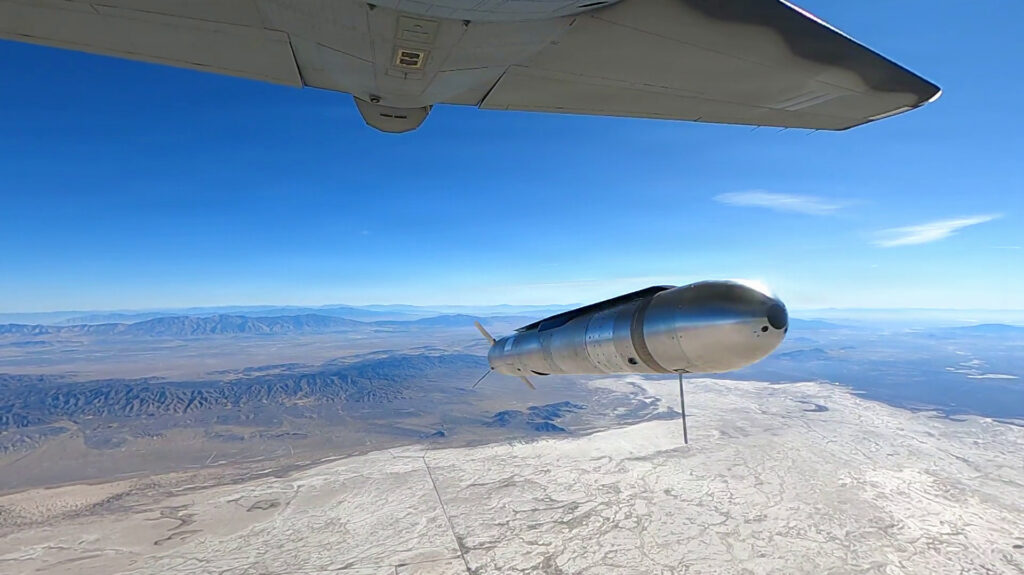
NATIONAL HARBOR, Md. — Air Force special forces are seeking to integrate a new cruise missile built by Leidos on “every type” of platform possible, after the weapon’s use in a live combat operation showed its effectiveness, according to officials.
In a press release published today, Air Force Special Operations Command (AFSOC) revealed that the AGM-190A Havoc Spear cruise missile was used to strike targets in US Africa Command (AFRICOM)’s area of responsibility on an unspecified date. The combat evaluation involved two missiles launched from an AC-130J hitting two separate targets, according to a spokesperson for AFSOC.
“Our ultimate goal is to try to get this on every type of SOF [special operations forces] platform as well as conventional platform possible, in multiple launch modes,” Col. Robert Johnston, AFSOC’s director of strategic plans, programs and requirements, said during a briefing with reporters ahead of the announcement. “The intent really is to have it wide scale as much as possible.”
The 200-pound class Havoc Spear has a range of over 400 nautical miles (460 miles), according to Leidos. Josh Cantera, who works on AFSOC’s requirements staff, said during the briefing that the AGM-190A’s cost per unit in low-rate initial production is roughly $600,000. Work on the weapon kicked off in 2022 via a cooperative research and development agreement with Leidos, Cantera said.
Johnston explained the Havoc Spear was developed in response to a Special Operations Command requirement, but added that the weapon “could nest very well within” an Air Force program dubbed the Family of Affordable Mass Missiles. The FAMM program is aiming to produce thousands of lower-cost munitions to boost the scale of America’s missile arsenal, whose inventory has been depleted amid war with Iran.
“If we can nest it under there, and the Air Force thinks it’s valuable within that FAMM portfolio, now we’re postured to take full advantage of that, and we can now use their resources in order to do more of a bulk buy,” Johnston said.
Special Operations Command awarded Leidos a $27.2 million contract for the Havoc Spear on July 8, according to a Pentagon announcement. Cantera said missiles ordered under that contract should start arriving “around next fall,” and that AFSOC will “be looking to employ them when the time is right.”
One challenge to scaling up, however: A high operational tempo means AFSOC has a limited number of platforms available to do tests with.
“To be quite honest, with current operations, we have to piecemeal what assets we can actually employ and get test dates on,” he said. But the team is “trying for multiple aspects” including “any kind of aerial delivery, whether it be from the back of a [C-]130 of any variant, or whether it be from a pylon of any variant.”
In the near term, AFSOC will be training crews on how to deploy the AGM-190A while working with Leidos to ramp up production, according to Cantera.
“And long term, the Havoc Spear is a very modular missile, and so we can go many different directions with new payloads and new missions,” Cantera said. “But we are not that far yet.”
During a briefing at Air and Space Forces Association conference today, Leidos CTO Doug Jones told reporters that the company’s production facilities in Huntsville., Ala., have the capacity to build up to 15,000 Havoc Spear units per year. The company is also working on non-kinetic and palletized versions of the missile.
Valerie Insinna contributed to this story.
PHOTOS: AFA 2026

 Gallery