Army photo

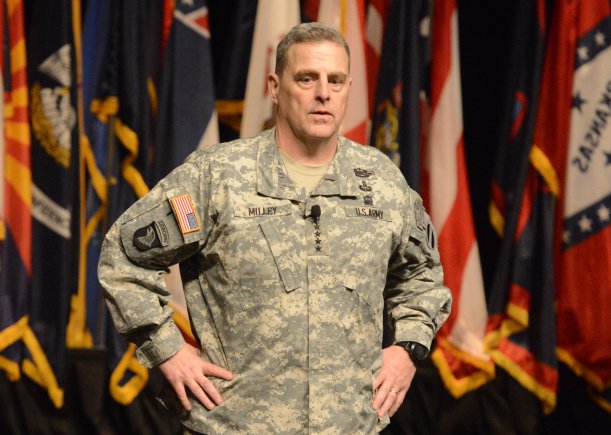
Gen. Mark Milley

UPDATED: Russia is No. 1 threat, Milley tells Senate; give “defensive” arms to Ukraine
CAPITOL HILL: The world has changed, and not for the better. That’s the message Gen. Mark Milley brings to the Senate this morning.

The current Army Chief of Staff, Gen. Raymond Odierno, has often said the Army cannot execute the national strategy if the Budget Control Act caps (aka sequester) go into full effect. Gen. Milley, his designated successor, goes further: He says the current strategy may be too optimistic.

In 63 pages of questions and answers provided to the Senate Armed Services Committee (and Breaking Defense) in advance of the hearing, the prospective Army Chief of Staff warns that the foundational 2012 and 2014 documents defining the current strategy may have been overtaken by events — events like the rise of the Islamic State, Chinese brinksmanship in the Pacific, and the Russian invasion of Ukraine.

Sydney J. Freedberg Jr.

Gen. Mark Milley talks to a senator after this morning’s hearing.

“The 2012 Defense Strategic Guidance was based upon a number of assumptions, such as the duration of conflicts, the contributions of our allies, and the nature and location of future threats. Some of these assumptions now appear optimistic,” Milley writes. “The 2014 QDR [Quadrennial Defense Review] was based on a set of facts and assumptions that did not include the current situation in Eastern Europe and Russia, the rise and spread of ISIS along with the disintegration of the nation-state in the Middle East, and the increasing military capability and foreign policy assertiveness of China. In short, the world has become more uncertain and unstable since the 2014 QDR was written.”

What does that mean for the US Army, currently cutting 40,000 troops and expected to lose another 30,000 under sequester? “The U.S. Army will continue to shrink,” Milley writes bluntly. “However…the demand for ground forces will continue to increase.”

“Right now the level of uncertainty, the velocity of instability, and potential for significant inter-state conflict is higher than it is has been since the end of the Cold War in 1989-91,” Milley writes. The italics are ours, but the emphasis is the Pentagon’s: The outgoing chairman of the joint chiefs, Army Gen. Martin Dempsey, also argued in his recently released National Military Strategy that the risk of war between nation-states, while still mercifully low, is growing.

Milley assesses risk across three crucial missions for the Army. The first and most critical is homeland defense, which he’s confident the service can handle. The second priority is global engagement and partnership-building, which the service has enough forces for, albeit with worrying “strain” and “stress.” The third, Milley says, is “to project power and win decisively” — as in a major war: “Here, the risk is significant and trending higher.”

UPDATE: What’s more, Milley made clear this morning, such a war would be “a different fight than what we’ve been dealing with for the last decade and a half. We’ve got ways to go with improving our readiness with respect to higher-end type of combat operations.” UPDATE ENDS

That’s a critical problem. The service has many missions, from disaster relief to logistics support, Milley told the senators in his opening statement this morning, but “our reason for being,” he said, “the core of what it means to have an Amy, is to win and win decisively in ground combat against enemies of our country.”

UPDATE: So what’s the No. 1 threat to the United States? “I’d have to say it is Russia,” Milley said in response to Sen. Joe Manchin this morning. “Russia is the only country on earth that retains a nuclear capability to destroy the United States, so it’s an existential threat.”

To deter Russia and reassure allies, Milley said, “additional ground capabilities are necessary” in Europe. He also favors providing “lethal defensive equipment” to Ukraine, Milley said in response to questions from SASC chairman John McCain. Overall, Milley said, while we can’t predict Russian intentions, their track record of aggression — Estonia 2007, Georgia 2008, Ukraine and Crimea 2014 — suggests we need to be prepared to face a nation-state threat. UPDATE ENDS

Milley doesn’t ignore the kind of counterinsurgency and counterterrorism operations that have consumed the Army (and Marines) for most of the last 15 years. Nor does he slight the global partnership-building that was a major emphasis of Odierno’s. (Milley himself has worked in Colombia, Somalia, Haiti, and Korea, as well as Afghanistan and Iraq). Nor does Milley overlook the rise of so-called “hybrid” warfare, in which states act like guerrillas and non-state groups act like states. (Russia’s “Little Green Men” and the Islamic State are the two main examples). But like Dempsey, Deputy Defense Secretary Bob Work, and Undersecretary Frank Kendall, Milley emphasizes the threat from sophisticated adversaries who can catch up with our technology.

“Both state and non-state adversaries have employed novel capabilities, created by combining increasingly available military and commercial technologies,” Milley writes. “The Army currently benefits from an overmatch that enables a historically small number of Soldiers to accomplish significant operations while minimizing casualties. This advantage has a shelf life; the technologies that gave us the advantage today are increasingly available to state and non-state adversaries at dramatically lower cost than even a decade ago. As that overmatch degrades, the risk to Soldiers increases.”

So while Milley says “my #1 priority, if confirmed, will be readiness” — an Army obsession since the Korean War and currently at half the service’s goal — “our #2 priority is to invest in the technologies, organization, and doctrine that will allow us to maintain overmatch.”

Specific technologies called out for investment include cyber, big data, and networks; robotics and autonomy; human performance enhancement; advanced munitions, rail guns, and lasers; nanotechnology, 3-D printing, and “advanced materials for mobility and protection.”

Just don’t expect a revolution any time soon, Milley says, echoing comments by Army acquisition chief Heidi Shyu: “Given fiscal constraints, the Army will likely have to continue to delay our next generation of platforms” — that is, no new tanks, helicopters, or missiles any time soon.

UPDATE: It wasn’t all gloom at the Hart Senate Office Building this morning, though. Rhode Island senator Jack Reed, the top Democrat on the committee, caught himself pronouncing the general’s name with a long “i” — as if it were “Miley” — and triggered a mini-seminar on New England dialects.

“I get confused b/c up our way it’s MY-lee,” Reed said.

“That’s in Rhode Island, sir,” Gen. Milley said gently.

“And you’re from Massachusetts, I know,” the senator said. “Forgive me if I mispronounce things.”

“As long as we both like the Red Socks,” said the general. UPDATE ENDS

Updated 10:30 am, 2:30 pm & 10:15 pm from Gen. Milley’s confirmation hearing.

Comments

  • John King

    Certainly our military is shrinking, as it should. With our European and NATO allies having an economy as big as our, they need to pick up their share of the burden, rather than having us borrow money from China, Japan and the Middle East sovereign wealth funds to pay for their defense. And by their share, I mean at least doubling THEIR militaries! If THEY feel so threaten by Putin, it’s for them to put up or shut up. It’s called tough love!

    • adaptus primus

      I’ve been hearing this argument a lot. But if that’s the case, you think US can still boss around NATO and expect our allies to follow our lead? Is a military strong EU in the best interest of US for the long run? Same goes Japanese re-militarization. Becareful what you ask for.

      • John King

        No, we shouldn’t be bossing NATO around. It’s THEIR countries. Yes, a strong European army is in our best interest, but that doesn’t mean we should shoulder nearly 70 percent of the burden. Most of these countries are wealthy and spend massive amounts on consumer goods. Time for them to “buy” some national security with that money, and if they don’t, then they’ve voted NO.

        • Roger Fish

          I hate to tell you this. The only way NATO can move around outside of Europe is by Americas power projection ability. We have Russia and China starting to act like fools yet alone the JV team ISIS. The world is getting very dangerous and cutting the military is the last thing we need to do. When the next world war starts it wont be won by the homeless/Food stamp programs or the legions of people on welfare it will be the solders that pay the price for this. Europe does not have the guts to fight a war anymore and if we don’t the west is done and gone.

          • Guest

            The world will get better when the State Dept and the DoD, with a nod and a wink from Capitol Hill, decide to allocate more money into transferring top flight Islamist brigades from Libya, Saudi Arabia and Turkey directly to Ukraine.

          • Jawaralal_Schwartz

            Roger that, er, Roger. R U ready to suit up for the next war you cite (want?), or perhaps just send the grandkids?

          • Roger Fish

            I am a few months away from 50. Now if you want to bring this up ill tell you this. In high school I took JROTC because there was the very threat of a war with the Soviet Union. I figured going in as a E3 would be better as just a private and JROTC I would become a Non Com Officer faster than starting out as a private. I was willing to join if was needed. What would be the cost if we don’t go to war with our foes? ever hear of WW2? and Neville Chamberlain peace in our time speech???

          • Jawaralal_Schwartz

            Ok. I get it. U want war more than most people and are confused about military action vs. diplomacy. Have a nice day.

          • Roger Fish

            There is a difference between being ready for a fight and actually getting into one. If your foe knows you will fight if pushed hard enough He has 2 choices to make. Start a war or don’t. That is a form of diplomacy and oh he is the one making that choice for a fight not me. Understand now?

          • Jawaralal_Schwartz

            You cannot have known war.

    • http://www.krantvannederland.nl/ Cees Boogaart

      That story goes around alot, except nuclear, non USA troops and weapons are the majority of NATO in numbers, and those 70% of costs?

      As long as its only used for playing around in drills its wasted money,, as timothy snyder said just 20.000 NATO/EU force could have prevented invasion in Crimea/east-Ukraine, https://youtu.be/yoUkoGn7cRU?t=1h23m7s but the “boss” of NATO, USA choose to call it a incursion a whole year, and said to Putin, do what you have to do…so despite Budapest Memorandum and sagging about costs, its all for the show and not really for the better of the world with its 900 bases in 153 countries…

      http://www.motherjones.com/politics/2014/11/america-still-has-hundreds-military-bases-worldwide-have-they-made-us-any-safer

    • PolicyWonk

      Indeed – if the NATO nations are now concerned about Russia and want US forces to be present to help counter the threat: they should be willing to PAY for our forces presence, which should be gradually dissipated as they increase their defense budgets.

    • fartoomanyaccounts

      The issue of NATO unity and the question of whether our erstwhile Western European allies are doing their part to handle the threat of Russia in Europe are definitely vital concerns.
      Well, no, let me rephrase that: there really is no question whatsoever that our European friends–particularly our populous, rich, Western European friends–aren’t doing nearly enough.* The big questions are: (1) whether that’s going to change anytime soon and (2) how long the United States will be willing to put up with them not doing so before we reach the point of insisting that some fundamental changes about NATO–including changes as to the membership of NATO–need to be made. Who knows what the future may or
      may not bring, of course, but present trends certainly seem to be headed
      towards a place where the answers to those questions could be (1) no, never and (2) not nearly as long as those Western European allies might still be assuming.

      *The evidence for Europe not pulling its fair share of the weight is so clear that it shouldn’t be necessary to go too far into the subject here. But just to illustrate…
      Let’s say that Europe woke up tomorrow morning to find that every country except the UK, France, and Germany had ceased to exist. (Well, and Russia,
      obviously. And maybe the Baltic states, to give Russia some neighbors to try to reconquer.) Those three major European powers would together make up a new European NATO that would still have about 50 million more people than Russia does today and a GDP about 7x what Russia today. Plus a considerably more technologicallyadvanced defense/industrial base. In other words, Russia should have no chanceof being able to compete militarily at all, even in this-most completely absurd scenario. Now, add the rest of Europe back into NATO.
      Russia should pose absolutely no conventional threat to any country in NATO whatsoever. The fact that it does says as much about NATO’s weaknesses as it does Russian desire for greatness through piecing back together what parts it can of the Soviet Union.

    • Brainiac3397

      I think this reliance on US=NATO was something fostered during the Cold War, where the US was basically at the forefront of NATO contribution and policy. However, now we need to make them understand that NATO is a multilateral organization thus the US shouldn’t be the biggest contributor of it.

      I’m not saying the US should just dump all the responsibility on them, but there should be a movement towards more multilateral cooperation so these countries at least feel some of the load of NATO. A touch so they get used to it, then slowly increasing it each time till they grow accustomed to handling the level of responsibility delegated to them.

      It’d be hard to argue for the US to significantly decrease their contributions. In the end, the US is still a global power and it’s influence and capabilities will be reflected by how much it contributes to NATO.

  • originalone

    Considering the state of the U.S. involvement in the M.E. today, exactly what has been achieved, aside from blowing up infrastructure that housed the civilian populations thereof, killing more innocent civilians than actual military aggressors, raising the debt of the U.S./future generations to pay for these C-F’s that have been created, and now, this General states war with Russia, to which the “Mother of all C-F’s” will be the end result, if not to humanity as we know it. Do have to hand it to the men in uniform, they sure have the “doom & gloom” down to a science. I noticed he mentioned “3-D” printing, which I guess means that now the “money tree” will be replaced, i.e., the printing press @ treasury. Of course, not one of the planners so far have been held responsible for the C-F’s to date. Hell of a way to instill confidence that they know what they’re doing? That goes for the Congress too.

  • Jawaralal_Schwartz

    The general has a great reputation, but he sounds a bit like Trump. We don’t measure capability and effectiveness by uniformed headcount. We do it by confirming the extent and deliverability of lethal force. That’s indirect to headcount–and in many ways indirect to dollars, given that so much funding is wasted.

  • http://popularsovranty.org/ Malcolm Kantzler

    The mission of the top military commanders, these days, is to put forth the worrisome news of the military-industrial complex (MIC), for which, there are never enough bases, never too few enemies, never enough troops or advanced-enough weapons, never a receding threat, and especially when preaching to congress, never enough money.

    For decades, the basic position has been that the U.S. military stands prepared to deal victoriously with conflict on two major fronts and a third, minor one. Well, with Russia and China as major, and IS as minor, what’s changed? Is the message, now, that the military has failed in the objective prior to cut-backs and threats of sequestration?

    Gen. Milley didn’t say what others are saying about Iraq, that we need to go back; nor is he giving any due to the fact that as long as we are out of Iraq and pulling down in Afghanistan, we don’t need the troop levels we once did. Nor did he mention the harm which totally ineffective procurement of inordinately expensive systems, like the F-35, has done and will continue to do to military budgets and planning, or the fulfillment of tactical combat objectives, nor could he say that there is reward for that excess, or a plan to correct the procurement and contracting process which allows good systems, like the A-10, be threatened to be replaced by lesser ones with which the only unquestionable trait is the back-breaking cost.

    The last time, it seems, that a major military commander spoke as a patriot with concern for the nation as a measure of proper defense, vested in a military in its proper place, was former WWII allied commander and President Eisenhower, in his farewell speech, warning of the dangers, from within, of a military-industrial complex, then already a threat in his eyes, gone out of control in the future. Eisenhower said that uncontrolled growth was the most serious internal threat facing the nation, and his warning, as evidenced by questionably needed and dubiously effective, yet monstrously pervasive and expensive weapons programs, like the F-35, and most recently, by Gen. Milley’s statements, has not been heeded, and the feared outcomes of not curbing the MIC have been realized.

    When will the generals of today access the threat they create with their own out-of-control appetites to keep the enormous wheels of the military-industrial complex, the defense establishment, turning, regardless of the state of draw-down or escalation of combat activities. How much more of the GDP and national debt must be bayoneted out and put into their rucksacks for them to say, “enough?”

    • herbloke

      The mission of the top military commanders, these days, is to put forth the worrisome news of the military-industrial complex (MIC), for whi….
      Incorrect sir, the number#1 priority is preventing sexual assault and harassment in the ranks. First statement before any briefing by any officer of any rank.

      • http://popularsovranty.org/ Malcolm Kantzler

        Not incorrect; not the context you reference. I guess I should have specified I was referring to the context of Gen. Willey’s statements, which were on defense policy and in testimony before congress, or as they are before other bodies where defense strategy is the subject.

  • Bluhorizons

    My Googling reveals that the US spends about $680B/year on defence, as much as the next 24 nations combined, most of whom are allies. Apparently, for the generals, this is not enough. The intriguing question is: How much is “enough?” Apparently the answer is “The sky’s the limit.”

    One may recall that the “sequester,” which caused limitations on military spending was the product of the Republicans refusing to raise taxes on the very rich. I am sure the administration would be willing to discuss this subject as soon as the Republicans care to reopen the discussion.

  • Jiesheng Li

    If Russia is the threat to all these new Commanders, then what about the Asia Pivot? Are they confident it’s handled effectively?

  • Kit Rice

    I think that you should start an alliance of the 200 Generals, gather up all of congress that agrees with you, get all that have gotten up petitions to stand with you and go on to the pentagon and force the supreme court to honor all the petitions that have been filed against obama. There is power in numbers and I think that most of the USA citizens are getting scared enough to stand behind you. It would not be so bad for us to go to a FEMA camp, we are odder folks, yet what scares me the most is for our future generations. I would hate to see them starve, no education, and to have to endure what ever else will befall them in these camps under dictator obama’s muslin laws. Please, you have the power if you all pull together and we will pray that you can get him jailed or something to get him even out of our country would be wonderful We have got to get him out of office if it is not too late already and get out country back. I admire all of you who are willing to stand up to obama and I will have your backs. This article, if true, scares me to death. I am so afraid for my grand and great grand kids. Please push this and push hard. We need somebody with power to do this for us. Please help. http://www.westernjournalism.com/obama-executive-order…/