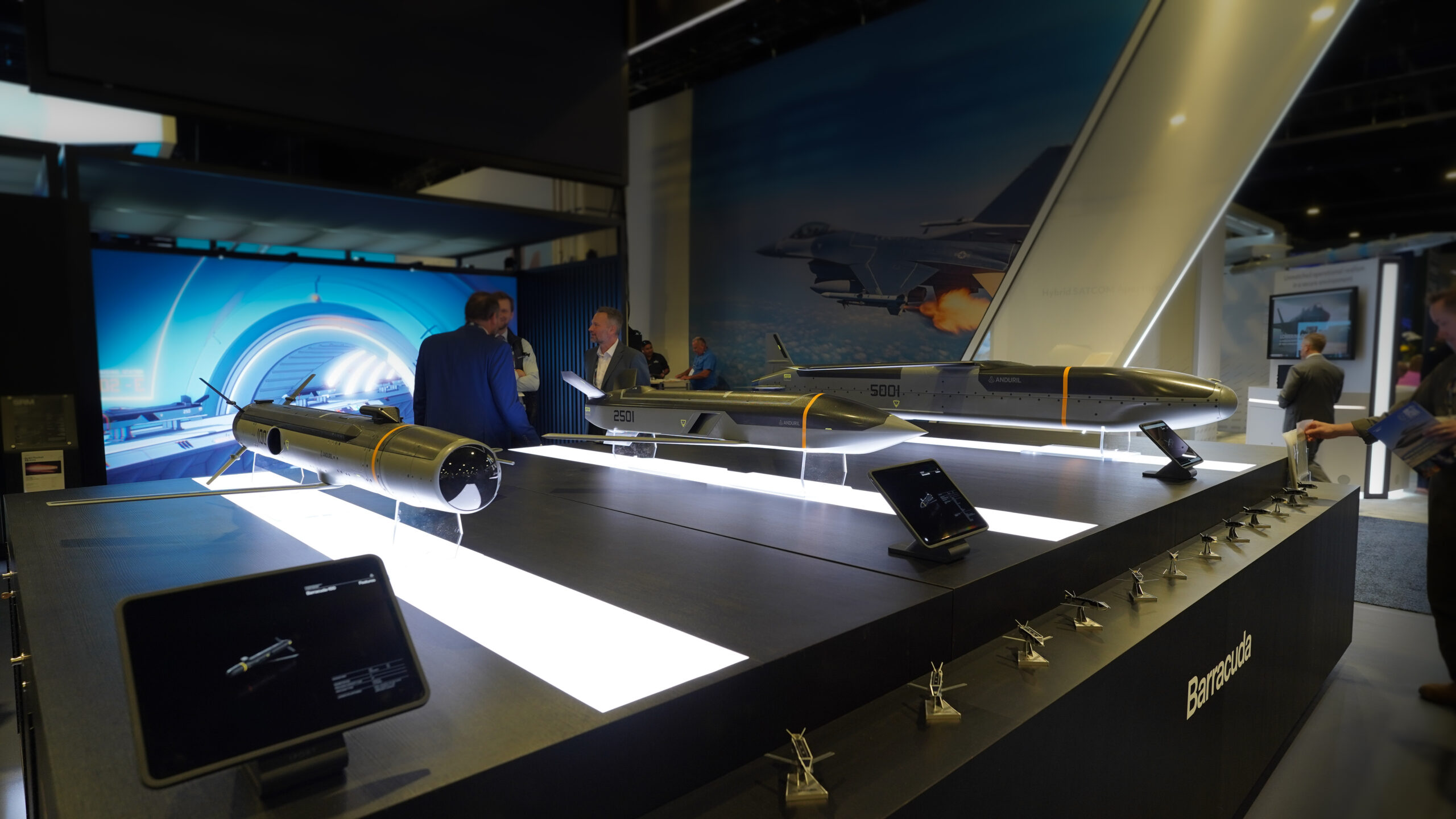
WASHINGTON — Arguing that many of today’s options don’t do the trick, Anduril worked to make up something quick: a new family of air-breathing, autonomous air vehicles, akin to cruise missiles or one-way drones, which the company calls “Barracuda.”
Unveiled today, the weapon comes in three configurations — the Barracuda-100, -250 and -500 — with each increasing in size and payload. According to the company, the largest configuration can offer a range of greater than 500 nautical miles and over 100 pounds of payload. The two smaller configurations have lower ranges and offer a payload of 35 pounds. The company says each of the three variants can fly at speeds of up to 500 knots. “The problem that we are seeking to solve here … is America and our allies and partners do not have enough weapons, full stop. And we are not capable of producing the volume of weapons that we’re going to need to establish deterrence against a peer competitor,” Anduril Chief Strategy Officer Chris Brose said in a briefing with reporters ahead of the announcement.
To do that, Anduril is striving to minimize defense-specific materials needed to produce the Barracuda and maximize the use of commercially available components. Depending on configuration, the weapon is compatible with different launch methods, the company says, such as from aircraft internal weapons bays, external rails, surface vessels, and ground-based systems.
While the Barracuda may be new to the public, Anduril Vice President for Air Dominance & Strike Diem Salmon revealed the weapon has been selected for the early stage of a joint Air Force and Defense Innovation Unit effort to develop a low-cost air vehicle.
Additionally, Salmon noted that the Barracuda can come in a -M configuration — denoting the qualities of a cruise missile or munition — and that modular features mean that the system is capable of “a lot of different things.” Working together in either manned-unmanned or purely unmanned teaming, Brose said Barracudas could offer different capabilities like decoys, target detection and strike.
At the core of the Barracuda enabling that autonomous collaboration is software, harnessing Anduril’s Lattice platform that serves as the foundation for much of the company’s weapons development. Called “Lattice for Mission Autonomy,” the software could enable some ways to defeat adversary countermeasures, says Salmon, as well as smooth the way for upgrades.
“What we have sought to do with Barracuda is solve that problem [of limited production] at the level of design, to build a system that is simple, that is easy to manufacture, that is software-defined and mass-producible,” Brose said.
Speak Now: Will Voice Commands Control Drone Wingmen?
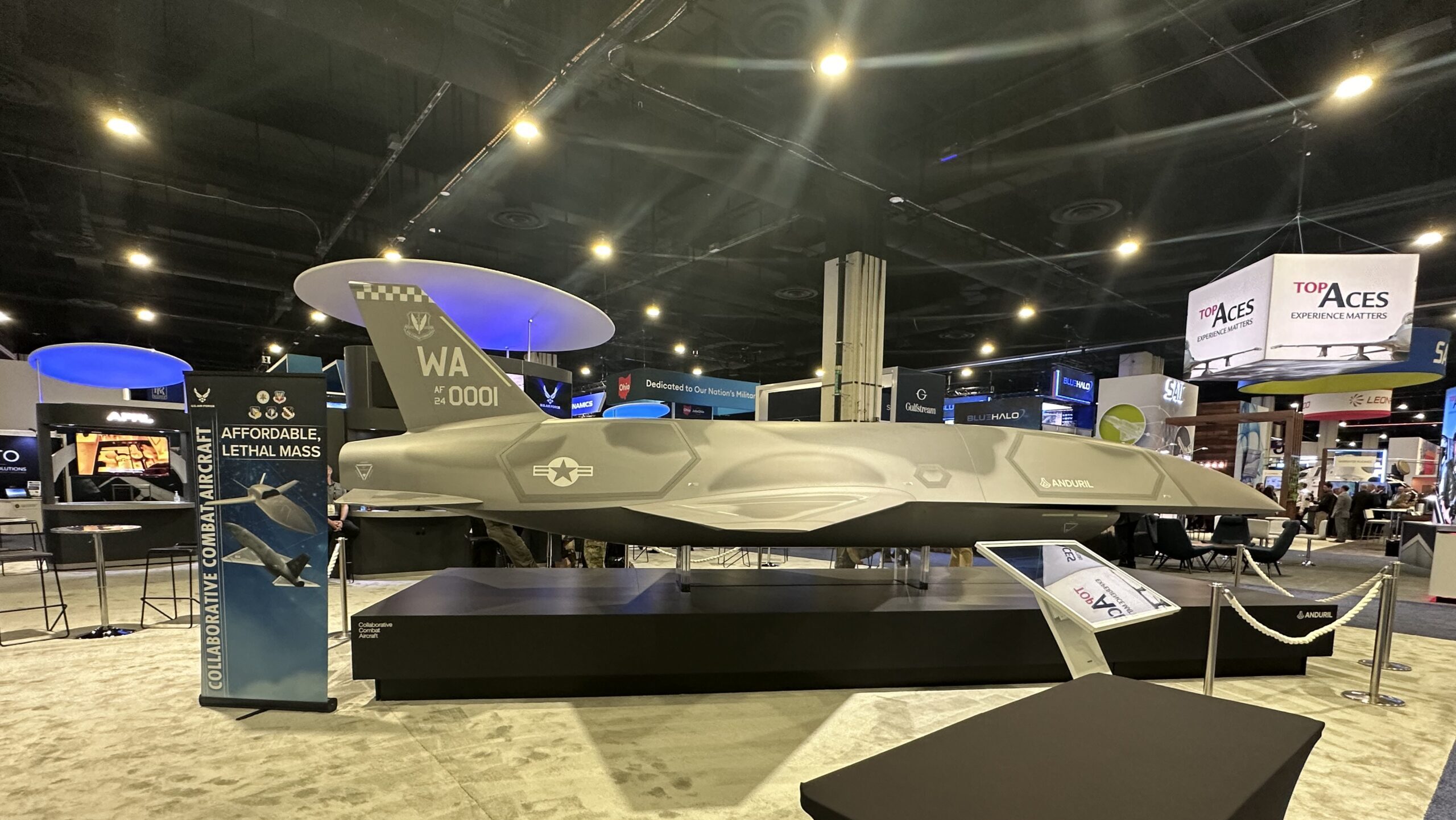
The Lattice software is also core to other high-profile efforts from the company. At a location in west Texas, the site of Anduril’s largest test range, company officials on Tuesday invited reporters to view a demonstration of what they think could be a step forward for programs like Collaborative Combat Aircraft (CCA), the Air Force effort to field drones that can join fighter jets in battle: voice commands to control drones in the heat of a fight.
The demo consisted of four mid-size, jet-powered drones, which the company referred to as “clay pigeon” jets. The drones took off from the company’s runway, then synched up in formation before being tasked to sweep virtual enemies from the area.
A simulated adversary aircraft then crossed into their airspace. Once the threat was detected, the fleet of drones asked for permission to blow up the enemy.
“Authorization requested for approval,” an AI voice asked, somewhat akin to Apple’s Siri voice assistant.
Armed with a laptop and microphone, an operator gave his consent for one of the four drones to eliminate the threat.
“Mustang 11, engage,” the operator replied. Within seconds, the Mustang 11 drone released a simulated missile — shown on a screen during the demo — downing the virtual enemy aircraft. Its job complete, the drone resumed its route alongside its fellow unmanned wingmen.
Anduril officials say it’s testing like this that can help burn down risk for efforts such as the CCA program, where the company and competitor General Atomics are on contract with the Air Force to build prototypes. Using Anduril’s Lattice autonomous software, engineers here inserted voice command capabilities with the aim of reducing cognitive load on pilots and other potential operators.
“We want our pilots to be able to command uncrewed platforms. They’re going to need to be able to do it inside the cockpit while they’re doing other things, their hands and eyes are already very busy, the environment is shaky. And a voice command interface will allow them to work with these uncrewed platforms pretty easily,” Andrew Burke, an Anduril mission software engineer, explained ahead of the demonstration. (Like other media, Breaking Defense accepted accommodations from Anduril for the trip.)
While this event involved the air domain, Anduril is developing the Lattice mission autonomy applications for other environments like the land and sea. Salmon said the software is “open and hardware agnostic” including for platforms produced by other companies. That could make the software a candidate for programs like a parallel CCA autonomy effort that the Air Force says has five companies on contract, though Salmon declined to comment on whether Anduril is involved.
And, according to Kevin Chlan, senior director for Air Dominance & Strike at Anduril, the company is exploring other tools like large language models — think ChatGPT — for drone operations. For example, Chlan said, an operator could ask a drone for a readout after a long patrol. The capability has been tested in simulations and could soon be introduced in a live environment, he said.
While the ability for a single operator to control small fleets of drones showed progress, company officials acknowledged that challenges remain, such as overcoming adversary interference in guidance systems. Still, with a focused development and specific use case, Salmon said her goal for fielding the technology that enabled the demonstration would be only a couple years away.
The voice command demo, which required the operator to give permission to a drone to fire, additionally highlighted debates around the permissible degree of autonomy for a lethal weapon system, a problem that Air Force Secretary Frank Kendall previously told Breaking Defense needs more work.
Chlan acknowledged the issue and said Anduril is striving to abide by relevant DoD policies that guide the use of autonomous weapon systems. Still, he noted that policies can change over time, and it’s always possible to build in a type of dial into the software that governs degrees of autonomy and can essentially be turned up or down.
“So I think that as long as we think about the software that we’re building that has the ability to kind of scale up and down with the policy, I think we’re doing right if we do that,” he said.
PHOTOS: AFA 2024

 Gallery