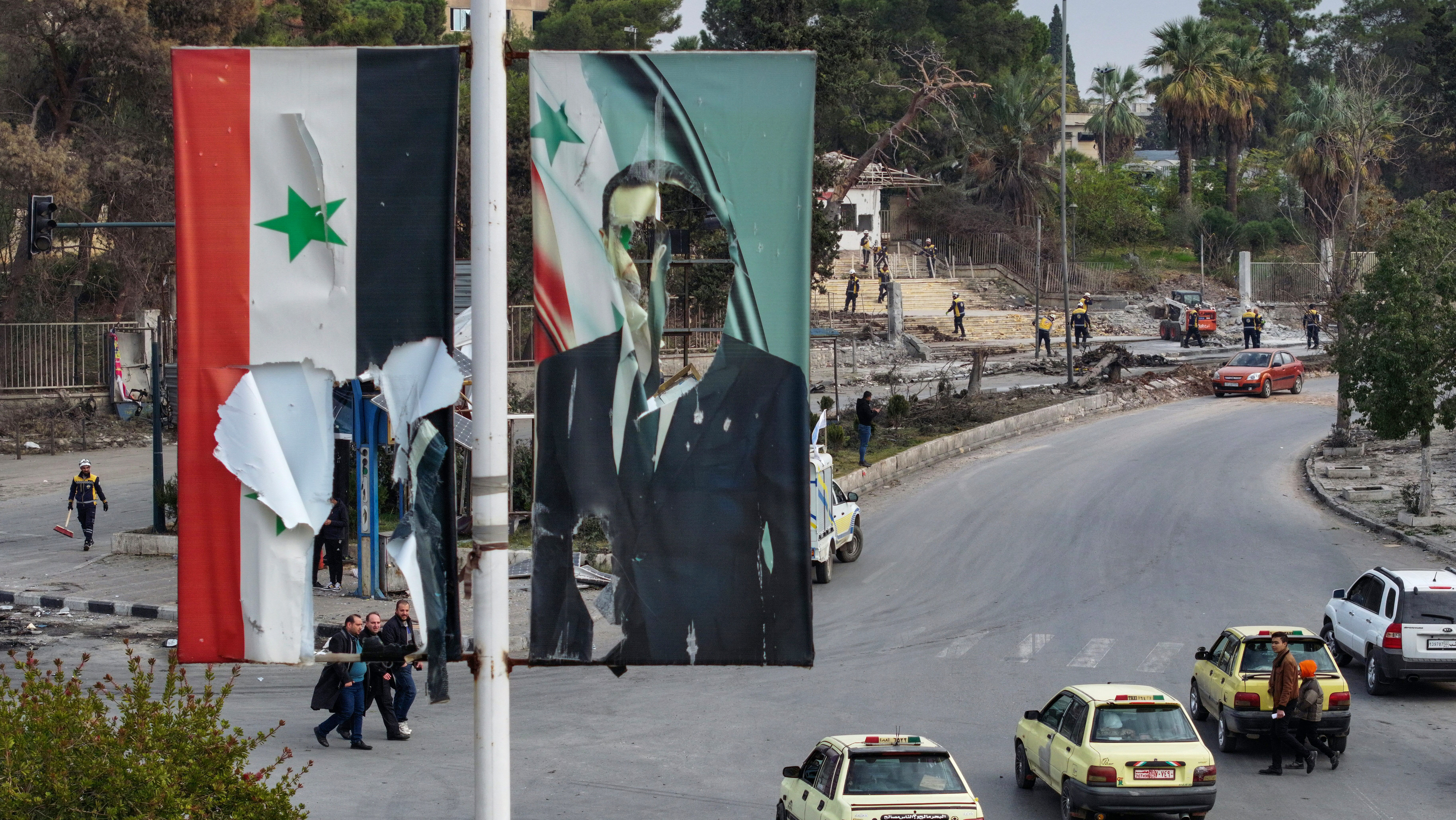
BEIRUT and WASHINGTON — As shockwaves from the sudden downfall of the Syrian regime reverberate throughout the Middle East and around the world, government officials in the region and in Washington appear to be taking a hopeful but cautious approach as they weigh what might come next.
“It’s really ‘wait and see,'” Anwar Gargash, diplomatic advisor to the president of the United Arab Emirates, said at the Manama Dialogue in Bahrain, adding that “ultimately salvaging the situation” would mean Syria emerges as a “credible nation-state.”
After over a decade of civil war, the end of Assad’s regime came shockingly quickly. In just a few weeks, rebel forces swept through the country, and on Sunday morning local time captured Damascus. Per a Russian government statement, Assad had fled the country, and Syrian officials remaining inside the country have issued statements announcing they will work with the victorious forces to develop a new Syrian government.
Gargash emphasized that “it’s still a very tense and difficult time in the region,” adding that sudden collapse of the Assad regime “is a clear indication of political failure, and the destructive nature of conflict and chaos.” (Gargash also reportedly said he didn’t know if deposed Syrian leader Bashar al-Assad, whose location is unknown, had fled to the UAE.)
Gargash said the UAE was concerned about the future of Syria’s territorial integrity, about more broadly “getting out of this spiral of chaos and violence” since the Arab Spring in 2011, and about the potential rise of extremism in the power vacuum left behind.
Saudi Arabia, the most powerful Sunni-dominated nation in the region, said in a statement that it “expresses its satisfaction with the positive steps that have been taken to ensure the safety of the brotherly Syrian people, stopping the bloodshed, and preserving the institutions and capabilities of the Syrian state.”
Qatar announced today that it is “closely monitoring the developments in Syria, and underscores the necessity of preserving national institutions and the unity of the state to prevent it from descending into chaos,” according to a statement by its Ministry of Foreign Affairs.
The Qataris called “upon all parties to engage in dialogue to safeguard the lives of the citizens, protect the national institutions of the state, and ensure a better future for the brotherly Syrian people and fulfill their aspirations for development, stability, and justice. Furthermore, the Ministry affirms Qatar’s unwavering support for the Syrian people and their choices.”
The ministry of foreign affairs of the Kingdom of Bahrain called upon all parties and components of the Syrian people to “give priority to the best interests of the country and citizens, and to preserve the state’s public institutions and the safety of its vital and economic facilities.”
A senior Turkish official, likewise, reportedly said the international community must help the Syrian people rebuild the nation, and keep extremists at bay.
The caution was reflected among US officials as well. At the Manama event, Daniel Shapiro, the deputy secretary of defense for the Middle East, said that “no one should shed any tears over the end of the Assad regime” and said it was the “direct result” of Assad’s “ongoing atrocities.”
But he called on all parties in Syria “to protect civilians, particularly those from Syria’s minority communities, to respect international humanitarian norms and to work to achieve a resolution through an inclusive political settlement, consistent with UN Security Council at Resolution 2254.”
Shapiro said the US will maintain its presence in eastern Syria, and “as we watch developments in Syria change by the minute, we will continue to consult closely with regional partners who are affected by this crisis to support their security needs. Our commitment to them remains stronger than ever.”
Speaking at the Reagan National Defense Forum the day before Assad’s government collapsed, White House National Security Advisor Jake Sullivan said that the regime had been left “naked” and unprotected by its usual backers: Iran, the armed Lebanese group Hezbollah, and Russia — all of whom have themselves been dramatically weakened by other conflicts.
The US, however, has long been concerned about what happens next, and whether extremists could take advantage of the power vacuum. ISIS, for instance, was already attempting to “reconstitute” itself in the Syrian desert. “We are going to take steps ourselves directly and working with the Syrian Democratic Forces, the Kurds, to make sure that does not happen,” he said.
Beyond containing ISIS, Sullivan said the US would work to protect allies in the region, like Israel and Jordan, from a spillover of violence and would do what it could to head of any humanitarian crisis that followed the change of power.