










UPDATED 10:55 with Deputy Assistant Secretary Miller comments HUNTSVILLE, ALA: After 20 years of costly and cancelled programs, the US Army wants to break its weapons-buying system wide open. This time, service leaders swear, will be different from previous, failed reforms. The pinnacle of the new process will be something called the Army Warfighting Assessment,…
By Sydney J. Freedberg Jr.New Army mounted system won’t play favorites when it comes to C5ISR, EW and A-PNT
The CMOSS Mounted Form Factor will facilitate tech insertion for new capabilities while co-existing with the Mounted Family of Computer Systems.
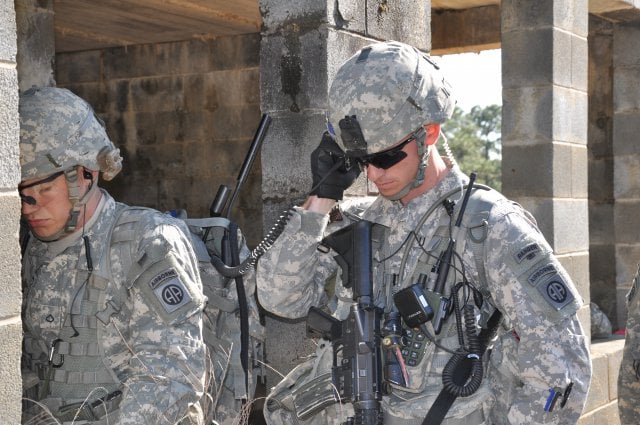
As the Army prepares to choose the new builder of its handheld digital radios, the incumbent contractors are tryiing to convince Congress to keep other companies out. The incumbents are General Dynamics, which publicly apologized to the Army over its half of the program last year, and Rockwell Collins. The Army’s own chief of acquisitions,…
By Sydney J. Freedberg Jr.FORT LAUDERDALE: It’s unnerving when you learn your program’s fate from the small print in a presenter’s PowerPoint slides. But that’s how difficult government-industry communications can get in the Army’s ambitious attempt to inject innovative technology into its cumbersome procurement process, the twice-yearly Network Integration Evaluations. “A question we’ve been asked many times over: ‘Have…
By Sydney J. Freedberg Jr.WASHINGTON: While Army forces in Afghanistan have more bandwidth and gadgetry than ever, bases back home still make do with archaic copper-wire telephone switches. As the war winds down and units increasingly operate out of the US, the challenge for the Army’s CIO is to move the whole service to a single set of compatible,…
By Sydney J. Freedberg Jr.[corrected Dennis Moran’s title at 3:45 pm] AUSA: General Dynamics issued what the Army’s top tester called a “mea culpa” over its troubled Manpack radio, while archrival Harris sharpened its knives to compete with GD for both the backpack-sized Manpack and the smaller Rifleman Radio. At a briefing for reporters at the Association of the…
By Sydney J. Freedberg Jr.The Army’s new, streamlined approach to improving its battlefield networks took a big step forward this week when five MRAP armored trucks with the latest digital communications gear shipped out to be tested at Aberdeen Proving Ground in Maryland. Testing at Aberdeen is the last major hurdle before fielding what’s called “Capability Set 13” to…
By Sydney J. Freedberg Jr.WASHINGTON: The defense spending bill passed by the Senate Appropriations Committee today keeps Block 30 Global Hawk drones flying, instead of letting them be warehoused as the Air Force had planned, a congressional source confirmed to Breaking Defense. That is arguably the final flourish on Congress’s utter rejection of the Air Force’s proposed cuts in…
By Sydney J. Freedberg Jr.
A new approach to speed, scale and efficiency for the industrial base
Radars, EW, EO/IR, space imagery, and microelectronics are brought under one roof for a streamlined approach to common people and factories.
PENTAGON: The Army showed off an impressive array of battlefield wi-fi gadgetry today in the Pentagon courtyard, exhibiting new-found realism about what gadgets it might not need. Consider the hardware to connect the individual foot soldier to the brigade-wide command network, which has been stripped down from a 14-pound prototype to a militarized smartphone plugged…
By Sydney J. Freedberg Jr.WASHINGTON: An Army general was named Friday to head plans and policy at Cyber Command, based at Fort Meade, Maryland. Maj. Gen. Jennifer Napper is moving from Fort Huachuca, where she headed Army Network Enterprise Technology Command, to Fort Meade, where she’ll be the director of plans and policy — staff section J-5 — for…
By Sydney J. Freedberg Jr.A mobile Army command-and-control system called “WIN-T Increment 2” set up for testing at Aberdeen Proving Grounds. Army Seeks New Network Tech For New Brigades’ Post-Afghanistan Missions The U.S. Army is shrinking, but its appetite for new network technology is only going to grow. Though the military has invested massively in digital infrastructure over its…
By Sydney J. Freedberg Jr.As the U.S. Army tries to field new mobile networking technology to its troops, it is betting that a new testing process built around biannual “Network Integration Evaluations” can avoid the acquisition disasters of the past. Success depends on a new division of labor between government and industry – something which the Army admits it…
By Sydney J. Freedberg Jr.WHITE SANDS, NM: After weeks of testing at the Army’s vast facility here a private summed up the service’s newest iteration of the so-called Nett Warrior communication system in one phrase: “It ain’t ready.” Soldiers with the 2nd Heavy Combat Brigade, 1st Armored Division (2/1 Armored) spent several weeks at the Army’s latest network integration…
By Carlo MunozWashington: Just weeks after the Army canceled the JTRS Ground Mobile Radio system, the service is rushing to test a number of industry prototypes during the Network Integration Exercises at White Sands Missile Range. Army officials have already picked the Harris-built Falcon III wideband radio as the interim replacement for the GMR system, Dennis Moran,…
By Carlo MunozWashington: Time has officially run out on the Army’s Joint Tactical Radio System. The Army will release its proposals request for a new handheld network radio to industry next month, the service’s top uniformed acquisition official Lt. Gen. Bill Phillips said. Army and Pentagon officials decided to nix the Boeing-built JTRS Ground Mobile Radio earlier…
By Carlo Munoz