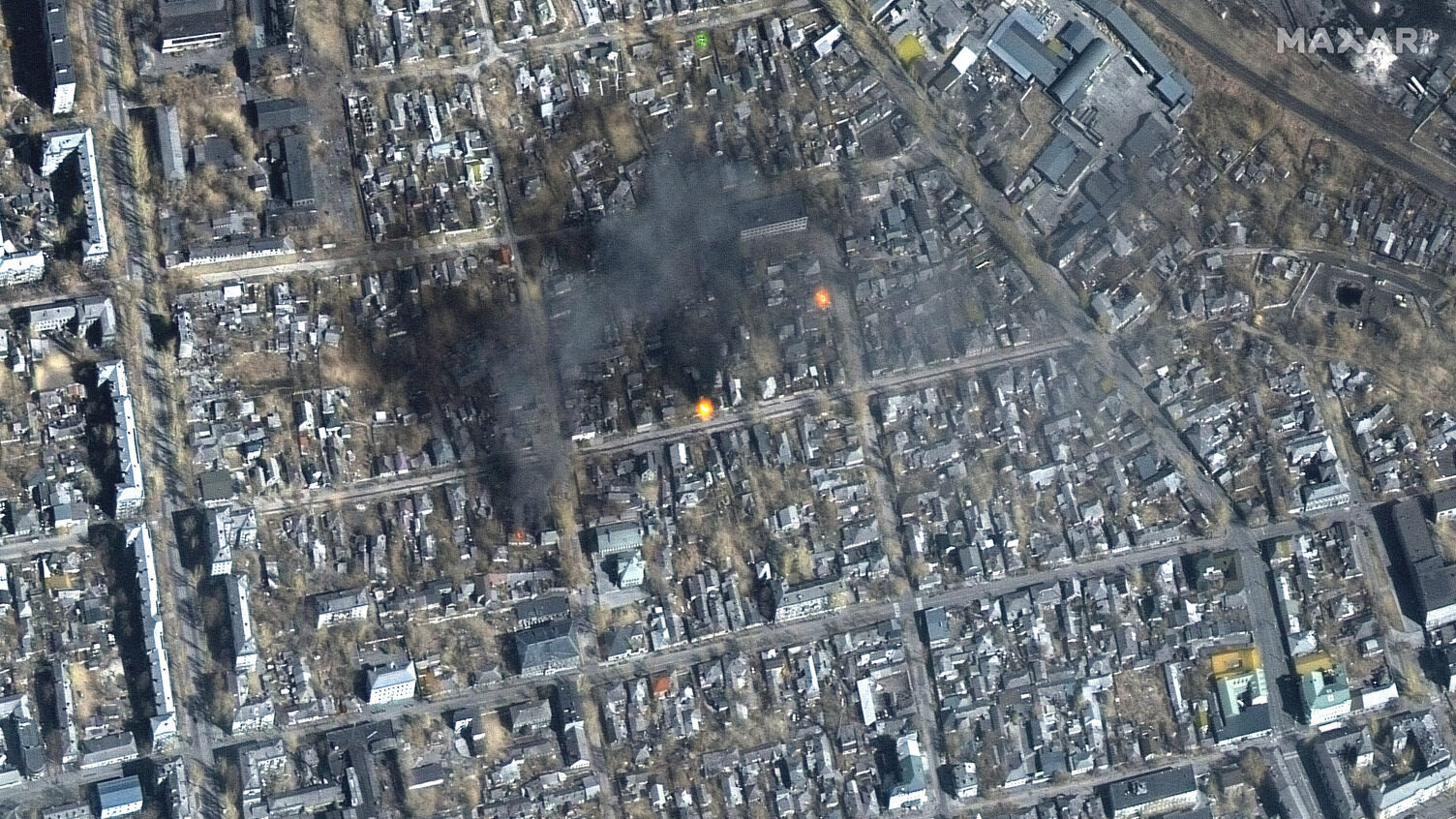
GEOINT 2022: The National Reconnaissance Office will issue formal contracts to chosen commercial providers of electro-optical imagery this summer, Pete Muend, the spy agency’s head of commercial operations said on Monday.
But while those contracts loom, Muend acknowledged to reporters that his organization has not accelerated their planned 2024 decision about a formal acquisition program from another kind of satellite-based capability, synthetic aperture radar (SAR) imagery — even though he noted that both EO and SAR imagery have been game-changers in the Ukraine conflict.
It’s a conflict that one prominent SAR firm CEO, Capella Space’s Payam Banazadeh, said was proving a unique opportunity for commercial firms to show their value.
“I think what makes the situation extremely unique in Ukraine is they’re not a NATO nation, right? So we can’t share the good stuff with them,” he said. “And so that has created this massive opportunity for unclassified American commercial imagery to play a huge role.”
Eyeing The Electro-Optical Commercial Layer
The NRO issued a request for proposals (RFP) for what the agency calls its Electro-Optical Commercial Layer (EOCL) of remote sensing satellites last November. The call for bids was limited to US providers, and at the time the agency said it was looking to issue multiple contracts this spring. EO sats carry sophisticated cameras, often in pairs to allow both wide area views and “spotlight” pictures taken at higher resolution.
Muend refused to comment during his press briefing on why those awards have been pushed back to the summer, saying only that his team has been “working through source selection.”
NRO currently has at least three electro-optical imagery providers under short-term contracts: Last July, San Francisco-based startup Planet announced that NRO has “extended its contract with Planet Federal to provide continued access to Planet’s Dove and SkySat imagery.” Then in August, BlackSky announced that NRO had modified its study contract, and that the company now would be supplying “on-demand satellite imagery through a monthly subscription” in order to transfer it formally into the spy agency’s new EOCL program. Also in August, Maxar Technologies announced that NRO has exercised the second of three one-year options, worth $300 million, on the company’s long-running “EnhancedView Follow-On (EVFO) Service Level Agreement,” which will run through Aug. 31, 2022.
Muend brought up each firm in his keynote speech here Monday.
“On the electric optical side, we’ve been working with our partners — BlackSky, Maxar and Planet — to collect millions and millions of square kilometers of imagery over the the [European Command] area, and Ukraine and Russia and specifically,” Muend said. “Not only just before the crisis, but also on an ongoing basis during the crisis. And we’ve been delivering that data on an ongoing basis to our partners and allies.”
NRO hasn’t revealed details of its planned EO imagery buy or the program’s total budget, saying only that multiple contracts are envisioned. Industry officials, however, have speculated that each of the three vendors now under contract will receive an award as early as June.
For Commercial SAR, No Problems With Cloudy Ukraine
In both his GEOINT presentation and the press briefing, Muend also praised the value of SAR imagery, which can not only image in all weather conditions but also at all day and night, unlike EO cameras.
“But it’s not just about electro-optical, we’ve been of course working with our commercial SAR providers, and specifically I want to call out Capella, … to provide SAR over often cloud covered areas,” he said. “And again, we’re pushing that data everywhere we can to make sure it’s it’s used by everybody in the community working again with our partners and allies.”
California startup Capella Space is one of five commercial SAR satellite companies NRO granted a study contract to in January, under a Broad Agency Announcement issued last October. The other companies are: Airbus’s US arm, Finnish firm ICEYE’s US branch; Florida startup PredaSAR; and California-based Umbra. Those contracts have options running through 2024, according to industry officials.
Muend explained to reporters that those contracts are highly flexible, allowing NRO to scale up its demand for images — something that it already has done with Capella, and may do with other firms as well.
“The contract deals that we’re putting in place are very, very flexible and able to accelerate,” he said. “And I think we’ve proven that with what we’ve done with Capella, providing a lot of data over Russia and Ukraine. I think we’ll continue to do that. We can continue to do that with the same contracts and if need be, we can continue to evolve into new contracts.”
Noting that currently in Ukraine “it’s cloudy all the time,” Banazadeh, the Capella CEO, said “obviously SAR, because of the cloudiness, has been super effective. And so it just happened to have all the right ingredients for this to be a such a critical place for the industry to show itself.”
Banazadeh also praised NRO for moving so quickly to both make use of commercial imagery across phenomenologies, and to encourage firms to share that imagery widely. “They really helped catalyze this, so you’ve gotta give them kudos for that.”
But despite what everyone agrees has been a resounding win for commercial SAR in Ukraine, Muend said NRO has no plans to speed up creation of a formal acquisition program for commercial imagery.
Instead, he told reporters that the spy-sat agency will continue to work with the National Geospatial-Intelligence Agency (NGA) and the rest of the Intelligence Community, including the Defense Department, to hash out formal requirements for a program of record.
NGA is the GEOINT “functional manager,” which is responsible for setting requirements for the acquisition of commercial imagery and other types of GEOINT data and leads the interagency requirements process.
“I think, for us, the next big muscle movement is going to be working with NGA and the community to kind of lay in place those pieces for a more formal program of record,” Muend said. “But in the meantime, we can continue to use our current contracts without any concerns.”