What’s in a name: Goodbye Maxar, hello Vantor and Lanteris
Both of the newly named companies are focusing heavily on the national security market for space-related capabilities.
NGA puts a "template" on the products that "literally acknowledges … what you are looking at has not been touched by human hands,” said Director Frank Whitworth. “It's important [for] combat commanders and the Secretary and the President that they have that knowledge.”
NGA's goal is to get through the bulk of the tasking under the $500 million Luno programs by early next year, NGA Director of Commercial Operations Devin Brande told Breaking Defense.
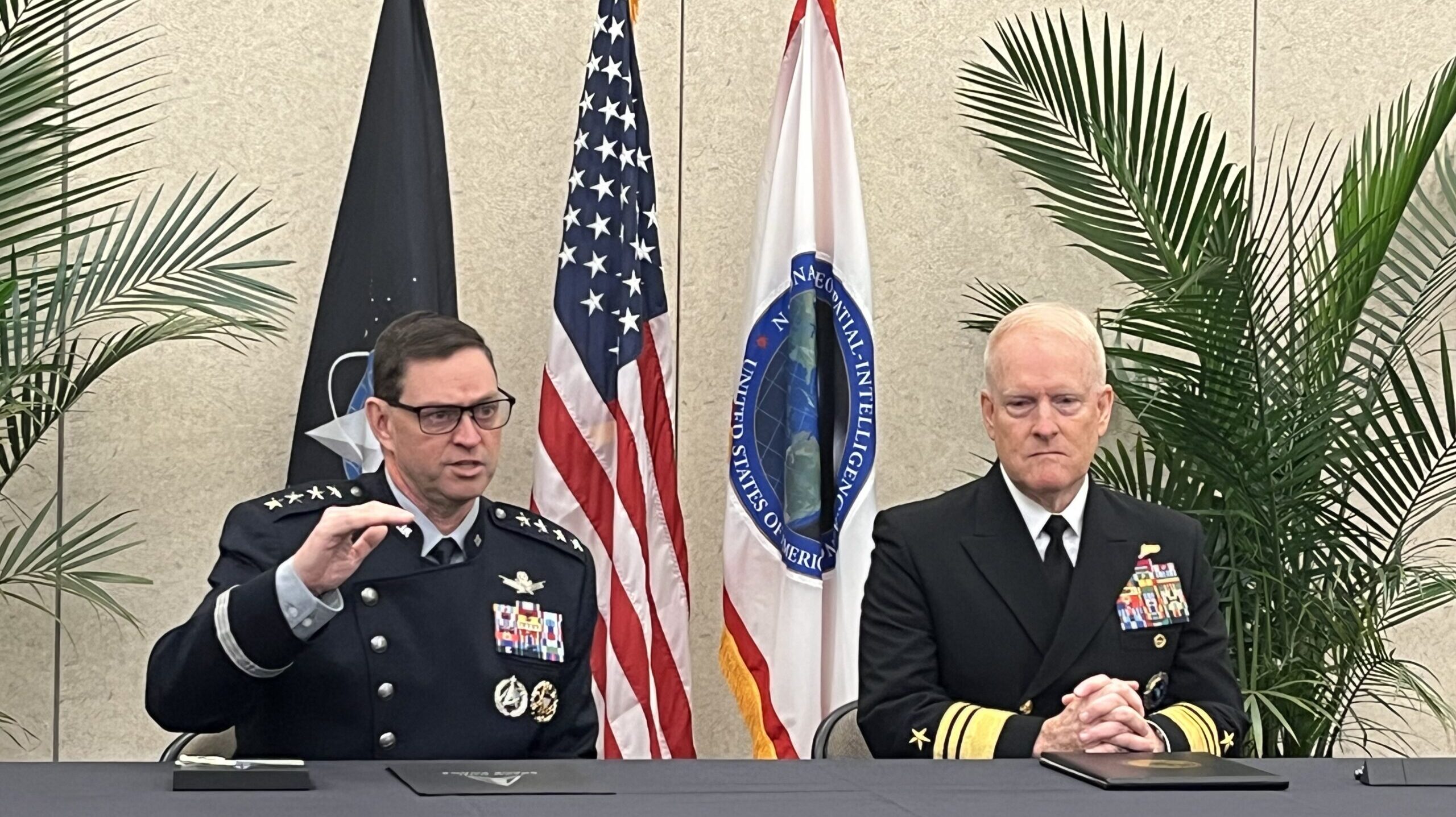
"NGA Maven is now available to all services and all combatant commands. There are 20,000 active users through more than 35 service and combat and command tools across three security domains," said NGA Director Vice Adm. Frank Whitworth.
Chief of Space Operations Gen. Chance Saltzman stressed that the commercial imagery the Space Force gathers will not be used directly for targeting, rather to allow commanders to rapidly understand evolving situations.
"COCOMs reported after these tests that J-REN and SlimGIMS not only met the capability gap, but also reduced the time to create a collection request from an hour to 5 minutes," an NGA spokesperson told Breaking Defense.
NGA Director Vice Adm. Frank Whitworth confirmed that the agency and the Space Force are working on a memorandum of agreement that will set "procedures" to ensure that they don't duplicate commercial imagery products.
"Going back to pre-Ukraine supplemental procurement levels would see the USG buying only a small fraction of the US commercial SAR capacity available; hardly enough to support combat operations or sustain a healthy US industrial base," said David Gauthier.
However, several industry sources said that their companies have not been blocked by NRO from taking pictures over Ukraine.
Other than that, for a number of reasons, including the transition to a new administration, our crystal ball for the Space Force in 2025 is pretty darn cloudy.
This year saw evidence that a shift toward more openness about US national security space activities is coming whether those deep in the "black world" are ready or not.
The new White House plan for cislunar S&T tasks DoD to lead development of new, and/or improvement of current, ground- and space-based sensors for monitoring the cislunar region.
Meanwhile, Meink said the spy agency is sticking to what it sees as its primary lane in the interagency division of labor for commercial acquisition: "procuring pixels."
"The stakes are high. Should any one country dominate the commercial remote sensing market, not only could it gain economic advantages, but it would also control the information narrative about the entire planet, from the environment to natural resources to human conflict," the report concluded.