WASHINGTON — Just as it is for all Joint Force missions, space support was essential to the success of the US military’s capture of Venezuelan President Nicolas Maduro, according to US Space Command (SPACECOM).
“Spacepower not only underpins the military’s ability to shoot, move, and communicate as designed, but delivers layered effects as overwatch which, as the Chairman of the Joint Chiefs Gen. [Dan] Caine mentioned on January 3rd, ensured the Joint Force’s freedom of maneuver during Operation Absolute Resolve,” a command spokesperson told Breaking Defense Tuesday.
Overwatch is a military tactic where one or more units provide protection for those units executing an attack. This includes, for example, supplying information on the location of enemy radar and troops, as well as covering fire.
While stressing that no specific details about the mission could be divulged due to “operational security,” the SPACECOM spokesperson explained that space-based capabilities such as positioning, navigation and timing (PNT) and satellite communications (SATCOM) are “foundational to all modern military activities.
“As such, to protect the Joint Force from space-enabled attack and ensure their freedom of movement, U.S. Space Command possesses the means and willingness to employ combat-credible capabilities that deter and counter our opponents and project power in all warfighting domains,” the spokesperson added.
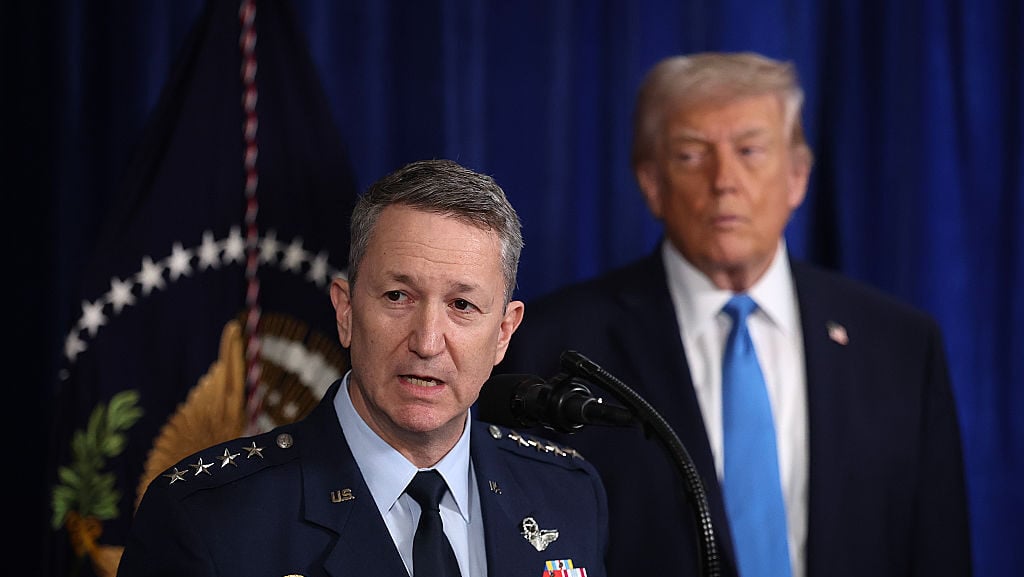
Caine gave a shout-out to SPACECOM during a Jan. 3 press conference with US President Donald Trump for its role in the mission to capture Venezuelan President Nicolas Maduro.
“As the night began, the helicopters took off with the extraction force, which included law enforcement officers, and began their flight into Venezuela at 100 feet above the water. As they approached Venezuelan shores, the United States began layering different effects provided by SPACECOM, CYBERCOM [US Cyber Command] and other members of the interagency to create a pathway overhead,” he said.


The reasons why Group 2 drones are right-sized for the fight
Fuel cell technology lets smaller, more versatile VTOLs handle tasks previously reserved for larger drones.
John Shaw, former SPACECOM deputy, told Breaking Defense today the level of coordination between SPACECOM and the rest of the Joint Force has been increasing over time — underpinning the success of recent US military operations.
“The integration of space into joint warfighting has reached a new apogee. We saw this with Midnight Hammer last year, with spectacular results of an operation on a global scale that relied highly on space capabilities, and now we’ve seen it with Absolute Resolve: the coordination between US Space Command, US Southern Command and US Special Operations Command appears to be at an all time high,” he said. “There is a likely a strong correlation between the success of these two recent operations and the integration of space capabilities to achieve this phenomenal success.”
Further, Shaw said these successes are “evidence that Space Command’s organic integration into joint warfighting is reaching a higher maturity level, but also demonstrates that other combatant commands and joint warfighting organizations themselves are organically integrating space into their operations more effectively than ever before.”
While the space support functions provided by SPACECOM are often taken for granted, Todd Harrison, senior fellow at the American Enterprise Institute, explained that they are critical for planning and executing all military missions.
“We haven’t heard much about how SPACECOM was specifically used, but I think it is safe to assume they played a major supporting role in several ways. SPACECOM would have been directly involved in setting up secure SATCOM links for forces, monitoring and overcoming any attempts at GPS jamming or spoofing, and monitoring for any missile launches that could threaten our aircraft or ships in the region.”
Further, he said the two key Intelligence Community agencies responsible for space-based intelligence, surveillance and reconnaissance (ISR) — the National Reconnaissance Office (NRO) that operates American spy satellites and the National Geospatial-Intelligence Agency (NGA) that provides analyses based on space-based ISR data — also no doubt had a hand in ensuring Operation Absolute Resolve’s success.
“The NRO and NGA likely played a major role in surveilling and mapping the compound Maduro was captured in (especially since SOF [Special Operations Forces] were training on a mockup of this compound in Kentucky), and NGA would have helped develop detailed maps of the area SOF could use to plan their routes and backup routes,” Harrison said.
“Signal Intelligence satellites also likely played an important role in mapping the air defense radars and communications systems Venezuela used to defend the area so that our aircraft could effectively knock these systems offline before they could pose a threat,” he added.
CYBERCOM’s Role
During the Jan. 3 press conference, Caine also indicated that non-kinetic effects were used by CYBERCOM to suppress Venezuelan defenses, with Trump further mentioning that “the lights of Caracas were largely turned off due to a certain expertise that we have. It was dark, and it was deadly.”
CYBERCOM deferred to the Defense Department for comment related to the command’s role in Operation Absolute Resolve, and the Defense Department told Breaking Defense in an email that it had “nothing to provide due to operational security.” When Breaking Defense asked the White House for comment, a spokesperson deferred to Caine’s comments in his Saturday address.
Though neither Caine or Trump elaborated on what exactly turning the lights out meant, some experts speculated that the command was able to deploy tactics affecting the Venezuelan capital’s power grid, including cutting off internet access.
“Well, it was dark because it was night, but apparently it was also dark because it seemed CYBERCOM turned off all the lights. This is the way that modern wars are fought, especially if you’re in the United States, and we operate very well in darkness,” Emily Harding, vice president of the defense and security department at the Center of Strategic and International Studies (CSIS) said during a virtual event Jan. 5.
Anthony Vinci, a senior fellow at the Center for a New American Security and former NGA chief technology officer for capabilities, told Breaking Defense Tuesday that he agreed that CYBERCOM could have used offensive tactics to shut down the power grid in Caracaras. However, he also speculated that someone on the ground with access to the power grid’s controls could have been responsible.
Nonetheless, Vinci said, such tactics will likely continue to be used by the US military in future conflicts.
“Bottom line, I think that infrastructure is now on the table for warfighting,” he said.
Further, Trump and Caine’s address over the weekend also suggested that electronic warfare tactics may have been used to disrupt Venezuela’s air defense systems. As Caine said, “the joint air component began dismantling and disabling the air defense systems.”
Lauryn Williams, CSIS deputy director of the strategic technologies program, and Taylar Rajic, an associate fellow there, told Breaking Defense in an email Jan. 5 that Caine’s comments “indicate the combined operations led to suppressed air defenses, disrupted communications and internet outages, and GPS jamming all to cripple Venezuela’s ability to coordinate any meaningful response.”
By using such tactics the US “should also absolutely expect our main cyber adversaries — China, Russia, North Korea, Iran — to learn as much as they can about the United States’ use of offensive cyber against Venezuela and apply those learnings domestically,” they added.