WASHINGTON — The Navy and the Marine Corps are eying a revamp of the force generation model for amphibious vessels as the services continue to work in tandem to improve the ships’ readiness, the Chief of Naval Operations said today.
The Navy currently employs a 36-month Optimized Fleet Response Plan for amphibious ships to accommodate maintenance, training, and seven-month long deployments. But shaking up this model could “kill the overhead of the phases of the force generation cycle that don’t add significantly to getting it ready for its next deployment,” Adm. Daryl Caudle said at the Modern Day Marine exposition today.
“What I can do today is go make our force generation more efficient,” Caudle said. “And so some of those things that need to be looked at, instead of a one deployment in every 36-month — which is really probably closer to 40-month cycle — can I get two deployments, and kind of a 50, 52-month cycle, and do two deployments within a cycle?”
The Department of the Navy is required to maintain a fleet of at least 31 amphibious ships, but leaders from both services have said that more are required to meet demand. While acquiring more amphibious ships is a time intensive endeavor, changes like altering the force generation model could allow the current fleet to operate more effectively, according to service leaders.
“So you reduce the overhead, so you will gain some efficiency,” Caudle said.
Lt. Gen. Jay Bargeron, the Marine Corps’ deputy commandant for plans, policies and operations, voiced similar sentiments and told reporters Wednesday that the services are evaluating a few force generation models, including a 56-month model.
The Navy and Marine Corps’ leaders’ comments come as the services launched the Amphibious Force Readiness Board (AFRB) in March in an attempt to solve amphibious readiness issues and determine how many ships are needed.
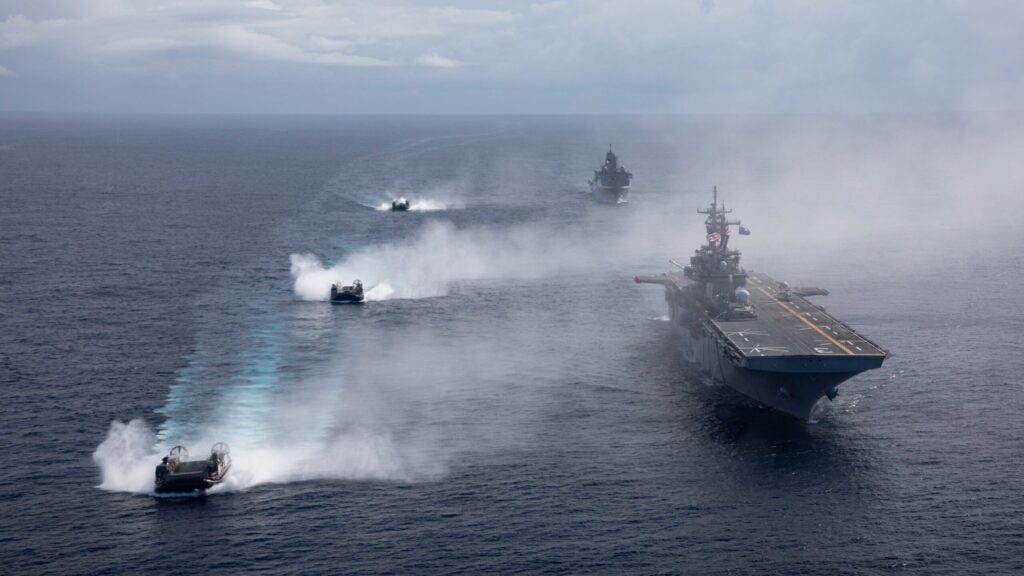
Amphibious ships deploy and create an Amphibious Ready Group (ARG) formation, which typically includes an assault ship, a transport dock, and a support vessel that together carry an embarked Marine Expeditionary Unit (MEU) of at least 2,200 Marines. Altogether, these assets create what the services call an “ARG-MEU,” and the Corps aims to maintain a 3.0 ARG-MEU presence globally.
While three ARG-MEUs are currently deployed, Commandant of the Marine Corps Gen. Eric Smith said that combatant commanders are calling for far more than that right now, but the force can’t meet their demands.
“Every combatant commander is calling for an ARG-MEU. Every one of them — SOUTHCOM to EUCOM, to CENTCOM, AFRICOM — they’re all calling for an ARG-MEU because it is the most flexible tool in the DoD inventory,” Smith said today at Modern Day Marine. “It takes you from humanitarian assistance crisis response to non-combatant evacuation operations, to key strike capabilities and lethality.”
As a result, Smith said that he wished he had more ARG-MEUs to offer combatant commanders, and said that the formation is becoming even more relevant “as the world becomes less and less predictable.”
Smith said that the services are pursuing three avenues to increase the size and availability of the amphibious force, including: optimizing maintenance schedules and force generation models, procuring new ships, and extending the service lives of existing ships.
Underscoring this approach, Expeditionary Warfare Director Brig. Gen. Lee Meyer revealed at Modern Day Marine on Tuesday that the amphibious assault ship USS Wasp’s service life had been extended five years until 2034, and indicated that other amphibious vessels could also see service life extensions as studies are ongoing to provide recommendations.
“I want to look at every class of amphibious ship in a deliberate way, find out ways that I can invest in that, with modernization, with maintenance, in order to extend the life of those ships,” Meyer said.
Breaking Defense Video