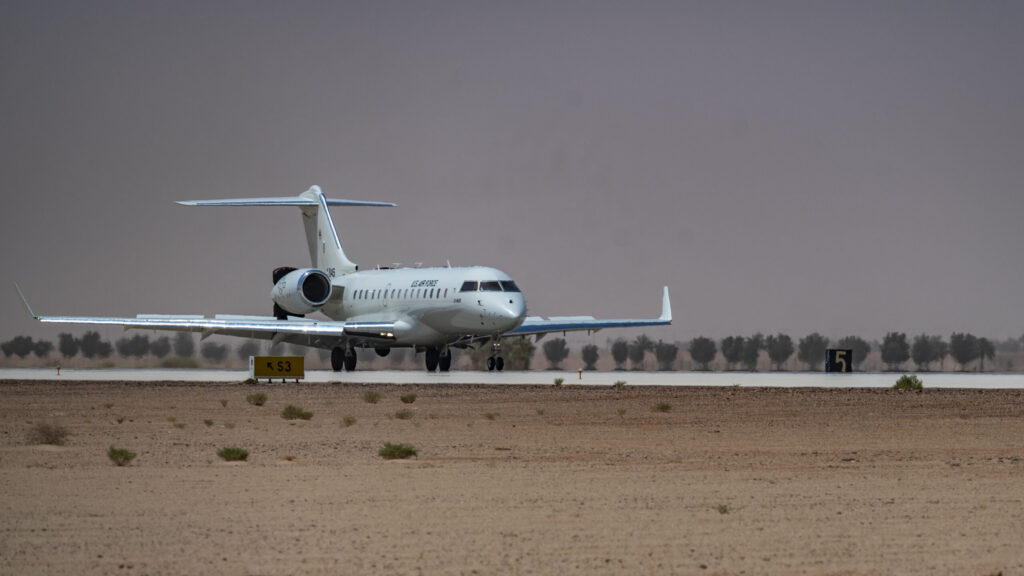
WASHINGTON ― The US Air Force now plans to divest its E-11 Battlefield Airborne Communication Node (BACN) aircraft and is seeking to retire the fleet in fiscal 2028, according to officials.
The divestment plan was revealed in written testimony [PDF] submitted jointly by Air Force Secretary Troy Meink, Air Force Chief of Staff Gen. Kenneth Wilsbach and Chief of Space Operations Gen. Chance Saltzman to the House Appropriations defense subcommittee today.
An Air Force spokesperson told Breaking Defense following the hearing that there are seven E-11s in the current fleet, and confirmed that the plan is to replace them with the emerging DAF (Department of the Air Force) Battle Network.
The service’s FY27 budget documents zero out funds for the E-11 program, after spending a total of $296 million on the program since its inception in 2005.
The BACN, pronounced like the sizzling breakfast meat, is a modified Bombardier Global business jet outfitted with communications equipment to serve as a data relay platform. Northrop Grumman integrates the aircraft’s communications equipment, which provides so-called “Wi-Fi in the sky.”
Future planned modifications included software to enable use the Global Positioning System satellite’s jam-resistant M-code, according to the Air Force’s budget documentation — a long-delayed capability considered essential for operating in today’s highly contested electromagnetic environments.
For now, the HAC testimony says that a “Hybrid SATCOM [satellite communications] Terminal program” will serve as a “near-term bridge in capability.” The testimony and Air Force FY27 budget documents show plans to integrate SATCOM terminals on a range of aircraft, such as the KC-135 Stratotanker air refueler and the B-1 Lancer bomber.


Winning the information war is as much about ideas and perception as it is about data
"Being able to tell the commander you don't need to do something is actually a pretty powerful message, as well."
The Space Force has a prototype effort underway to develop such terminals, according to its FY27 research, development, test and evaluation budget request. Hybrid SATCOM terminals will “enable assured communications through both commercial and military satellite constellations in multiple orbital regimes, while accessing multiple frequency bands to maintain resilient connectivity and security,” the documents state. Experimental flight tests are planned on an unspecified “nine different aircraft types” through FY28. The service requested $20.5 million for the project in FY27, but none in FY28.
As well as the E-11, Meink briefly addressed two other Air Force aircraft programs: the E-7 Wedgetail and the EC-138 Compass Call.
The embattled Wedgetail last year was on the service’s chopping block in favor of shifting its air moving target indication (AMTI) mission to satellites, but was blocked by Congress.
In accordance with congressional direction in the FY26 defense appropriations bill, the Air Force in March awarded two separate, sole-source contracts to Boeing to continue development of the embattled E-7 Wedgetail ― but did not specify how many aircraft were being funding or commit the service to ultimately procuring any aircraft at all.
Meink told the HAC subcommittee today that the service has put five additional E-7 developmental aircraft on contract, in addition to the two rapid prototypes.
While the Air Force’s FY27 budget documents show funding for only 12 Compass Call electronic warfare aircraft, today’s written testimony cited a plan for the service to buy 22. The Air Force spokesperson confirmed that 22 is the currently planned fleet size, but did not provide budgetary details.
Breaking Defense Video