
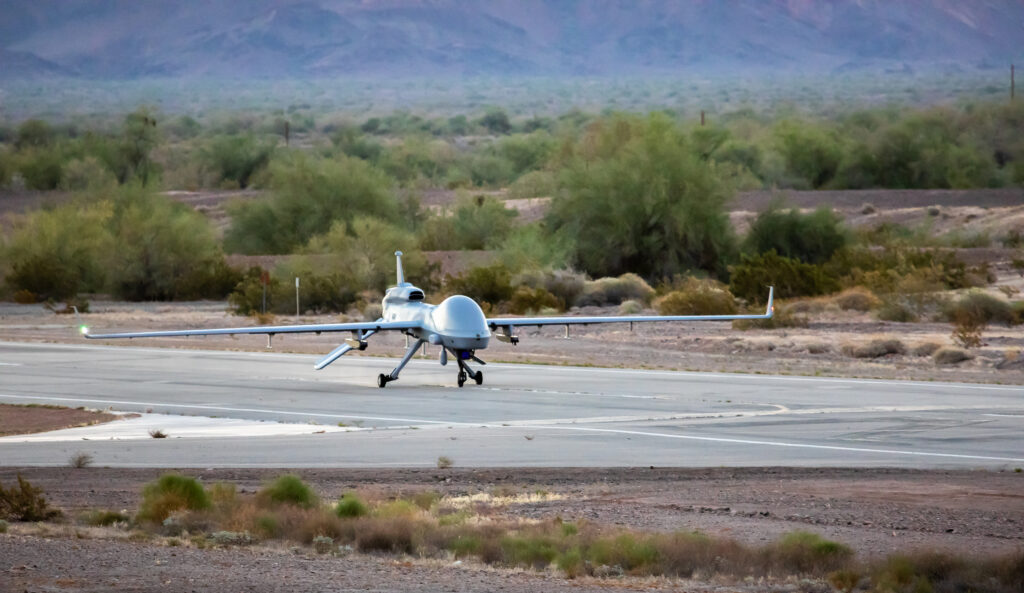
The Army National Guard is an essential part of America’s defense and a core part of the total Army – so why doesn’t it have one of the active component Army’s most essential tools?
The MQ-1C Gray Eagle is a multi-mission aircraft essential to active Army divisions in conducting reconnaissance, surveillance and target acquisition. And the Army National Guard represents around 40 percent of the Army’s combat divisions, so it’s past time that those units achieve parity with the active component force and acquire their own Gray Eagles.
Without their own aircraft, the Army National Guard units don’t have the equipment they need to train adequately or deploy with the full complement of combat power. And the absence of these aircraft also means that the state populations who rely on their Army National Guard units for myriad other tasks — from homeland defense to emergency and disaster response – don’t have the highly versatile tools of their own they need to do those jobs.
That isn’t because those involved aren’t aware and aren’t asking: the Gray Eagle continues to be a primary request from many Army National Guard division commanders and state adjutants general. They know what active component soldiers also know: Gray Eagle is an invaluable asset that gives the Army what nothing else can.
Much of that derives from the aircraft’s long-proven record of millions of hours of safe operations, automatic takeoff and landings, and kinetic and non-kinetic engagement in combat. The Gray Eagle can carry eight AGM-114 Hellfire air-to-surface missiles. It has an electro-optical infrared sensor for full motion video, Synthetic Aperture Radar and a laser designator. The aircraft excels as an enabler for Army units working together over big sections of territory against an enemy.
The Gray Eagle-Extended Range can fly for around 40 hours in some configurations and that permits a quantity and quality of real-time battlefield intelligence that commanders can’t get in any other way.

An aircraft can serve as the eyes and ears for a division. It enables networking and long-range targeting for artillery. It serves as a tactical scout to increase the survivability and effectiveness of other aviation assets. Crews aboard the Army’s AH-64E Guardian-model Apache attack helicopter, for example, can use a Gray Eagle to give them a peek over terrain so they don’t need to get within sight of an enemy themselves until they’re ready to shoot. It can simultaneously provide real-time radar and FMV images of potential landing zones for an air assault mission.
In some cases, an Apache’s crew doesn’t even need to release its own weapons – as in one exercise in which an attack helicopter identified a target using one UAS and then fired on the target from a Gray Eagle. Manned-unmanned teaming, as it’s called, is taking place at ever-greater ranges and with increasing sophistication, with Gray Eagle often serving as the fulcrum.
Integrating the Gray Eagle into big operations this way is part of the training and work of the active component Army, but Army National Guard divisions can’t match it – and maintain true parity of skill and readiness – without their own aircraft. Adding Gray Eagles would help the whole Army by adding this kind of depth across more of the force and permit the existing, active component Gray Eagle companies to slow their rotations, which would assist with active component personnel attrition.
Acquiring more aircraft, in other words, not only would deepen the skill and experience of the whole force but also spread the operational burden, permitting new reserve companies to step into place of the active units that currently handle all of it.
For a model, look no further than the Air National Guard, which includes units that operate the Gray Eagle’s larger sibling, the MQ-9A Reaper. This summer, for example, two Air National Guard Units – the 119th Wing of the North Dakota Air National Guard and the 174th Attack Wing of the New York Air National Guard – took part in historic large-scale exercises over the Pacific Ocean.
Operators flew their aircraft to Guam and then took part in the joint field training exercises with many other units; the Reapers played a central role: “Without the MQ-9 being in this kill-chain exercise, it would not have gone well,” one pilot said.
Other operations that integrate the Air National Guard, active force and other units also continue, including operations that support the Air Force’s agile combat employment concept and beyond.
The ever-increasing sophistication of the battlefield means that the United States can’t afford to have so much of its operational force – which is what the Army National Guard is – effectively tiered at a lower level of readiness and training than the active component Army. The nation needs a complete force fully prepared to take part in multi-domain operations as threats continue to evolve and emerge, including from potential near-peer competitors in Europe and Asia.
The Gray Eagle is a central component of multi-domain operations. Its abilities range from standard peacetime roles up to full-scale conflict. New uses, new payloads and new types of integration are being pioneered all the time.
Manufacturer General Atomics Aeronautical Systems, Inc., has completed a number of tests and demonstrations proving out these new refinements, including new long-range sensors; Air Launched Effects — small aircraft that launch from a Gray Eagle and extend its ability to sense and strike; and scalable command and control to reduce the equipment footprint, making employment more expeditionary.
And forthcoming from GA-ASI are a new 200-horsepower Enhanced Heavy Fuel Engine and dual 7.5 kW brushless generators. The powerful new engine will push the aircraft’s reliability and speed to a new level. The increased onboard power will mean that new Gray Eagles can accommodate more and better sensing, computing and communications equipment, preserving their place on the leading edge of what’s technically possible for supporting Army multi-domain operations.
These and other pending improvements mean that the Gray Eagle is on track to continue to expand what it can do even as it remains the active Army’s flagship unmanned aircraft system – another reason why the reserve component must not be left behind. The Army National Guard needs its own aircraft, and it needs them yesterday.