Air Warfare

Meet Anduril’s new loitering munitions, the firm’s first (but not last) weapons program

"This will be a large and growing family of systems that we intend to add to in the years to come," Anduril chief strategy officer Chris Brose told Breaking Defense in an exclusive interview.

anduril-altius-m-float-no-logo
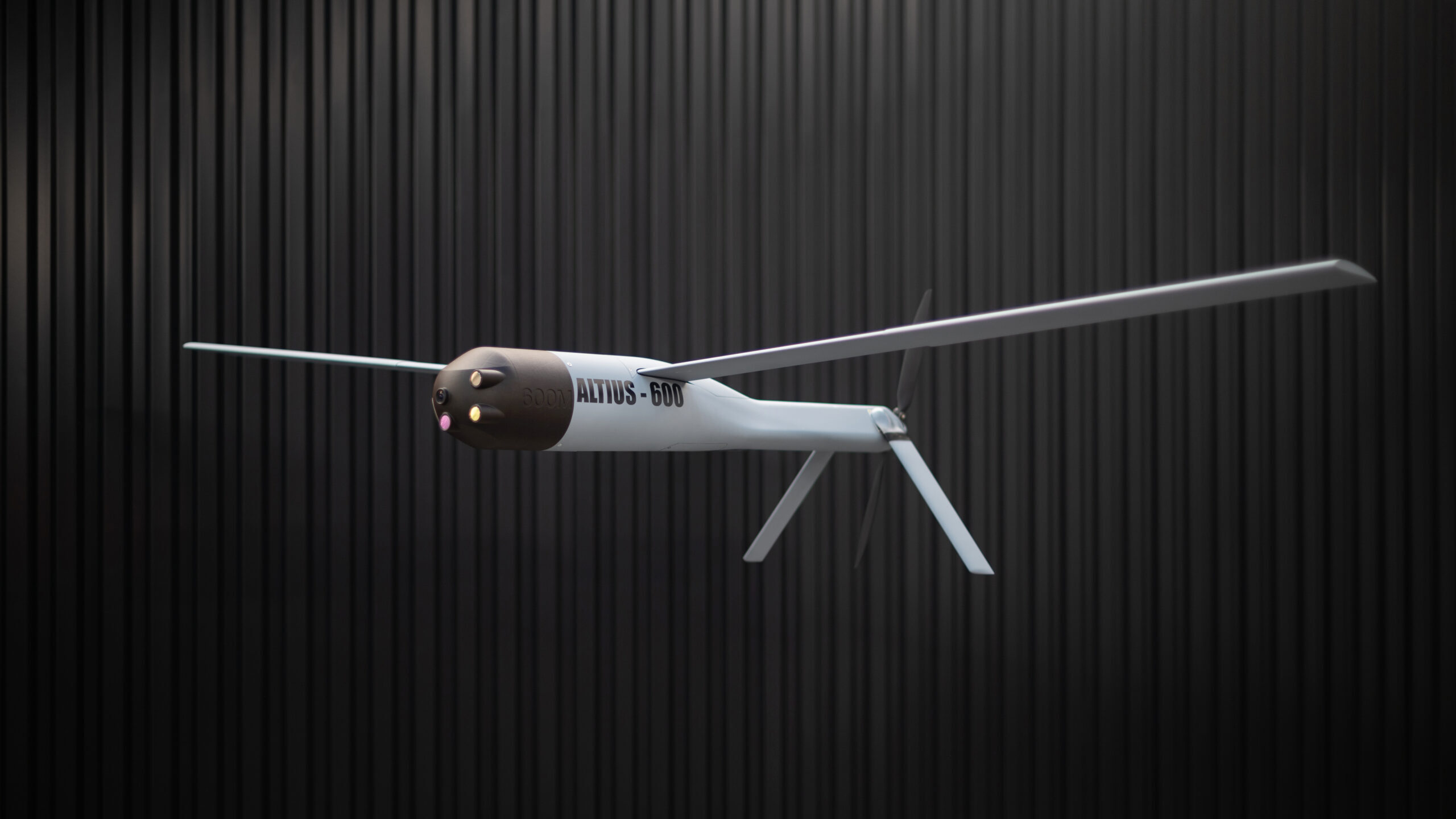
Anduril’s Altius 600 loitering munition. (Courtesy of Anduril)

AUSA 2022 — Anduril Industries plans to unveil a pair of loitering munitions at the upcoming Association of the United States Army conference, in what a company executive told Breaking Defense is just the start of the tech firm’s foray into weapons programs.

“For Anduril, this is the first weapon that we are talking about developing,” Chris Brose, chief strategy officer at Anduril, said in an exclusive interview ahead of the announcement. “It is not the only weapon that we are developing, and it is definitely not the last weapon that we are going to develop.”

Brose declined to disclose more about the other programs, but Anduril’s new loitering munitions are modified versions of its autonomous unmanned aerial vehicle, the Altius 600 and 700. Those two platforms are small drones, that can be launched from air, land or sea and can carry intelligence, surveillance, and reconnaissance (ISR) or electronic warfare payloads.

Brose claimed that Anduril’s loitering munition offerings will have “twice the range and endurance of what’s currently best of breed” in the loitering munitions market.

There’s “really a desire to have greater range, greater endurance, greater time on station,” Brose said. “Particularly as you start looking at theaters like [the Indo-Pacific], where the geography is just so vast, that really matters.”

Anduril’s website provides some insight into the endurance and range of the Altius platforms when used as air-launched effects. It says the Altius 600 has a range up to 276 miles with four hours of endurance, while the larger Altius 700 can fly 310 miles with more than two hours endurance.

Brose also declined to go into the specific details of the loitering munitions’ capabilities. But as loitering munitions, he said the Altius 700 will fly “less far” than the 600, but carry a larger explosive payload. He said the Altius 700 had demonstrated a 35-pound warhead.

Brose told Breaking Defense that the company has been working with “government customers” over the past year, but declined to name them. He added that the loitering munitions were geared toward a “handful of very specific missions,” but declined to share which.

Over the next year, he said the company is focused on developing the systems to meet the immediate needs of their customers, but added that “there are a lot of other missions that these systems are going to be really effective and conducting.”

“This will be a large and growing family of systems that we intend to add to in the years to come,” Brose said.

He said that the company began exploring entering the loitering munitions market after acquiring drone-marker Area-I, which makes the Altius drones, in March last year. Brose stressed in the interview that the loitering munitions built by Anduril will be designed with open systems, meaning they can be easily upgraded with, for example, a more advanced seeker or warhead in the future.

“As we’ve been engaging with customers, as we’ve seen problems that they’ve been encountering, and the world has been throwing up, it’s become very clear that a more capable loitering munition is something that’s desperately needed,” Brose said.

AUSA 2022

AUSA 2022

Over at Rheinmetall's booth sat the hefty Lynx OMFV (Optionally Manned Fighting Vehicle). The company, as its competitors, is hoping to make a strong impression as the Army looks for OMFV proposals later this fall -- the early stage of an almost certainly lucrative long-term contract award. (Breaking Defense/Brendon Smith).
All the way from down under, the Australian firm Defendtex presented some of its modular UAVs. Here visitors can see the Drone155, which the company says can be outfitted with ISR payloads or explosives. (Breaking Defense/Brendon Smith).
The MVPP from Globe Tech stands for Modular Vehicle Protection Platform, a vehicle add-on that can take the brunt of improvised explosive device detonations. (Breaking Defense/Brendon Smith).
AUSA was well attended by international officers and officials as well, and by foreign defense firms. The Korean booth, shown here, featured some products hoping to make a splash in the US military. (Breaking Defense/Brendon Smith).
Not your traditional defense contractor, the computing giant IBM has a booth at AUSA showing off its flashy but functional quantum computer. The US government as a whole, and the Pentagon in particular, are heavily invested in the quantum computing race with the likes of China. (Breaking Defense/Brendon Smith).
Among the fleet of vehicles parked throughout the AUSA floor for display was the Flyer 72-U, made by General Dynamics. The company says the vehicle takes a "modular approach" so it can be configured for anything from "light strike assault" to rescue and evacuation. (Breaking Defense/Brendon Smith).
The stuff of counter-UAS nightmares, the Virginia-based BlueHalo firm makes drone swarms that use AI and machine learning to provide battlefield intelligence to soldiers. The Army's Rapid Capabilities and Critical Technologies Office awarded the company $14 million in February to develop the HIVE. (Breaking Defense/Brendon Smith).
It's a .50 caliber Gatling gun, one that Dillon Aero says can fire 1,500 shots per minute, or 25 rounds per second. (Breaking Defense/Brendon Smith).
For this year's show AM General rolled its own Humvee Saber, Blade Edition, onto the floor. The company claims "leap-ahead" technology for a light tactical vehicle. (Breaking Defense/Brendon Smith).
Patria, a defense firm owned jointly by Finland and Norway's Kongsberg Defence & Aerospace, made it's way across the Atlantic for AUSA 2022, bringing along its AMV multi-role vehicle. The AMV was recently purchased by the dozens by Slovakia and its home country of Finland. (Breaking Defense/Brendon Smith).
At the Pratt Miller Defense booth, visitors will see a full-sized Expeditionary Modular Autonomous Vehicle (EMAV) is the "newest and perhaps most mobile and lethal" of the company's autonomous offerings. (Breaking Defense/Brendon Smith).
Marathon's Autonomous Robot Targets are exactly what that sounds like: shooting targets guided by computer code and designed to "look, move, and even behave like people," the company says. The robots were on the move on the AUSA floor -- though no shooting was allowed. (Breaking Defense/Brendon Smith).
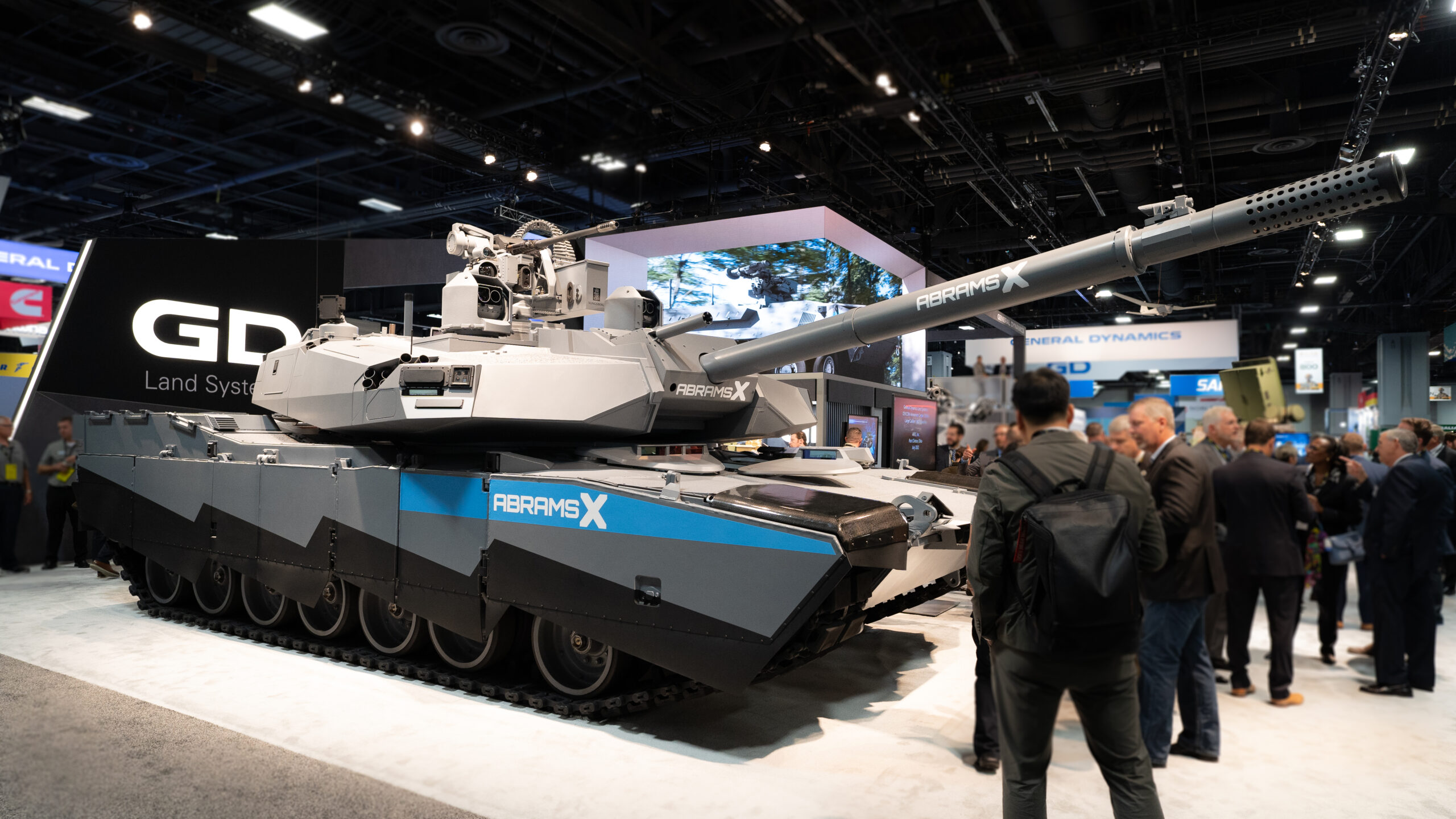
The AUSA show floor offered a fresh look at a futuristic version of an old Army standby: the Abrams tank. This one, the Abrams X, is made by General Dynamics Land Systems, manufacturers of the current Abrams M1A1 and M1A2 battle tanks used by the US Army. (Breaking Defense/Brendon Smith).
Attendees may walk by model versions of the famous Iron Dome system, in use for years in Israel, and its sister SkyCeptor system, both made by Rafael. The SkyCeptor, in particular, is meant to "defeat short- to medium-range ballistic and cruise missiles and other advanced air defense threats," the company says. (Breaking Defense/Brendon Smith).
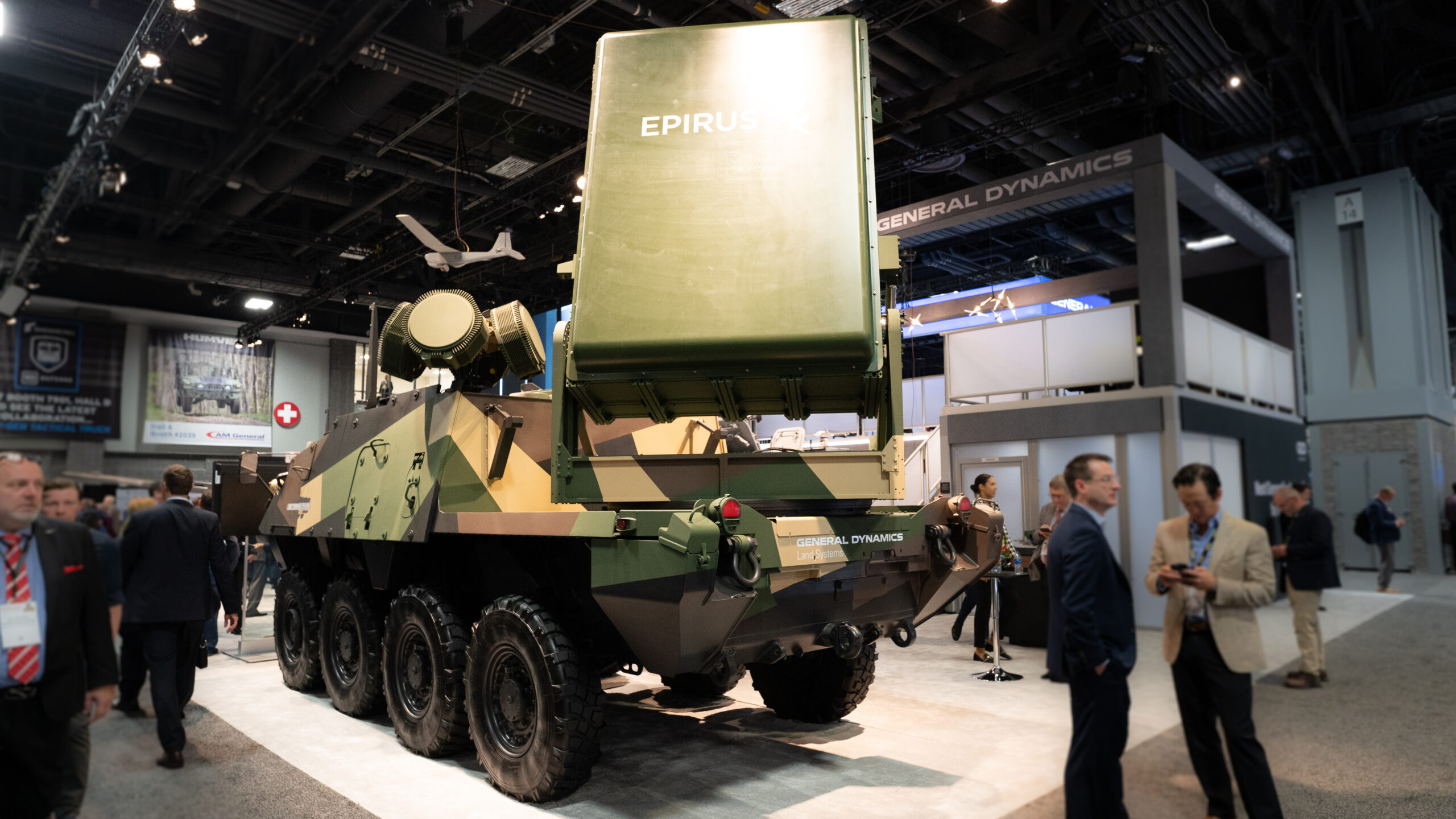
As the need for counter-UAS systems explodes, Epirus is at AUSA repping its counter-electronics system Stryker Leonidas, made with General Dynamics. The system's "counter-swarm" weapon "fills a pressing short range air defense (SHORAD) capability gap," the company says. (Breaking Defense/Brendon Smith).
A new unveiling for AUSA, Rheinmetall announced this week the Mission Master CXT platform, the newest addition to the company's "family" of autonomous ground vehicles. The company says the CXT "combines the power of a diesel engine with a silent electric motor." (Breaking Defense/Brendon Smith).
The GMC Hummer EV Platform, the first vehicle on GM's New Ultium EV Platform, goes on display at AUSA 2022. All-electric offerings are the center of much of the Army's attention these days as it aims to electrify its non-tactical, and eventually tactical, fleet. (Breaking Defense/Brendon Smith)
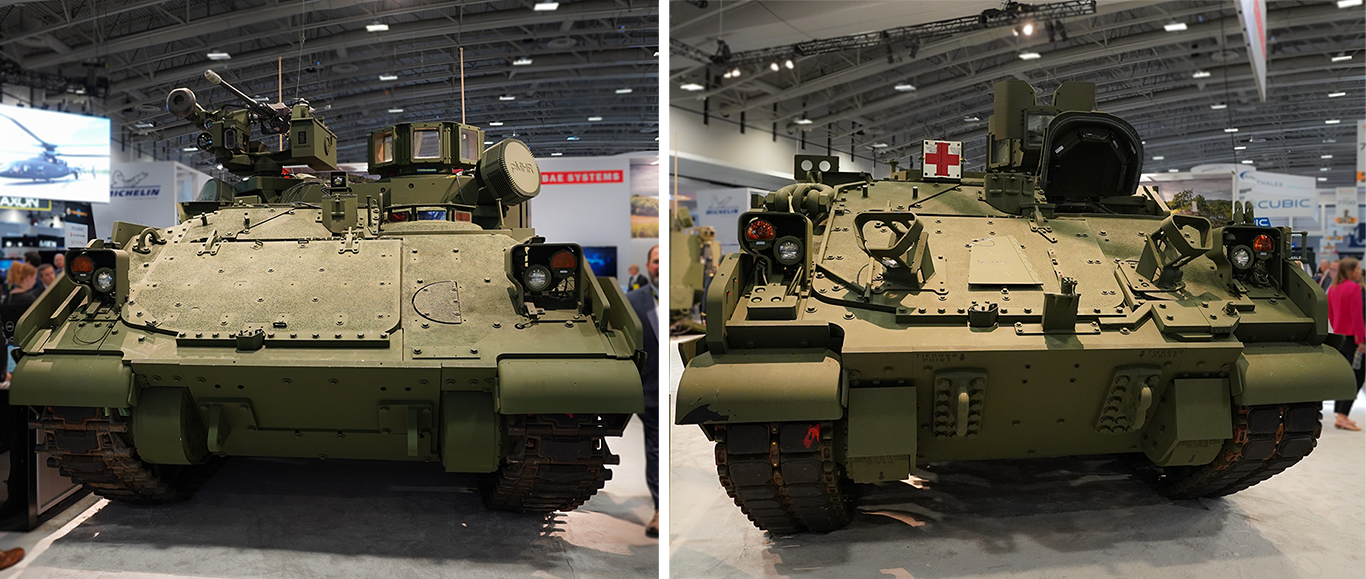
Two new Armored Multi-Purpose Vehicles (AMPV) sit at the booth by Bae Systems. The vehicles are meant to replace the Army's venerable, but old M113s. (Breaking Defense/Brendon Smith)
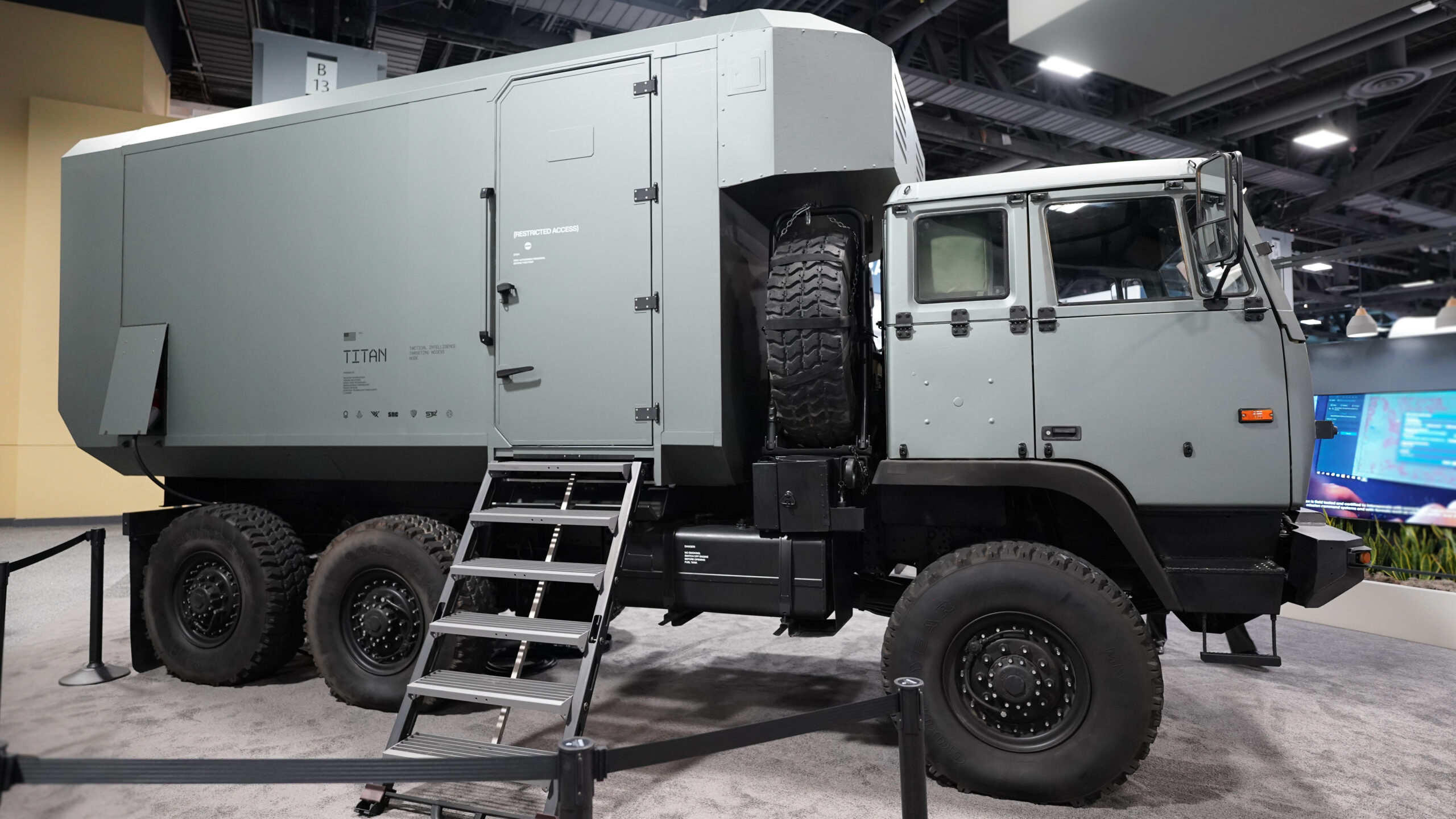
Palantir shows off its prototype for the Tactical Intelligence Targeting Access Node (TITAN) vehicle. The company says the TITAN "will be the critical backbone that provides correlation, fusion, and integration of sensor data alongside insights from AI/ML overlaid at the tactical edge." In other words, it's meant to find the signal in the noise. (Breaking Defense/Brendon Smith)
A model of a "modernized" Boeing Apache AH-64E shown Association of US Army Conference in 2022. While the Army is about to choose two new airframes, there's currently no Apache replacement on the horizon. (Breaking Defense/Brendon Smith)
Lockheed Martin teamed up with Sikorsky to produce the Raider X, the team's competitor in the Army's Future Attack Reconnaissance Aircraft (FARA) program, one of two high-profile Army Future Vertical Lift contests currently underway. (Breaking Defense/Brendon Smith)
The Bell 360 Invictus is the other FARA competitor, looking to beat out the Lockheed-Sikorsky team. The Army's expected to make its decision in fiscal 2024. (Breaking Defense/Brendon Smith)
The defense start-up Anduril has expanded its footprint in the defense market in recent years. This product, the Mobile Sentry, "brings autonomous fixed site counter UAS and counter intrusion capabilities into a mobile form factor," the company says. (Breaking Defense/Brendon Smith)
The military's no-so-furry friendly robot dogs are back at AUSA this year. This model, called the Vision 60 Q-UGV from Ghost Robotics, is an "all-weather ground robot for use in a broad range of unstructured urban and natural environments for defense, homeland and enterprise applications," the company says. (Breaking Defense/Brendon Smith).