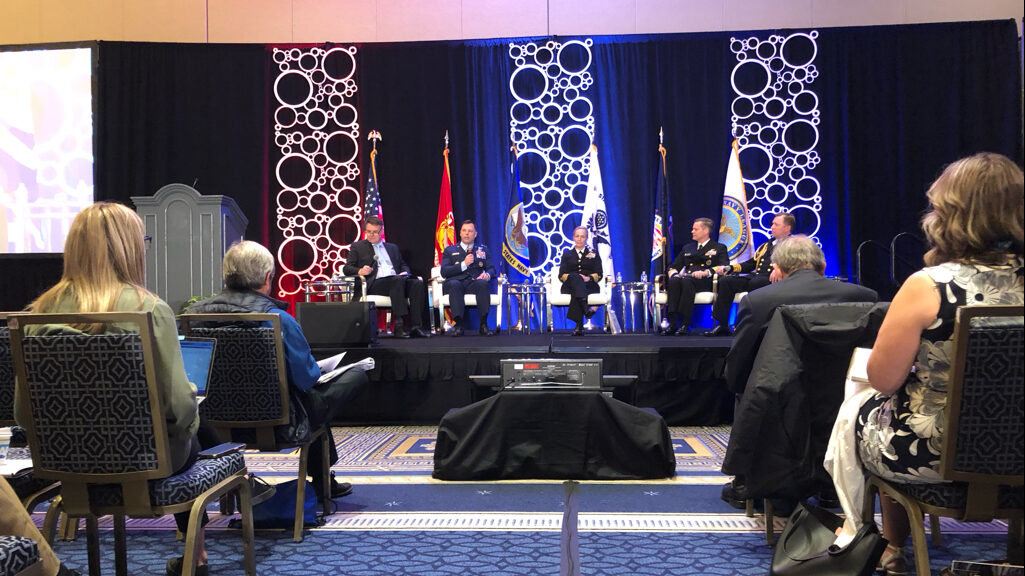
SEA AIR SPACE 2023 — Networks can glitch out while you’re walking down the street, so imagine how hard it is stay connected on a ship a thousand miles from land. That’s why senior officials from the Navy and Marine Corps emphasized here the importance of bringing cloud services and the applications that run on them, including artificial intelligence, from their on-shore infrastructure to their ships at sea and other small elements scattered around the world.
“Ashore, we have the entire enterprise available to us,” said Rear Adm. Stephen Donald, deputy commander of Navy Cyber Command, AKA 10th Fleet, at a panel during the Sea Air Space conference Tuesday. “We need to extend that enterprise for our maritime assets afloat, for all of our weapons and weapons platforms out there.”
RELATED: Long-distance reps and sets: Navy looks at C2 capabilities, expanding virtual training onto ships
The difference between capabilities afloat and ashore is all the more jarring now that the service has upgraded its shore-based networks for COVID-era remote work under the initiative known as Flank Speed. “I keep getting asked the question, ‘when is Flank Speed going to the ships?’” said Rear Adm. Tracy Hines, director of the Navy Cyber Security Division on the Chief of Naval Operation’s headquarters staff (section N2/N6). “There are many [people] that are working on that.”
The problem’s even more acute for the Marine Corps, which leans heavily on Navy infrastructure, and for the Coast Guard, which isn’t under the Pentagon at all but in the Department of Homeland Security. The Marines have to move entire units from shore to ship to shore, potentially under fire, while the Coast Guard operates on small ships (and often on a shoestring budget) around the world.
“We are often small and lean, [and] we have units operating at both poles,” emphasized Rear Adm. John Vann, chief of Coast Guard Cyber Command. “We are on the [Department of] Defense Information Network, the DODIN,” he emphasized, but “[we’re] a little bit unique.”
FULL COVERAGE: Sea Air Space 2023
The Marines, meanwhile, have a new doctrine emphasizing forward deployments on small islands in land-based missile range of major threats like China. “A lot of our world is on a ship, and then we go ashore,” said Russell Meade, executive director of Marine Corps Cyber Command. “We’re going to be inside the weapons engagement zone. We’re already there today… As you fight and you take hits, how do you reconstitute [the network] once you’ve gone down? [What can] help with things like that is you have small segmented networks when necessary that you can bring up and, in time the cloud.”
Likewise for the fleet, “our warfighting platforms are going to go into contested areas,” said Donald. “I may turn everything off so no one can see our emanations, [and] I’ve got to fight through adversaries’ jamming, adversaries’ deception.” By emanations, he’s referring to electromagnetic transmissions and other signals that missiles can home in on.
Even in peacetime, connectivity can be iffy. In an earlier assignment aboard the 7th Fleet command ship USS Blue Ridge, Hines recalled, ”we had a whole lot of bandwidth, a whole lot of capacity on board the Blue Ridge, so when we were up, it was awesome. But when we were not, it was not awesome.”
Obviously, you can’t run fiber optic cables to a ship at sea. High-speed satellite connections are ideal, Donald said, but often ships must fall back on VHF or even HF transmissions. That’s not compatible with applications that take constant connectivity.
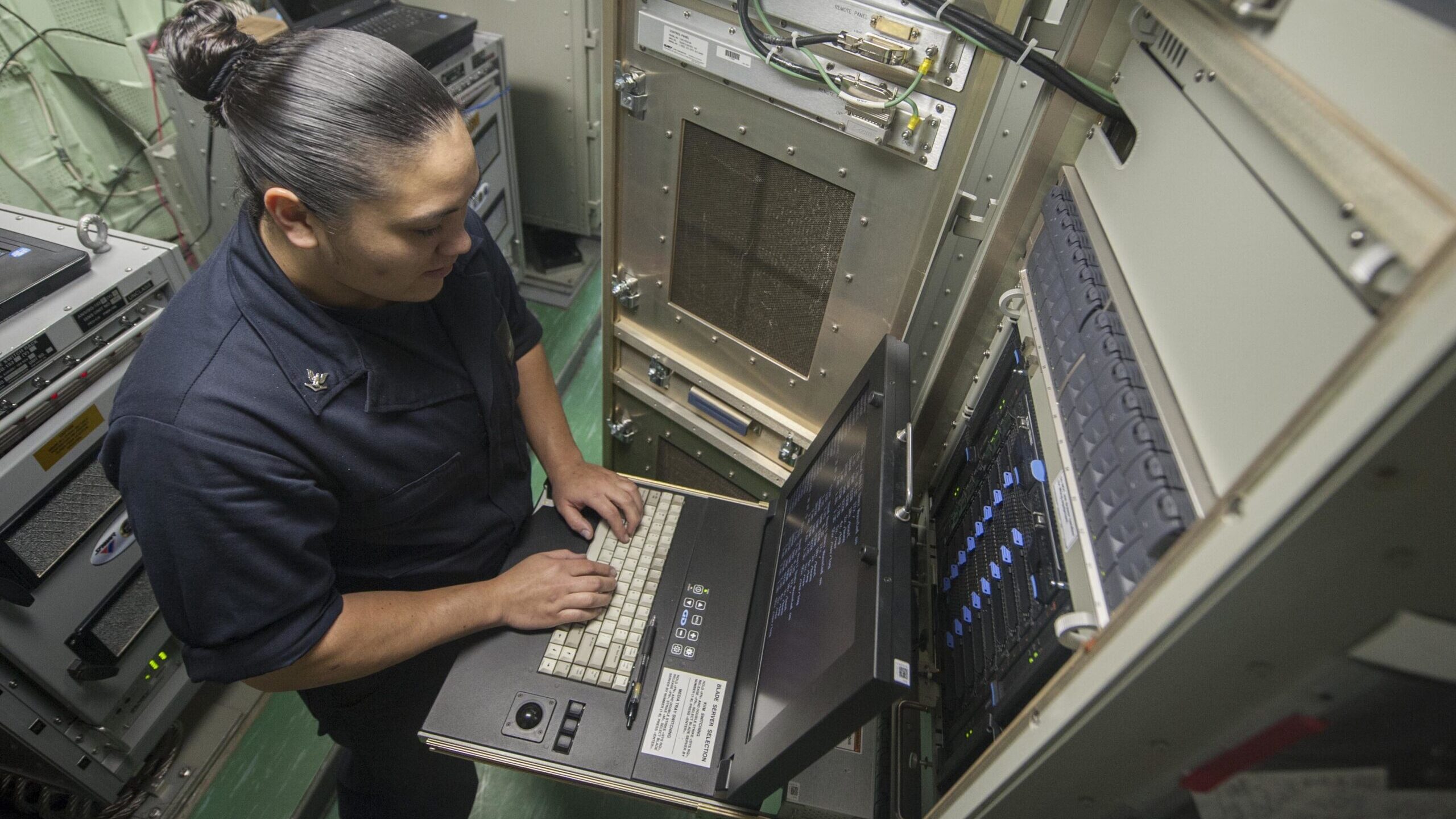
Part of the solution is to put more computing power on the ships themselves, said Donald. “They need to be almost mini-data centers, mini-network operation centers, and mini-security centers,” he said. “There is an initiative to put a cloud on some of our large deck [ships],” specifically aircraft carriers and larger amphibious assault ships.
Another part is to use more flexible forms of the cloud, able to shrink to a local enclave aboard ship when long-range connectivity breaks down, then automatically reconnect to the global network when the links reopen — without forcing users to manually switch over or deal with two separate, inconsistent sets of data.
“I love the cloud, but I don’t have access to the cloud all the time while I’m afloat,” said Donald. “I need industry to figure out how to give me a virtual cloud, if you will, while afloat, so that while I’m disconnected, I have all the capabilities that I can possibly have locally, and then when I reconnect, it is seamless…. I don’t have two different identities, I don’t have an afloat identity and a shore identity, I have one identity that is seamlessly transferred as I go out, that moderates itself as bandwidth limitations or other network issues occur.”
Such flexible connectivity will be especially crucial for AI. In many cases, the algorithms and the databases they learn on require tremendous computing power and storage; but the actual user just needs to be able to send a query and get an answer back — perhaps even in plain English text, as with ChatGPT and its kin. That means even a weak connection can work for a lot of queries, as long as the high-intensity computation is done elsewhere.
“The hardest thing is moving data around in a low-bandwidth environment,” said Donald. “A query and a response are relatively low bandwidth.”
Hines said the Navy’s cyber teams are “really excited about artificial intelligence.”
“We’re gonna need a lot of bandwidth,” she said. “We know we are resource constrained in that arena, but I think it can be done.”
PHOTOS: Sea-Air-Space 2023

 Gallery