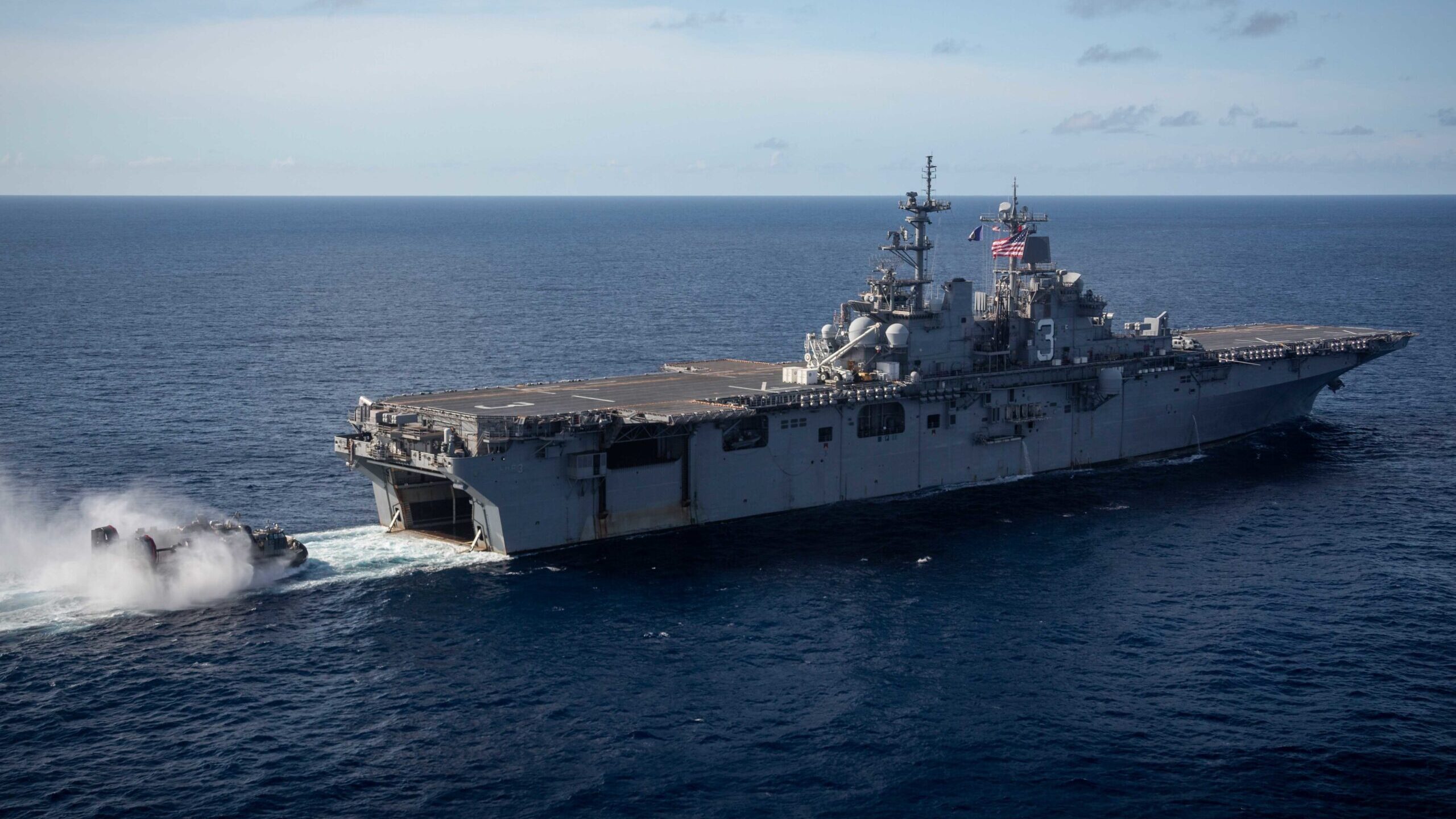
NORFOLK, Va. — When the Navy commences one of its largest global exercises next month, the service will focus on replicating the “objective tension” of trying to satisfy the requirements of multiple command authorities that its commanders would face during a real conflict.
“We needed better representation of our leadership, the combatant commands, the secretary of defense, [and] chairman level to put pressure on the Navy component commanders that are going to be trying to service their combatant commanders” Adm. Daryl Caudle, commander of US Fleet Forces, told a group of reporters here this morning during a briefing about the Large Scale Exercise.
To replicate those pressures this time around, the service will bring in 13 retired flag and general officers — “graybeards” as Caudle called them — to role play members of the Joint Staff, civilian leadership and other non-Navy personnel, who, if a real conflict arose, would seek time and resources from Navy and Marine Corps commanders already under strain. Among those role players will be retired four-star admirals James Foggo, who led US Naval Forces Europe/Africa, as well as Scott Swift, who commanded US Pacific Fleet.
“If you don’t have that objective tension, then it becomes a little bit as we like to say in the Navy, a self-licking ice cream cone,” Caudle added.
Large Scale Exercise was initiated by Chief of Naval Operations Adm. Michael Gilday in 2021 to test whether the Navy’s commands, scattered across the world, are truly prepared for a global conflict to break out. This year’s events, which will take place between Aug. 9 and Aug. 18, are being led by Caudle and his senior Marine Corps officer, Lt. Gen. Brian Cavanaugh, commanding general of Fleet Marine Forces, Atlantic.
What makes LSE unique among the other exercises and events is its size — more than 50 commands across 22 time zones — and its purely naval nature. The focus will be squarely on the US Navy and Marines Corps, rather than the integration of international partners or the broader joint force.
The details of the scenario being used for LSE 2023 are classified, according to the military briefers. Further, the exercise’s directors stressed the service was not connecting its envisioned adversary to a particular country — although the Pentagon’s relentless focus on China, Russia, North Korea, Iran and violent extremism make it easy to imagine from where the planners might have gathered inspiration.
The exercise will make heavy use of “Live, Virtual and Constructive” training, which the military uses to describe units involved in the events, but not necessarily on-site. In layman’s terms, enemies can be simulated and friendly units can participate remotely; the briefers compared “LVC” to an advanced video game.
The bottom line is that the list of units and assets participating in Large Scale Exercise 2023 is, well, large: six carrier strike groups, three amphibious readiness groups, 25 ships or submarines and more than 25,000 sailors.
To emphasize how important this exercise is, Caudle noted that his four-star Navy counterparts, Adm. Samuel Paparo, commander of US Pacific Fleet (and the just announced pick to lead US Indo-Pacific Command), and Adm. Stuart Munsch, commander of Naval Forces Europe/Africa, will also take part, despite their own growing lists of tasks and issues to contend with in their respective areas of responsibility.
Caudle and Cavanaugh declined to go into explicit detail about what capabilities might be tested during the event, but the admiral did say any unit using technologies associated with Project Overmatch, the service’s contribution to the Pentagon’s Joint All-Domain Command and Control effort, “will be tested as part of this event.”
“The reason I can say that with such confidence is the overmatch capability set by its very nature is tested anytime we command and control units with that capability,” he said. “So yes, that will be part of Large Scale Exercise to further overmatch [and] to get more feedback.”
Read more of Breaking Defense’s coverage of Project Overmatch.
Beyond the capabilities and the tensions between the Navy and the Joint Staff, the LSE also presents an opportunity for the Navy and Marine Corps to test its own integration.
Gen. David Berger, who stepped down as commandant earlier this month, frequently talked about the need for the Marine Corps to return to its “naval roots” after spending two decades conducting counter-terrorism operations in the Middle East. The LSE and the law, Cavanaugh said, requires Marines to not only be capable of land warfare, but also to be “soldiers of the sea.”
“This training is imperative, because, again, it’s by law, why we exist,” he said.
Caudle added that the Marine Corps’ capabilities will be “brought to bear” through logistics operations in a contested environment and establishing expeditionary bases that ultimately improve the Navy’s targeting and firing as well as sustain aviation operations.
“There’s a lot that the Marine Corps can bring to bear in that type of environment, and that is new,” he said. “We’re still just on that journey and part of this exercise, along with that continuum of learning, is trying to flush out how we do that.
“It’s a high-risk type of utilization of Marine Corps forces… that needs to be practiced,” he added.