WASHINGTON and SIMI VALLEY, Calif. — Beyond a recent reorganization, the Army is ushing in a holistic reevaluation of its approach to autonomy, especially for ground vehicles, that may result in cuts to some programs in development, according to a senior official.
“Maybe we don’t see some of these through because they no longer match the direction of where the Army is going,” Alex Miller, the Army Chief Technology Officer, told Breaking Defense on the sidelines of the Reagan National Defense Forum on Dec. 6.
“This is a bigger thread. If acquisition reform is going to be successful, which I really think it will, it will take us exercising our authority to stop things that don’t make sense anymore. Even if they’re new. Even if they made sense a year ago [but] they no longer make sense,” he later added.
One effort has already fallen by the wayside: the Army’s internally developed autonomy suite dubbed the Robotic Technology Kernal, later renamed Army Robotic Common Software. More than a year after Breaking Defense reported that industry had concerns about the Army’s approach to that technology, Miller confirmed RTK is no more.
The possible cuts, Miller said, will be made in service of a new approach to autonomy. When the Army unveiled its acquisition office reshuffle last month, it carved out an autonomy shop and placed it under the Portfolio Acquisition Executive (PAE) for Maneuver Air.
However, that decision was not mission-driven but rather an avenue for the “care and feeding of the officers,” Miller explained.
“The autonomy portfolio will be entirely cross cutting, so most of the things in the autonomy portfolio will actually be ground autonomy,” he added, noting that aerial drone work is also indeed. “What I am trying to avoid, and my advice and recommendations to the chief and the secretary… is I don’t want to create an RTK for the sky.”

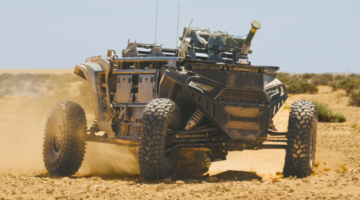
AGVs vs. UGVs: A new class of ground autonomy takes the field
One commander, many robots: Fully autonomous ground vehicles are reshaping the battlefield.
While ground autonomy plans are still in the works, the plan is to focus on different, individual missions like autonomous breaching, autonomous reconnaissance, autonomous strike and autonomous fires. By looking at it through this lens, the goal is to find the right company for the right program.
“Some of the vendors are really, really good at off-road autonomy… some of them are really, really good at on-road autonomy, which is also really hard because it’s very much rules-based,” he furthered. “And then some of them are good at sort of abstract functions that you can layer and orchestrate.”
By mid-January, the service plans to sit down with some of those companies to “expose” them to a new “autonomy reference architecture” and solicit their feedback on everything from what the autonomy layer should look like and communication between robots to making sure the Army isn’t simply creating RTK 2.0.
‘Freeing Up Resources’
As the Army works through that new ground autonomy construct, Miller said it is not yet clear which existing contracts will move forward, which will be altered and which might get the ax.
For example, the service is working on a Human Machine Integrated Formation (HMIF) concept designed to explore ways of integrating robots and autonomous systems into Army formations. This fall it awarded AeroVironment with a deal to provide the tactical mission planning and command and control software for HMIF Increment 1 program.
The future of that deal, and others under the HMIF umbrella, are now up in the air. Miller said Army acquisition czar Brent Ingraham is expected to decide in 2026 just what is “useful” to keep from HMIF and what no longer matches up with the direction the Army is going.
“We need to start freeing up resources to do the things the secretary and the [Army chief of staff] want to do,” he added.
As for the Army’s earlier plans to take the Infantry Scout Vehicle and turn it into an unmanned platform under the UxS effort, Miller explained that the service altered the deals with Forterra, Overland AI and Scout AI so that any vehicle can be used. It is also evaluating other companies as well including those from the service’s new venture capital-style model dubbed the FUZE program and the xTechOverwatch competition that had 40 vendors to demo capabilities for the 1st Cavalry Division in October.
“Hey, [UXS winners] you can bring whatever you want and we’re going to give you a fair shake across a bunch of tasks” while also looking at other possible vendors, Miller said.
Army plans for a Robotic Combat Vehicle are also evolving after the service opted to not ink a deal earlier this year in order to reprioritizing spending. However, it asked industry for cheaper vehicle options in August when it issued a request for information under a new moniker, the Unmanned Ground Commercial Robotic Vehicle.
Additionally, plans to design a new Common Autonomous Multi-Domain Launcher (CAML) are also moving ahead, albeit at a slower clip than initially envisioned that would have already had two contracts issued.
“It was a step back to take a look at the entire space, rather than just charging forward, simply because we thought we had a problem,” Miller said. The goal now is to get over the hump by having three or four vendors show off prototypes around the July timeframe and then possibly issue 18-month prototyping deals.
Lastly Miller said one of the services older autonomy initiatives, the Leader-Follower program for unmanned trucks, is ongoing, but has been moved under the new PAE construct.
Clarification: This report and headline were updated on 12/12/2025 at 2:30 pm Eastern to better reflect that cuts are possible to ground autonomy programs but have not yet been finalized.
Breaking Defense Video