MODERN DAY MARINE 2023 — Marine Corps plans to unfurl new ground-based air defense (GBAD) systems, and upgrade existing ones, have kicked into high gear, with several efforts poised to move forward over the next-year-plus, according to a key service official.
“What kind of program office are we? We don’t develop anything, we integrate,” Don Kelley, the service’s GBAD program manager, told an audience last week during the Modern Day Marine expo in Washington, DC. Kelley’s tenure as the Program Executive Officer Land System’s Ground-Based Air Defense is winding down but with his pending departure, he is leaving behind a portfolio of rapidly developed programs designed to protect Marines on the move and at fixed sites.
That integration work includes upgrading several weapon systems in Marines hands today, while rushing to get others — like the modified, expeditionary Iron Dome capability — ready to operate.
“I’ve got everyone nervous on the schedule, because I’m telling them we’ve got to get there,” Kelley quipped about his push to get the modified Iron Dome system, dubbed the Medium-Range Intercept Capability (MRIC), ready to begin fielding in 2026. Here are updates on a few other capabilities.
Fighting Pairs
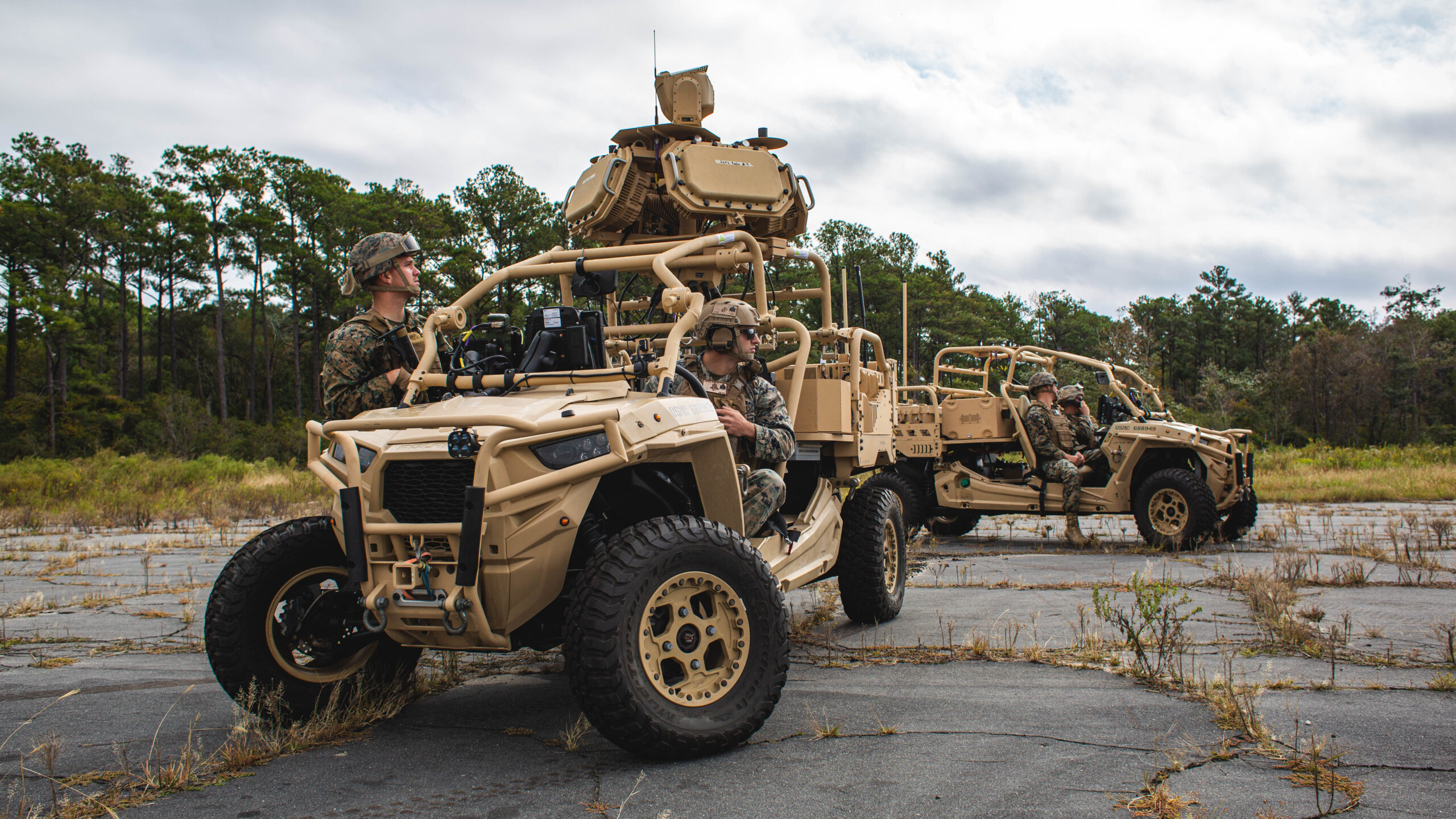
Part of the office’s directive revolves around the Marine Air Defense Integrated System (MADIS) and Light MADIS development, both which involve a pair of vehicles outfitted with sensors and the ability to down aerial threats.
LMADIS, currently on the Polaris MRZR, uses one vehicle to detect incoming UAS and fixed-wing/ rotary-wing aircraft, and the other to jam the signal between the aircraft and its operators.
Marines already have been using the fighting pair, but the effort is now transitioning from an “urgent need” to a program of record. That means the capability can be ported over to other vehicles, and the Marines have decided to put it on the service’s new Ultra Light Tactical Vehicle (ULTV). If all goes as planned, Kelley said the technologies and weapons will be integrated onto the new vehicles later this year for rapid testing before the service makes a production decision.
Platform aside, Kelley is also eyeing ways to enhance LMADIS’s lethality and plotting a Block 2 pathway.
“We have progressively upgraded the LMADIS… as we get feedback from the Marines,” Kelley explained. “As we understand what those threats are, we then change out the components go to a better option, go to a better a jammer, go to a better whatever and continue to continue to improve.”
Similar to the lighter version, MADIS is also a two-platform system but centered around the Joint Light Tactical Vehicle Heavy Guns Carrier variant. Under MADIS Increment 1, one JLTV is outfitted with a 360-degree radar, command and control suite, remote weapons station, electro-optical/infrared optic, and electronic warfare system, while the second vehicle hosts Kongsberg’s RS6 remote weapon station, stinger missiles, a 30 mm XM914 gun, an electronic warfare capability and more.
The service has begun receiving the low-rate initial production vehicles and is poised to begin testing them out in July, Kelley said. Those tests will lead up to a key initial operational test and evaluation event.
Like improvements to the LADIS, Kelley said the service is moving ahead with plans to upgrade the MADIS but does not yet know what the changes will include.
“We do not have a prime integrator for a reason: It allows more competition to industry to be able to bring components,” Kelley told the audience. “We’ve locked down our configuration to get through the [initial operational test and evaluation event] and then as we go through that and learn more about the vehicle, we will then start competing individual components to be integrated…[which] allows us to keep up with the threat.”
“The intent is, we’re going to do kits,” he later added. “There is not one panacea, that’s going to take out group 1-3 [UASs].” Group 1-3 refers to drones up to 1,320 pounds.
Mobile Iron Dome
Over the past several years, USMC officials have been developing the new, mobile MRIC centered around Israel’s famed Iron Dome and geared toward countering cruise missiles. That system includes a truck-mounted Iron Dome launcher paired with Tamir interceptors that use the Common Aviation Command-and-Control System (CAC2S) and a mini battle management control (BMC) system for the Tamir missile, along with the AN/TPS-80 Ground/Air Task Oriented Radar (G/ATOR).
After the service wrapped up a trioof MRIC live-fire tests in September 2022, the Corps’ Milestone Decision Authority met in December 2022 and decided to move forward with the certification process with the aim of the first battery ready for fielding around 2026.
To get there, the USMC is making a series of improvements and testing them out to make sure the system is ready for prime time. Then in September 2024, it will host a quick reaction test (similar to an operational test) with four launchers, and the associated equipment. If testing is deemed successful, the program office will seek the green light for middle tier acquisition rapid fielding and buy three batteries for the Marines.
Part of this plan hinges on Tamir interceptor production inside the US, and Rafael Advanced Defense Systems and Raytheon have teamed up to do just that with plans to call the missile the SkyHunter.
Kelley said production plans are moving forward, and he is tracking a forthcoming announcement about where that site will be. He said that since the missile contains six non-US components, the intent is to “update” it.
“By the time we get to 2025, I fully anticipate that we’ll be producing most of those missiles [in the US] depending on when they get to capacity early on,” he told the audience.
Base Protection And Local Problems
Not all of the programs are designed for expeditionary operations but static protection for Marine Corps facilities, including the Installation-Counter small Unmanned Aircraft Systems, or I-CsUAS, that has also evolved from an urgent need to a program of record.
“It’s probably my hardest program to get [my] hands around: There are so many moving parts,” Kelley said, noting that one basic configuration needs to be adapted for small, medium and large sites.
Although each site is unique and can have unique challenges, Kelley said, like one post that has to consider a concerns of the local Fine Arts Commission with the Marines tearing down trees.
“For every tree I tore down, I had to plant three more,” Kelley said. “If you think it’s hard to buy a counter-UAS capability, go ask the contracting officer, ‘How do I buy three trees and have them planted?’”
Additionally, Federal Aviation Administration rules hinder which interceptor the Marines can use, which means that so far the effort relies on jamming aerial threats.
Now that it’s a program of record, the Marines can buy capability packages from vendors and ink logistical support deals, as they seek to make I-CsUAS an “as a service” option for facilities.
“We’re going to do [this] in a more traditional approach, we’re going to have a prime integrator,” Kelley said. “It’s all about the…contractor logistics support that is a 24/7, 365-days a year requirement to maintain these.”
If the program proceeds as planned, the service will select a winner and award a contract in mid-2025.