WASHINGTON ― Developing capabilities for operations in cislunar space, including offensive space control, is among the top new science and technology (S&T) priorities for US Space Command (SPACECOM), according to the command’s top scientist.
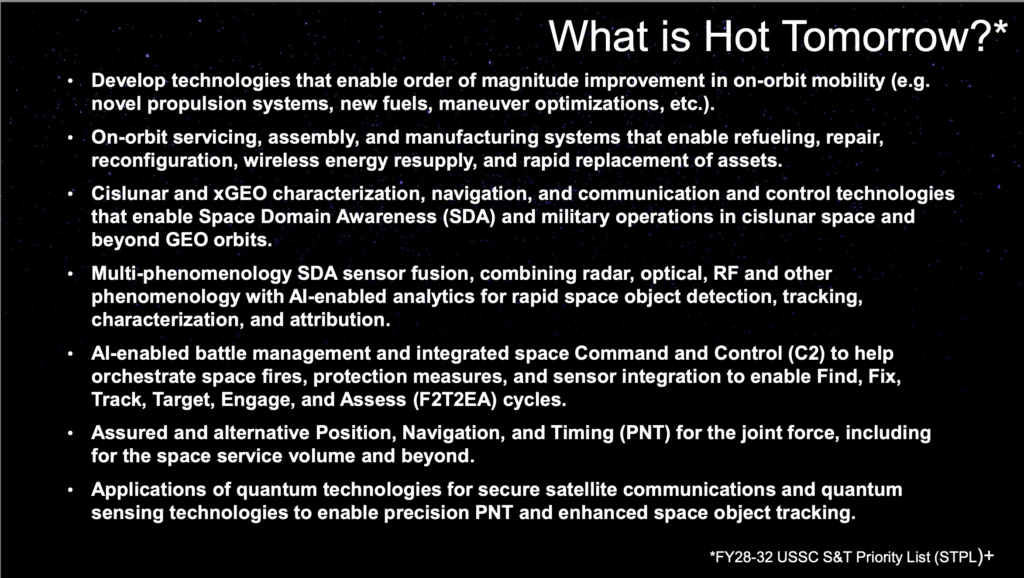
David Denhard, SPACECOM’s chief scientist and technical advisor, told the State of the Space Industrial Base (SSIB) conference in New Mexico on Thursday that operations beyond geosynchronous Earth orbit (xGEO) are on the command’s “what’s hot for tomorrow” list of S&T activities he approved earlier this month.
“Cislunar and xGEO is important to us,” Denhard said.
“First, from a PNT [positioning, navigation, and timing] perspective, you need timing in that area. You don’t get GPS signals very far out of GEO. We want space domain awareness in that area; so, we want to know what our adversary is doing in GEO and beyond. And then, eventually, we want to exploit that space from an offensive sort of space control perspective,” he elaborated.
US doctrinal publications define space control as including both defensive and offensive operations, and the Space Force’s April 2025 warfighting framework further explains that the concept includes waging orbital, electronic and cyber warfare.
Both SPACECOM and the Space Force have been expressing increased interest in future operations in the vast volumes of space between Earth’s outer orbit and that of the moon as an outgrowth of President Donald Trump’s December Executive Order on space superiority. However, until now, officials have been coy about any plans to utilize cislunar space beyond space monitoring primarily aimed at keeping tabs on Chinese activities there.
“Cislunar is part of USSPACECOM’s Area of Responsibility like any other region in the space domain. As such, we will execute all of our UCP responsibilities accordingly to ensure that the U.S., working alongside its allies and partners, has the freedom of action to operate in space and the ability to project power when and where required,” a SPACECOM spokesperson told Breaking Defense on Thursday.

The gap between demand and delivery is widening. AI can help close it.
Supply chains are only as strong as their weakest link, which has been repeatedly proven to be true over the last few years.
Peter Garretson, a senior fellow at the American Foreign Policy Council and a long-time advocate for the US military to move out on cislunar operations, said that Denhard’s statement was the first time he’d heard SPACECOM publicly acknowledge a future need for space control operations beyond GEO. Indeed, he said, that until this year senior officials at the Defense Department, the Department of the Air Force, Space Force and SPACECOM were less than enthusiastic about investing at all in cislunar activities.
“For the last seven years it has been pushing a wet noodle uphill … [I]t was just deflect and talk to the hand,” he told Breaking Defense in an email. “This year, the remarks on cislunar are committed and all in. It’s a massive policy change.”
According to a chart Denhard presented at SSIB, cislunar and xGEO capabilities are at third place on a list of seven S&T priorities. At the top of the chart is research aimed at achieving on-orbit mobility.
Denard said that that the number one goal for future S&T research is to develop “technologies that enable an order magnitude improvement in mobility” including “novel” propulsion systems.
“We want to be able to go to different orbits fast. We want to be able to go quickly to anywhere we need in a point of space,” he said.
Breaking Defense Video