
The defining logistics problem in the Pacific is measured in thousands of miles. It’s a theater where the distance between two friendly ports can rival the width of a continent, and where keeping forces supplied may depend on whether vessels, data, and smart decisions can move fast enough across thousands of miles of contested water.
But open water is only part of the challenge, which is compounded by compressed timelines, disrupted communications, and the possibility that traditional logistics ships, infrastructure, and supply routes could themselves become targets.

“The commands and people who’ve operated there talk about four tyrannies: distance, water, time, and scale,” said Steve Boraz, Leidos‘ vice president for maritime growth and strategy, and former assistant program manager for maritime domain awareness with U.S. Navy. “And those four tyrannies are not anything that you can necessarily overcome. You have to figure out ways to mitigate them.”
This is the goal behind the Indo-Pacific Logistics and Sustainment Services (ILS2) program for US Pacific Command (PACOM) and Special Operations Command Pacific (SOCPAC). The approach is designed not simply to move supplies across the Pacific, but to give commanders more options when conventional logistics networks are disrupted or unavailable. This includes a combination of prepositioned resources, regional partnerships, artificial intelligence for predictive analytics and courses of action (COA) generation, resilient communications, and autonomous vessels capable of delivering supplies without putting the Joint Force in harm’s way.
Getting ahead of the four tyrannies
Mitigation starts with having resources in the right places, and Leidos sees technology as increasingly central to helping commanders decide how to do that. Boraz pointed to AI as a way of accelerating operational planning across a theater where circumstances can change quickly – not to replace human decision-makers, but to rapidly analyze operational data and present commanders with potential courses of action.
“With so much data in the hands of operators, being able to lay artificial intelligence on top of it creates speed to decision through COA generation and optimized routing,” Boraz said. “That’s a huge advantage that AI brings to the table.”
Without AI, the deliberations behind the planning of a logistics course of action can take hours or even days. With it, commanders can often get there “in minutes,” said Boraz, noting that Leidos’ recent partnership with Rune Technologies does just this by pairing its own decision-support AI with Rune’s TyrOS predictive logistics software.
The addition of AI becomes particularly important in disconnected, denied, intermittent and low-bandwidth (DDIL) environments, where forces cannot assume continuous communications. Leidos’ approach includes mesh networking and caching data locally so AI-enabled tools keep functioning when communications degrade, then sync up once connectivity returns.
That same emphasis on adaptability extends to what’s called “non-standard logistics.” A typhoon striking a Pacific island is something that could create an urgent need to move US forces for humanitarian relief when Navy ships aren’t available. In such an instance, Leidos has the capability to turn to an existing relationship with regional commercial shipping companies and secure a vessel capable of supporting hundreds of troops.

Matt O’Brien, senior capture director, framed the distinction in operational terms: “The traditional logistics functions are well understood and executed in the day-to-day environment of campaigning. But as you move into contingency and crisis, those responses aren’t rehearsed and aren’t easily executed.”
This is where an asymmetric network comes in, he said, a way of responding to threats like enemy jamming or kinetic fires that “can’t be countered one to one.” Sometimes that means AI-enabled dynamic routing in contested environments, or sending more of something to guarantee the mission still lands. “It requires resilience, a defense in depth strategy where you send more to be able to ensure the mission is completed and successful, shoulder-to-shoulder with the warfighter,” O’Brien said.
Resupplying while keeping sailors out of harm’s way
Nowhere is that defense-in-depth thinking more visible than in Leidos’ multi-year push toward autonomous surface vessels.
“The first benefit of autonomy is using it in a way where you don’t have to put service members in harm’s way and that you have the same confidence in successful execution of the mission through autonomous means,” O’Brien said.
Because Leidos both builds and operates autonomous naval vessels, the company can offer the Navy whichever business model best fits the mission – contractor owned and operated, government owned, or some hybrid – while also understanding the most effective ways to employ them to accomplish the mission.
Under ILS2, Leidos’ software for platform autonomy combined with a separate collaborative layer will let one operator manage a fleet of unmanned craft all at once, sorting which vessel should be loaded with “beans,” which with “bullets,” and which with “bandages,” then routing each one safely through a contested environment. Predictive logistics embedded in that software stack can flag “when the next bullets need to get there” and reroute vessels accordingly, explained Boraz.
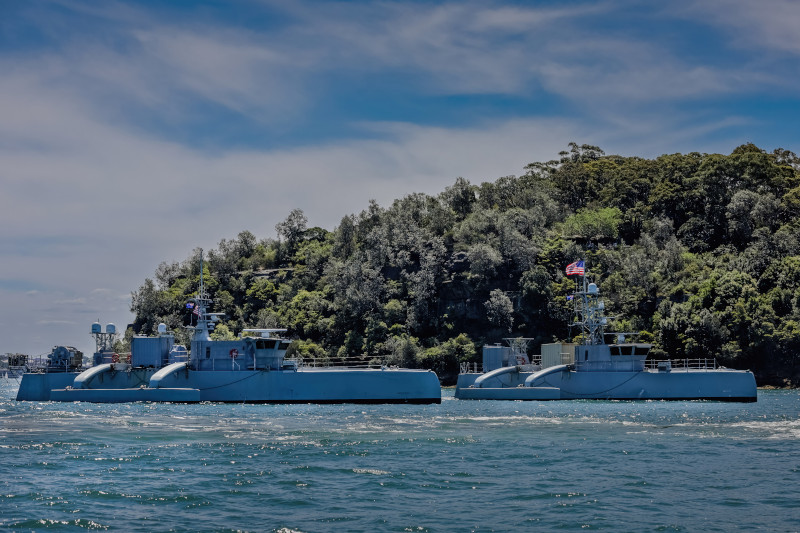
This is not theoretical capability. Leidos-built Medium Displacement Autonomous Vessels Sea Hunter and Seahawk have logged years as experimental Navy platforms, and this spring the Seahawk was formally handed off from the acquisition community to the fleet, and folded into the Theodore Roosevelt Strike Group for the Composite Unit Training Exercise (COMPTUEX).
Autonomous vessels like Seahawk and Sea Hunter – most recently a part of Exercise Rim of the Pacific 2026 (RIMPAC) – demonstrate capabilities the Navy needs today with persistent, distributed forces that extend reach, reduce risk, and operate effectively in contested environments.
Previously, Seahawk, Sea Hunter, and two larger autonomous vessels converted by Leidos (Ranger and Mariner), completed a trans-Pacific deployment called Integrated Battle Problem 23.2. This was a US Pacific Fleet multi-domain unmanned exercise, where they sailed from California (San Diego and Port Hueneme) to Guam, Japan, and Australia and back while exercising autonomous operations the whole way.
These naval autonomy accomplishments under Leidos’ belt speak to the company’s capability in end-to-end lifecycle support for its vehicles, proven, in particular, through years of sustaining Ranger and Mariner. Leidos also sees an opportunity to accelerate autonomous fleets by converting existing commercial vessels rather than waiting exclusively for newly built unmanned ships.
“The ability to take a traditional vessel and convert it to an autonomous one is one way to deliver those ships more quickly than if you were starting to build them from scratch,” O’Brien said.
Building logistics depth before a crisis
Leidos began to take action to address Pacific logistics years ago, and has assembled what it calls the Indo-Pacific Logistics Alliance, a network of more than 70 companies pulled together to provide multiple layers of capacity across the theater. According to O’Brien, the alliance already has 14,000 personnel prepositioned in the region, including foreign partners with access to local workers and trusted supply chains.
The strategy is to build depth into the network before a contingency occurs rather than construct it after supply chains come under pressure. “One way to mitigate the tyrannies is a purpose-built team with a defense-in-depth strategy so that you have both a second and even a third provider to ensure execution of any mission when required,” O’Brien said.
Companies within the alliance fill different roles: some provide vessels and other original equipment, others specialize in maintenance, repair and overhaul, and still others bring technologies mature enough to be incorporated into existing platforms. Leidos notes that this model mirrors the importance that PACOM places on alliances across the region.
Finally, the company also points to significant past performance in logistics on top of its leadership in naval autonomy. At the top of the list is the ongoing 13-year UK Ministry of Defence Logistics Commodities & Services Transformation (LCST) program. Said Boraz, “We believe there’s not another contractor who’s running an entire Department of Defense-level logistics program for any of the Five Eyes countries. That’s a significant discriminator.”
For 20 years during the Afghanistan war, Leidos was a primary provider of US contract logistics support until the drawdown. In another long-term logistics contract, Leidos led the multi-billion-dollar Antarctic Support Contract for the National Science Foundation as part of the US Antarctic Program.
It’s this combination – prepositioned depth, proven naval autonomy, AI-enabled planning, and past performance in massive logistics operations – that aims to ensure the DoW has the ability to move fuel, ammunition, spare parts, and essential survival supplies to Joint and Coalition Forces at the edge.
It’s about providing operational advantage to the warfighter, according to Leidos, because history shows that logistics win wars.