Air Warfare

Air Force bullish on drone future: ‘We’re gonna need them around just about everywhere’

“What I would say is, be on the lookout [because] there's going to be a CCA near you… because we're gonna need them around just about everywhere,” Pacific Air Forces Commander Gen. Kenneth Wilsbach said.

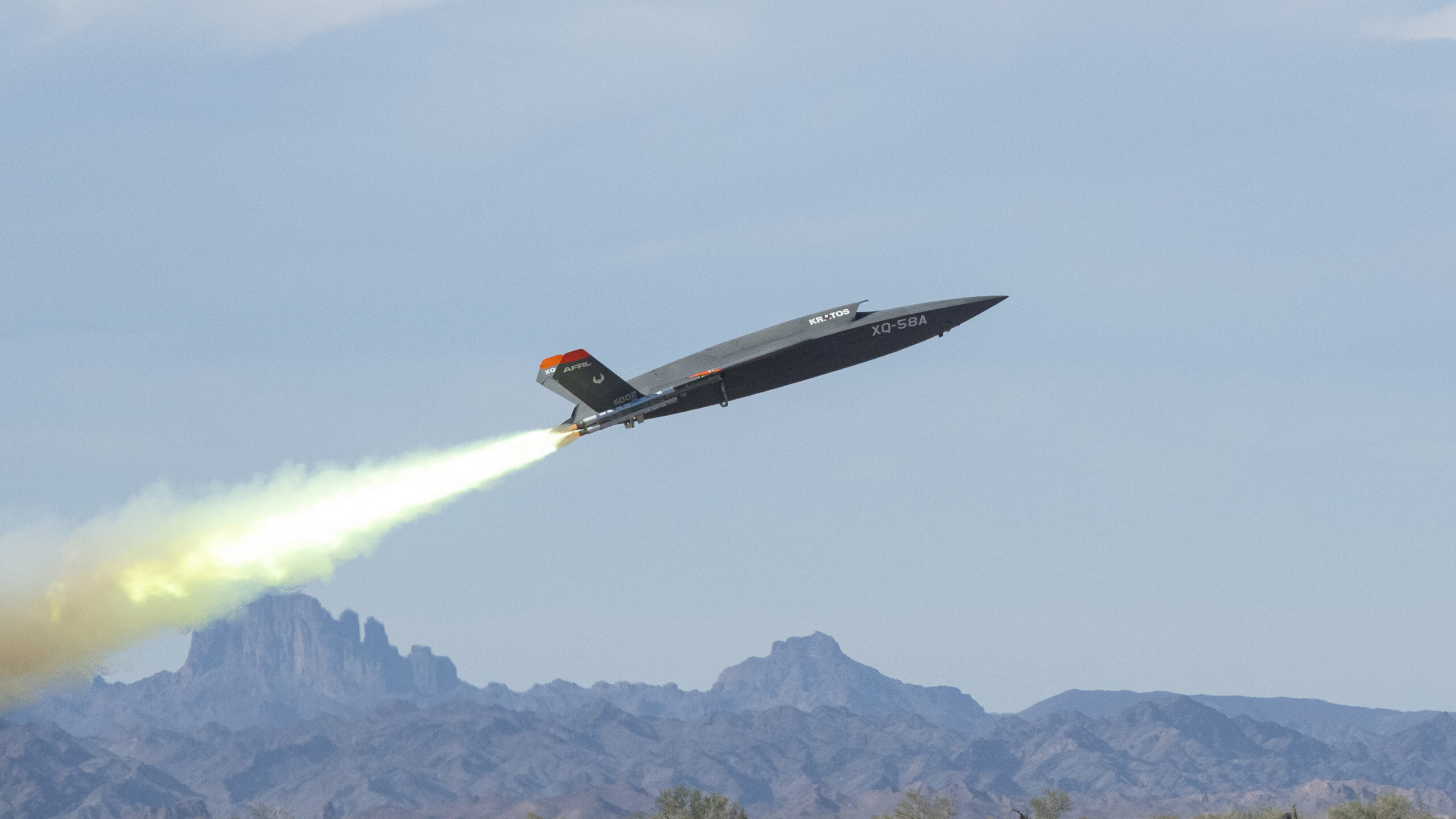
XQ-58A Valkyrie
An XQ-58A Valkyrie low-cost unmanned aerial vehicle launches at the U.S. Army Yuma Proving Ground, Ariz., Dec. 9, 2020. The flight successfully demonstrated the ability of new communications data to exchange information with an F-22 Raptor and F-35 Lightning II and the transformative warfighting impact of the open architecture underpinning the Advanced Battle Management System. (U.S. Air Force photo by Staff Sgt. Joshua King)

AFA 2023 — Drones dominated the discussion during the first day of the Air and Space Force Association’s Air, Space and Cyber conference, where officials were eager to talk up all the ways the new technology could change the nature of warfare. 

While the Air Force’s forthcoming autonomous wingman effort known as Collaborative Combat Aircraft (CCA) was a key topic of discussion with several senior officials, other drone concepts were also detailed — a sign of how ubiquitous the topic was at the start of the conference, held in National Harbor, Md.

Kicking off the CCA discussion was Gen. Jacqueline Van Ovost, who heads US Transportation Command (TRANSCOM). Among the numerous ways TRANSCOM is thinking about how to adapt to future operations, such as deploying ground-based decoys, Van Ovost said during a briefing with reporters CCA might present a new possibility for protecting mobility aircraft.

“Do we really need… F-15s to watch every tanker, or is there going to be some CCA capability that we’re going to have, you know, that goes with us?” she asked.

RELATED: ‘Largest conundrum of them all’: Air Force still unsure how to keep forces supplied in Indo-Pacific

For Gen. Kenneth Wilsbach, who commands Pacific Air Forces, CCA are a new opportunity to befuddle adversaries with targeting dilemmas, like whether blowing up a drone is worth the missile that doing so would require.

“I really am a CCA fan, and the main reason why I like CCA is because you can create mass,” he explained in a separate briefing. With so many of the drones flying out in a battlespace, “your adversary would have to worry about and wonder, you know, is that something I have to use some munitions on, or is that something that I can let go? And they’re not going to be able to tell,” he added.

CCA can also augment the stealthiness of fifth-gen jets, Wilsbach said, which could hide among the drones and confuse adversaries who are “so enamored with everything else that’s going on” that they won’t be able to react in time.

“What I would say is, be on the lookout [because] there’s going to be a CCA near you …because we’re gonna need them around just about everywhere,” Wilsbach said.

CCA Categories; Replicator ‘Candidates’

Lawmakers have been largely receptive to the service’s CCA efforts, though Air Force Secretary Frank Kendall made clear that not all steps taken by them have been helpful.

RELATED: Wittman: Why manned-unmanned teaming could be the Fourth Offset for America’s military

In particular, Kendall zeroed in on a set of categories delineated by the House Armed Services Committee, which attached a price ceiling to three different kinds of CCA designs.

“We’re very opposed to those cost targets,” the secretary told reporters. “I don’t know where those categories came from. They’re not what we’re doing.”

Kendall also discussed Deputy Secretary of Defense Kathleen Hicks’ “Replicator” initiative, where the Pentagon hopes to field thousands of drones over the next two years. For that effort — which Hicks said at the Defense News conference last week would require no new funds — DoD-level resources will be directed toward programs selected by the Innovation Steering Group, Kendall said. The Air Force has “candidates” for that funding, he said, though “we haven’t resolved all that yet.” 

It’s still unclear exactly how the military services might achieve Hicks’ goal — and at least one expected user of the capability admitted recently to being in the dark entirely on the program.

“I’m Wikipedia-deep,” Air Force Gen. Mark Kelly, who heads the service’s Air Combat Command, said at the Defense News conference. “You guys probably know better than me. I’m not going to be much help with that as far as [how] the CONOPS [concept of operations] integrate,” he added.

Minihan’s Mini Drones

Gen. Mike Minihan, head of the Air Force’s Air Mobility Command, also had some ideas for how drones could change his operations.

In a memo earlier this year that quickly went viral due to a prediction by the general that war with China would break out in 2025, Minihan ordered KC-135 crews to develop a plan for launching “up to 100 off-the-shelf size and type UAVs from a single aircraft.” Smaller in size, it’s likely these drones wouldn’t fit the CCA mold officials are envisioning, though Minihan outlined several ways the uncrewed systems could make a difference in a fight. 

“A drone could come out, and it could provide precision, navigation, timing to someone that doesn’t have it. It could fly a life vest down to a downed pilot or a radio to a downed pilot. It could actually fly down and survey the runway which you’re about to land on,” he said in a press briefing.

Minihan listed off several other examples — like serving as a decoy or landing somewhere to “go to sleep” until it’s ready for use — and said the drones could be shot off an aircraft with something similar to a Common Launch Tube used by special forces. 

The AMC commander said he expected the idea to become a reality during his remaining time in the role. 

“I think to a certain extent we already have these abilities,” he added. “We just need to make sure that we can execute that safely and then get some operational reps underneath our belt, and then move forward quickly. I don’t think it’s expensive.”

PHOTOS: AFA 2023
PHOTOS: AFA 2023

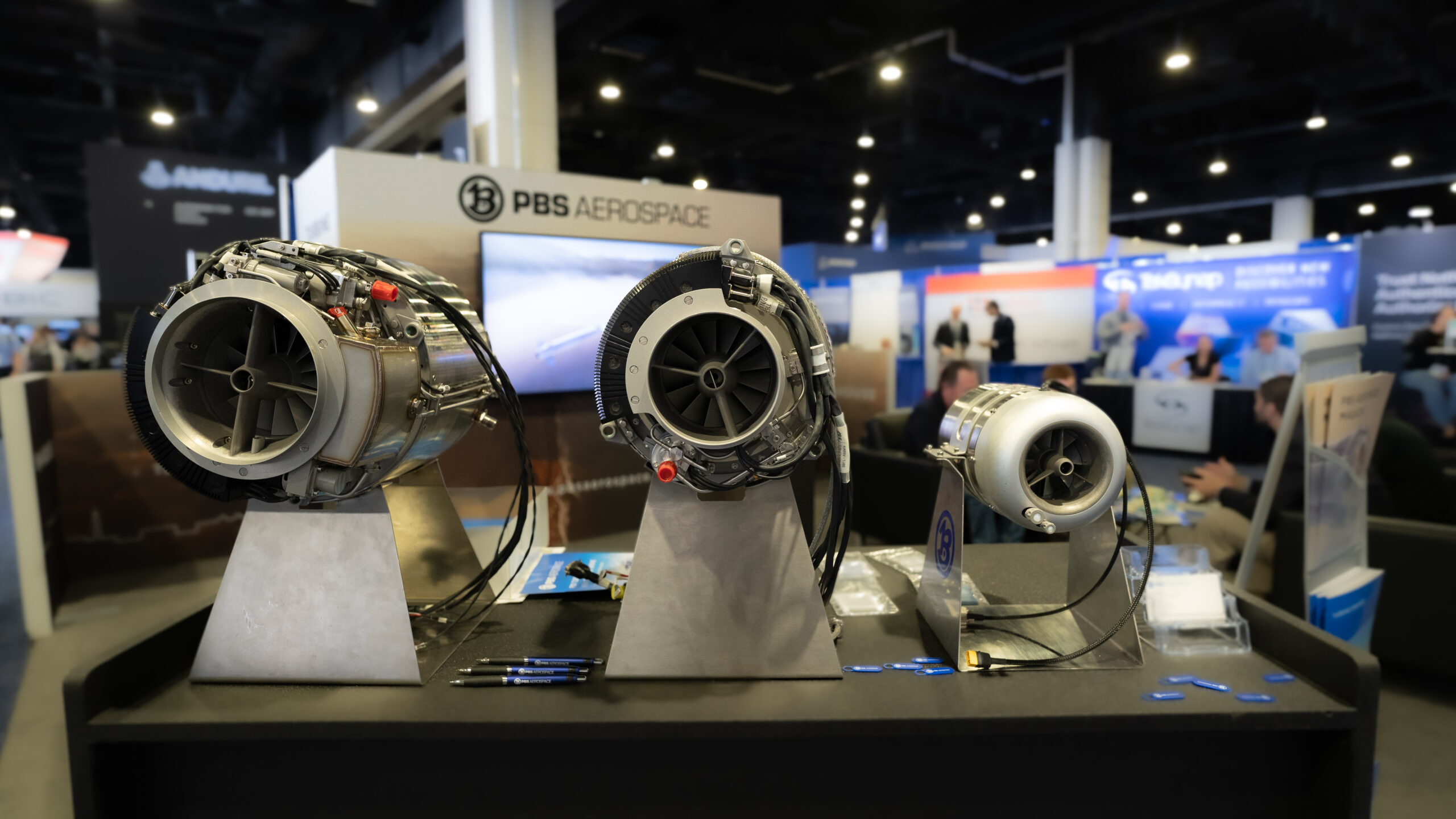
You don't see too many turbofans on unmanned aircraft systems but PBS Aerospace hopes to change that. Besides drones, they're also used for target drones, experimental aircraft, and ultralight helicopters.
Whether you fly fixed wing or rotary wing aircraft, Centex has a helment for you. Their suite of headborne protection systems manage hazardous conditions such as high-G, ejection, wind shear, noise and debris.

Elbit Systems of America wants to jam with you. That is, they. want to help you jam others with their systems that target threat radars, multiple emitters simultaneously, and surface-to-air and air-to-air missiles.

Augmented reality is going to be a boon to aircraft maintainers, in particular, and Amentum says it's perfect for reducing troubleshooting time and increasing situational awareness and collaboration. The dummy agrees.
CAE is here at AFA but their latest news came out of this week's Defence and Security Equipment International (DSEI) conference. CAE signed an MOU with Textron Aviation Defense that expands efforts to support defense force preparation, integrate next-generation aircraft. and develop advanced capabilities.
With decades of experience behind it, variants of the Aerojet Rocketdyne/L3Harris RL10 engine power the upper stages of United Launch Alliance’s Atlas V and Delta IV Heavy rockets. Two RL10 engines power the upper stage of ULA’s new Vulcan Centaur rocket, and RL10 engines also help propel NASA’s Space Launch System (SLS) rocket
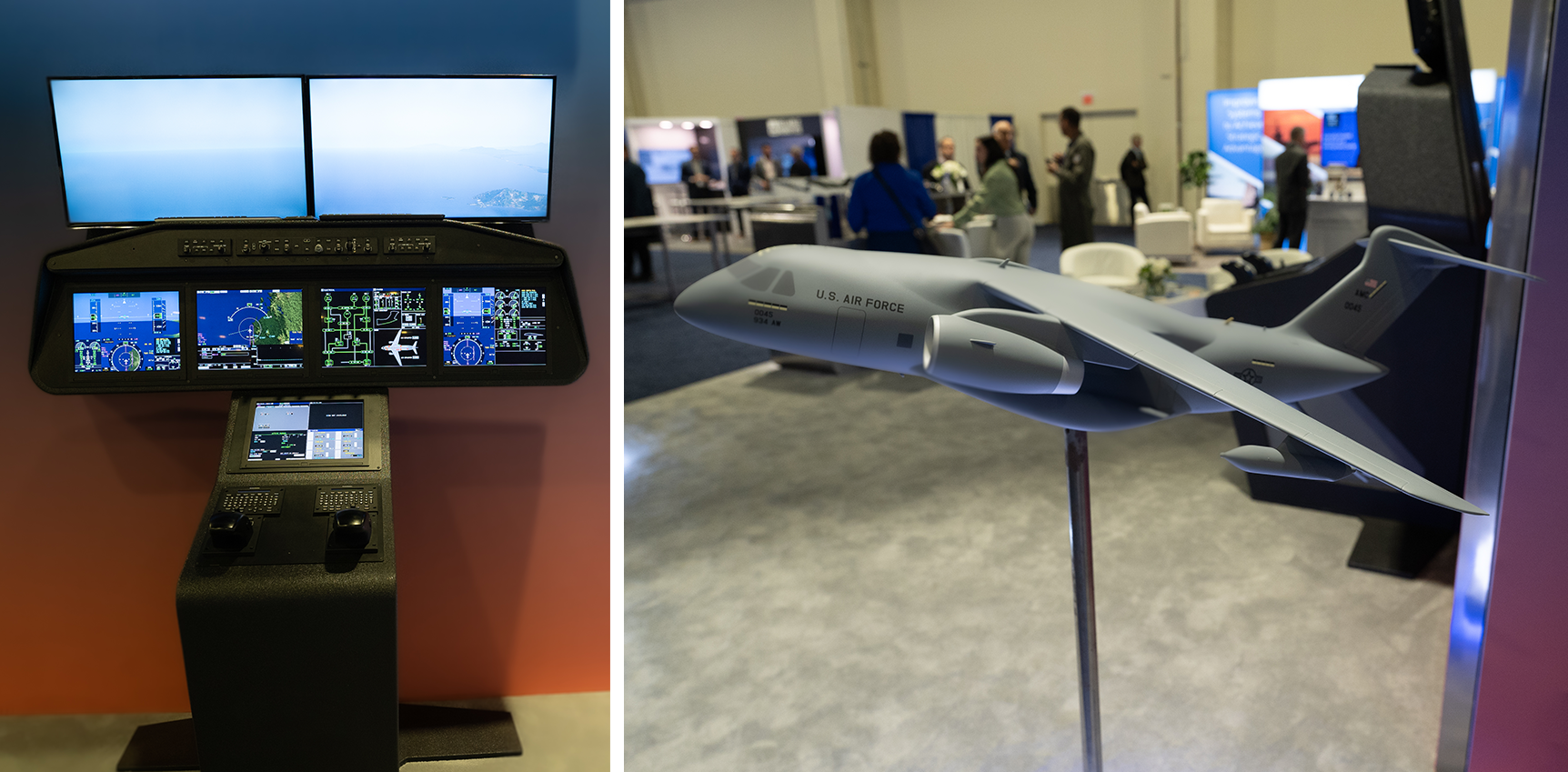
You can never have too many transport aircraft and Embraer is showing off its C-390 Millennium multi-mission transport to any US Air Force procurement execs walking the show flow. To the left are some of the C-390's cockpit controls. Embraer recently delivered the sixth C-390 multi-mission transport to the Brazilian Air Force.
Taking its visual cues from the Star Wars X-wing starfighter, the dart-like ROC-X VTOL precision strike missile from IAI is a version of the company's POINT BLANK electro-optically guided missile that is backpack carriable. Earlier this year, the DoD awarded IAI a multi-year, multi-million-dollar contract for the system. (Brendon Smith/Breaking Defense)
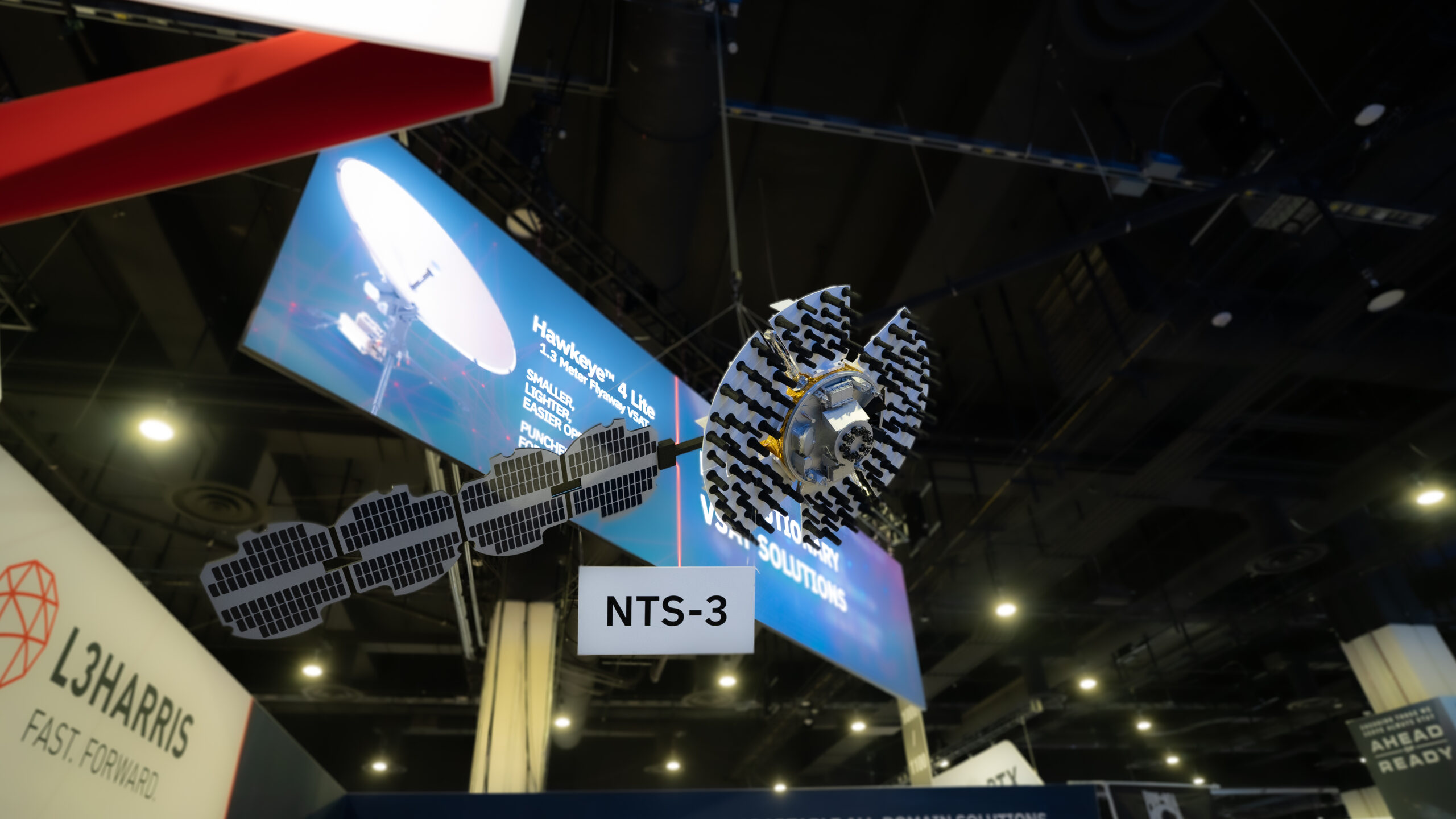
What do we want? We want uninterrupted position, navigation and timing. So says every military service. That's the purpose of the Navigation Technology Satellite – 3 Vanguard from L3 Harris. The NTS-3 is the first U.S. integrated satellite PNT experiment in almost 50 years, says the company. (Brendon Smith/Breaking Defense)
You know what would supercharge development and production of unmanned aircraft systems? That would be 3D printing. Earlier this year, General Atomics teamed with Divergent Technologies to support its additive manufacturing applications development efforts and implement a full digital manufacturing process for GA-ASI’s products. We all have the pleasure of seeing one of their early efforts here on the show floor. (Brendon Smith/Breaking Defense)
Red 6 envisions a future where warfighters across all domains are connected in a joint, augmented battlespace. The company is working to make that happen through its augmented-reality training helmet. (Brendon Smith/Breaking Defense)
The Kratos XQ-58A Valkyrie is not necessarily new but what it did recently was news. As part of a three-hour sortie in July, the Air Force Research Laboratory demonstrated for the first time a machine-learning trained, AI algorithms on an XQ-58A Valkyrie. (Brendon Smith/Breaking Defense)
It's both an advanced trainer and now also a light-combat aircraft. The M-346 trainer on the Leonardo booth, which also includes wares from its DRS company in the US, is also flying in a "Fighter Attack" version. (Brendon Smith/Breaking Defense)
Airmen all in a row. Given that they're at the FlightSafety booth, their virtual reality goggles are displaying training like emergency procedures, cockpit familiarization, and traffic pattern operations.
In his AFA 2023 keynote address, Air Force Secretary Frank Kendall talked about his plans to "optimize" how the service works. He recently released a memo mentioning broad plans to reorganize the Air Force. Details to come.
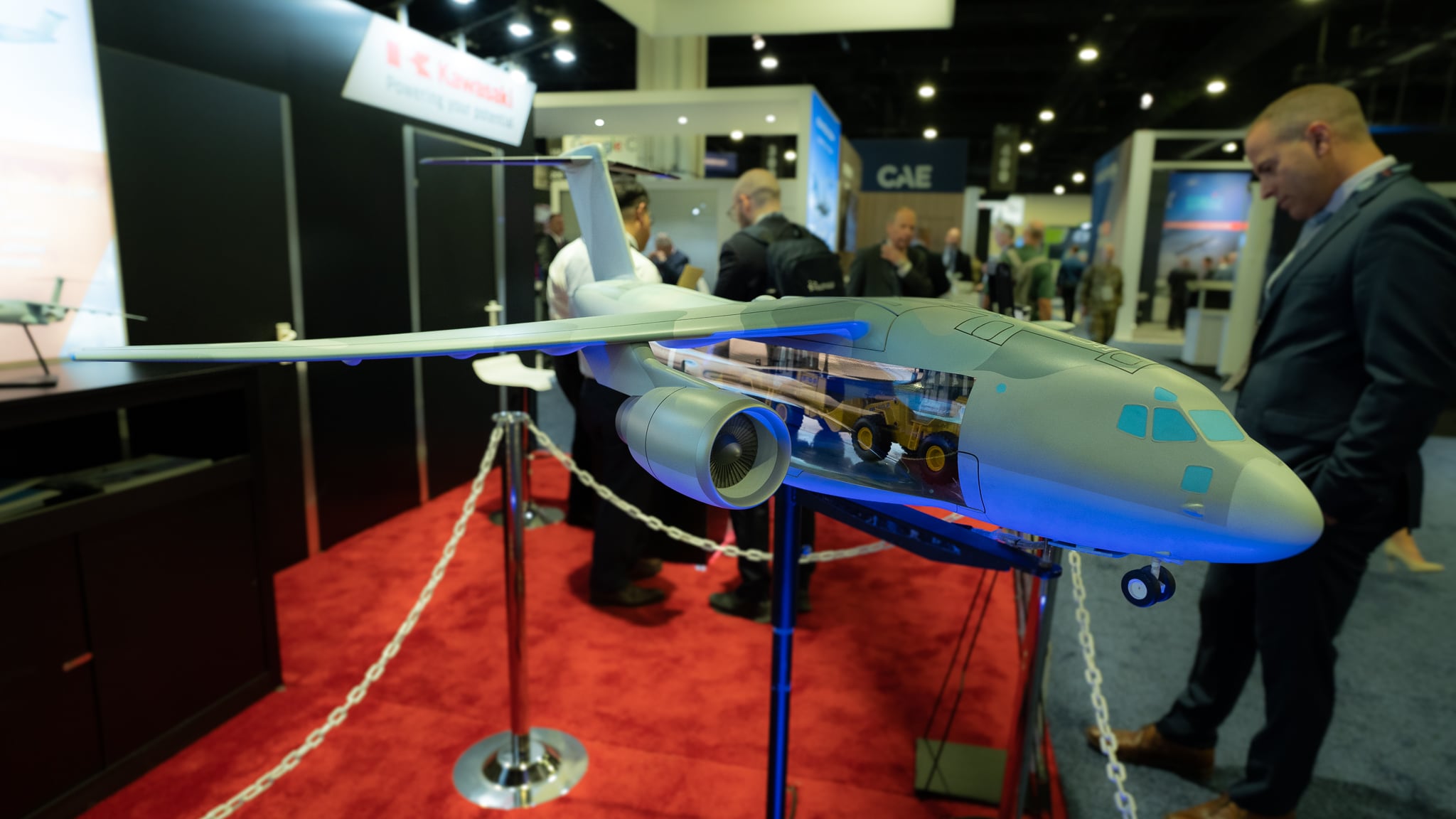
Kawasaki is here at AFA but not on two wheels. The C-2 transport model displayed a neat cut-out showing off its cargo capacity.
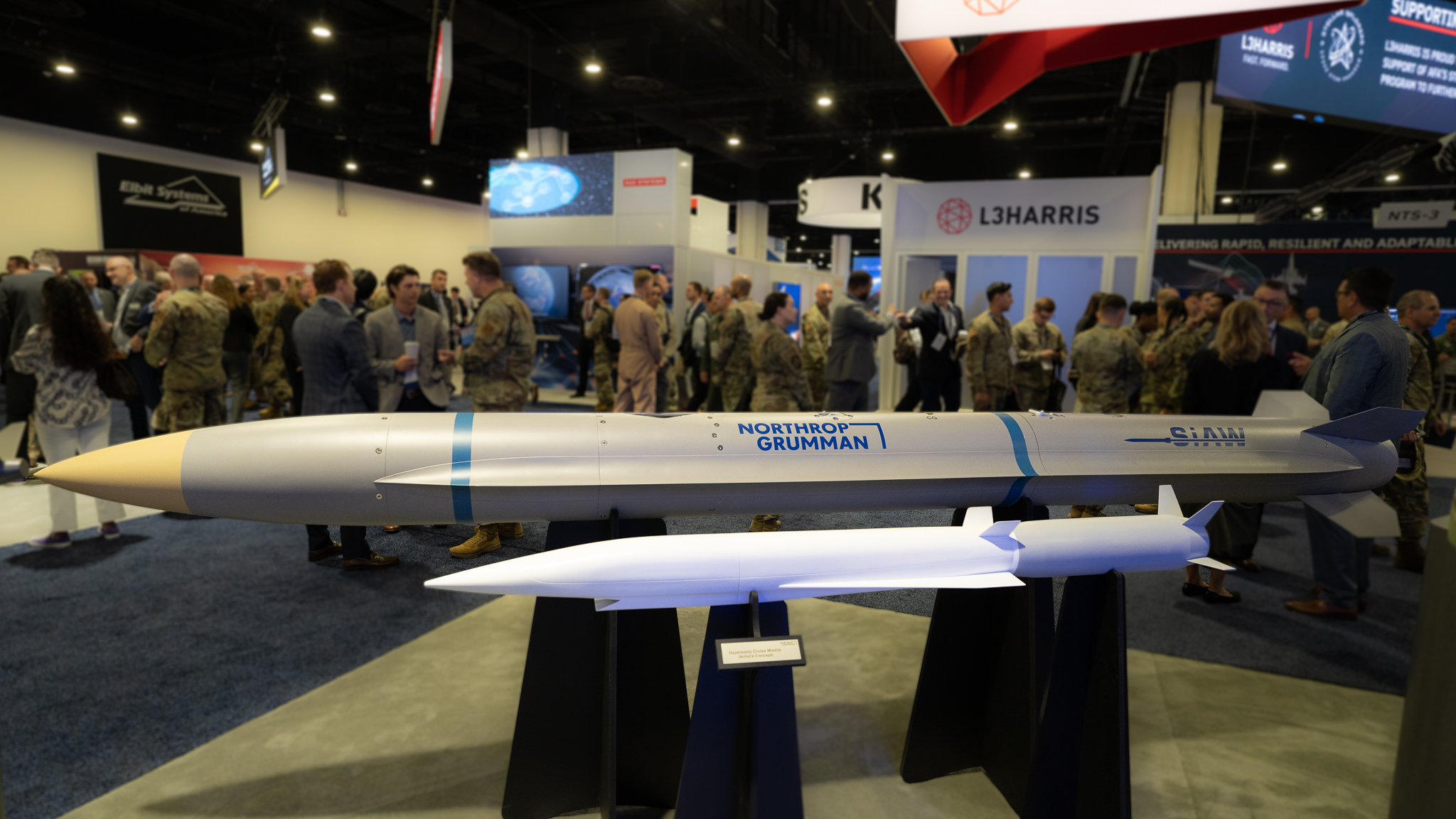
We spied a first-time visitor to be displayed at an industry show: a model of Northrop Grumman's scramjet engine that powered the Hypersonic Air-breathing Weapons Concept (HAWC) missile. Behind it is a Stand-in Attack Weapon for the Air Force.
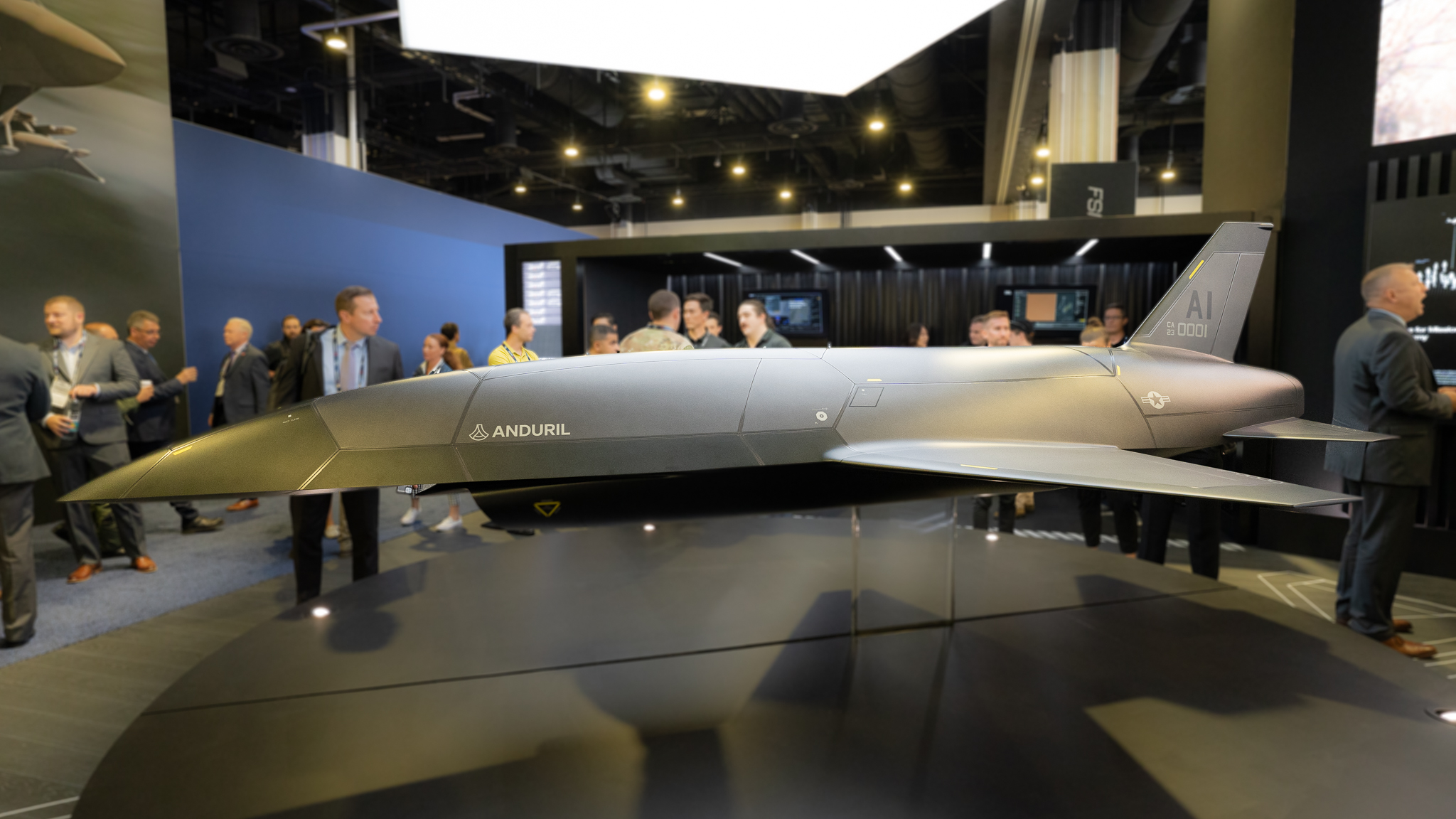
If looks could kill, Anduril's Fury multi-mission Group 5 autonomous air vehicle certainly fits the bill. Fury's mission is to accelerate the development, testing, and fielding of mission autonomy.
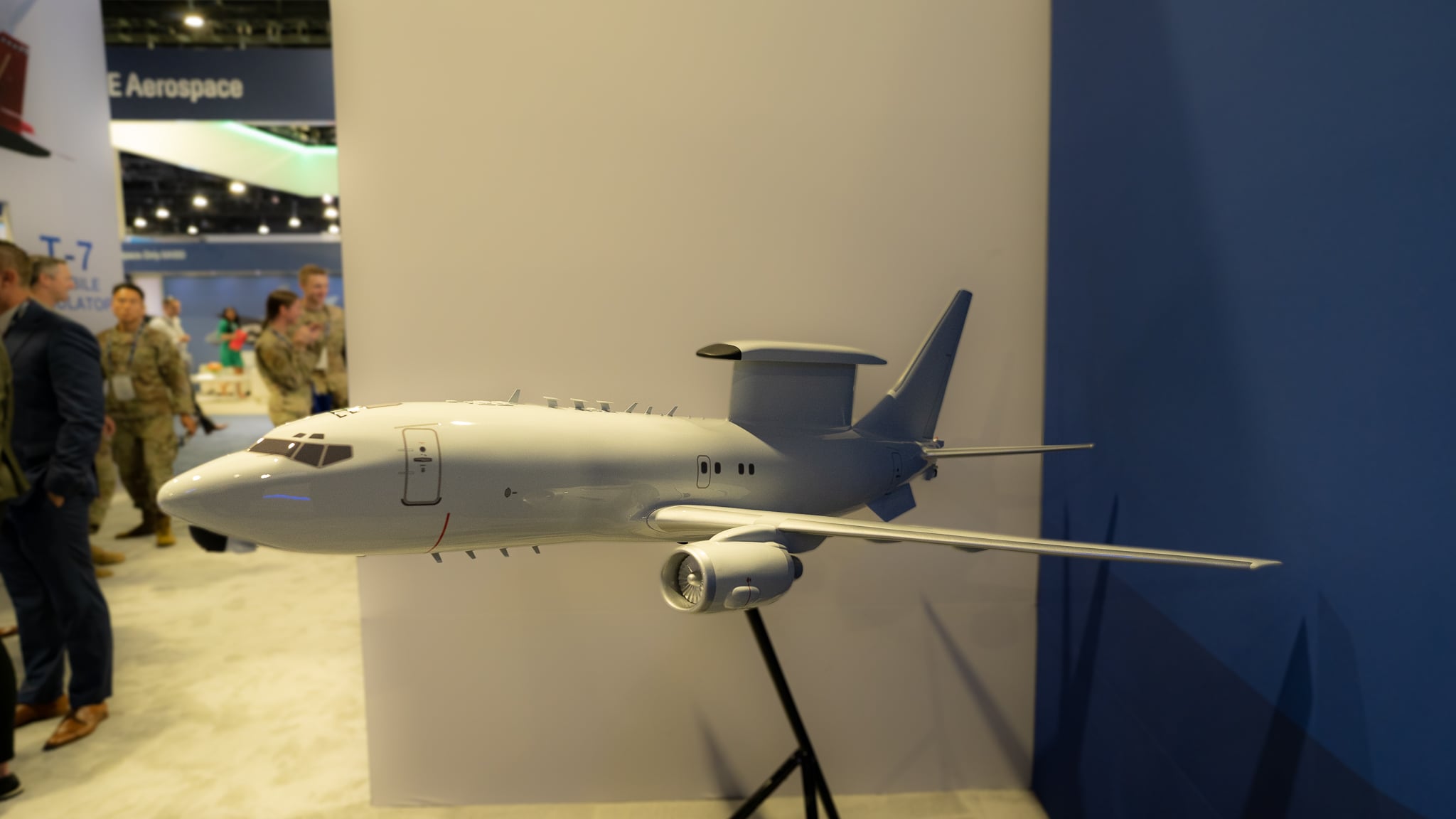
Tucked in a small seating area on the Boeing stand is a model of the E-7 airborne early warning and control aircraft. It's a command-and-control platform for multi-domain awareness.
Missiles a flyin' at AFA; at top left is a Joint Strike Missile from RTX. Also on their booth is an AIM-9X Sidewinder just below, an AIM-120 AMRAAM at top right, and a GBU-53/B StormBreaker glide bomb at bottom right.
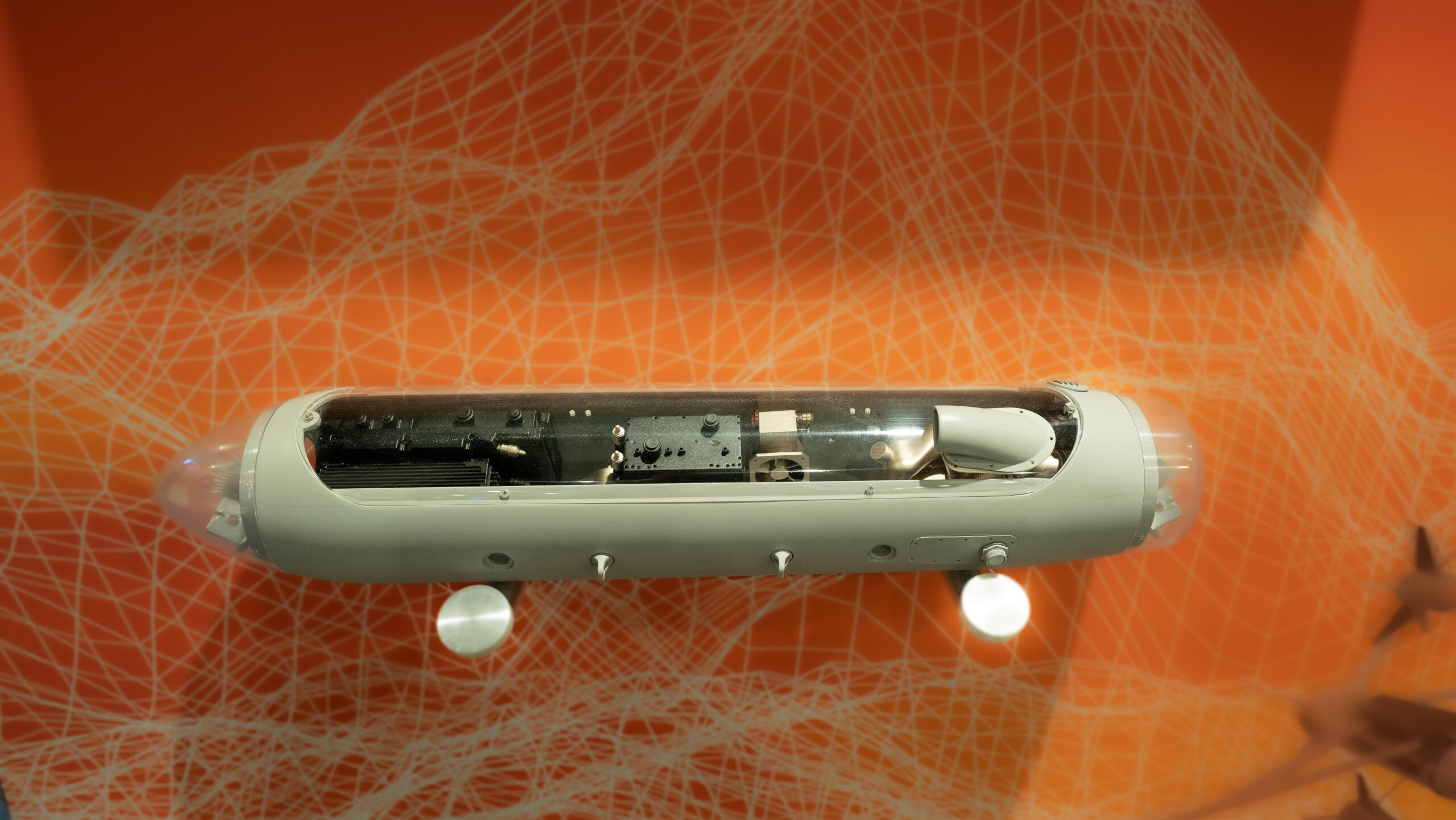
It's a surveillance and communications balloon named SHADE (Synchronized High Altitude Distributed Environment) that's designed to "leverage the stratosphere," says SNC. The black bit at the bottom of the model is a solar panel, and many more panels can be added depending on payload.